• About Me
  • Study Links

Renaissance Woman

~ Test All Things; Hold Fast What is Good-1 Thessalonians 5:21

Renaissance Woman

Tag Archives: Holy Spirit

With Peace as My Guide

15 Monday Aug 2022

Posted by Kate in Isaiah 45:7, Studies

≈ Leave a comment

Tags

Bible Study, Biblical Hebrew, Book of Isaiah, Following Peace, Hebrew Letters, Holy Spirit, Indwelling Spirit, Isaiah 45:7, Knowing God, Lamed, Peace, Shin

Welcome-or welcome back-to Renaissance Woman!  I wish a very happy start-of-the-week to you all.

I am continuing my study of Isaiah 45:7: “I form the light and create darkness, I make peace and create calamity; I, the Lord, do all these things” and am still studying the word “peace”.  The Hebrew word translated as “peace” in this passage is shalom spelled Shin (ש) Lamed (ל) Mem (ם). I see something new in the meaning of the Shin every time I look at it but I did intend to move on to the Lamed this week.  I got sidetracked by a passage I needed to understand so didn’t get as much study on the Lamed as I had wished but, as the Holy Spirit always does, He brought me full circle.  I didn’t so much as study the Lamed this week as I experienced its meaning.

Allow me to explain-

I am reading through a series of studies on the Book of Revelation and got hung up on Revelation 13:8 which says, “All who dwell on the earth will worship him whose names have not been written in the Book of Life of the Lamb slain from the foundation of the world (NKJV).  The study I am reading pointed out the Greek word translated “names” in this passage is singular rather than plural as it is rendered in the Emphatic Diaglott: “And will worship him all those dwelling on the earth, of which not has been written the name in the scroll of the life of the lamb of that having been killed, from a casting down of a world”.  The study also suggests a more proper rendering of the Greek Grammar in this passage is more akin to what we find in the New American Bible and the New Revised Standard Version: “and all the inhabitants of the earth will worship it, everyone whose name has not been written from the foundation of the world in the book of life of the Lamb that was slaughtered” (NRSV). 

The translations I use the most often-the New King James, Young’s Literal, Amplified, and New International-all render this passage as if it is the Lamb slain from the foundation of the world rather than the names being written-or not, as the case may be-from the foundation of the world in the book belonging to the Lamb who was slain.  Which is correct?  I am not yet prepared to say which translation I find the most accurate as I’m not finished with my study of this passage.  The reason I stopped everything to scrutinize this passage was because, curious what Francois du Toit’s commentary had to say on this passage, I looked it up in his Mirror Study Bible.

Mr. du Toit translates this passage this way: “The plan was to engage the entire earthbound population of the planet to worship the Beast [The counterfeit “slain and risen lamb”].  This would endorse the idea [of the religious system] that there were individuals, since the fall of the cosmos, whose names were not included in the slain Lamb’s Book of Life.”  Mr. du Toit then has some extensive comments on this passage which I found worthy of consideration.  I do not disagree with his conclusions but I am unsure whether or not I agree with his paraphrase of this verse. More study is needed. I do wonder…if “the name not written from the foundation (or fall) of the world in the book belonging to the Lamb who was slain” is the correct translation, then is this passage meant to distinguish between the two lambs?  Is it referencing back to the Lamb slain in Revelation 5:6 so that we have this image in our minds when we read about the false lamb in Revelation 13:11?

I do not know.  Yet.  What I do know is that I am not afraid to ask these questions because I know the Holy Spirit will answer them.  It’s His job: the Bible tells me so.  “But when the Helper comes, whom I shall send to you from the Father, the Spirit of truth who proceeds from the Father, He will testify of Me” (John 15:26).  “I have many things to say to you, but you cannot bear them now.  However, when He, the Spirit of truth, has come, He will guide you into all truth; for He will not speak on His own authority, but whatever He hears He will speak; and He will tell you things to come” (John 16:12-13).  “But the anointing which you have received from Him abides in you, and you do not need that anyone teach you: but as the same anointing teaches you concerning all things, and is true, and it not a lie, and just as it has taught you, you will abide in Him” (1 John 2:27).

What am I saying and what does it have to do with peace?  As I began to look at the Lamed, I found the root word for the word Lamed means “to learn, study, or become familiar with.”  This is awesome.  When we know Jesus Christ, we have peace.  We know Him because His Spirit lives within us, revealing Him to us, teaching us who He is, and leading us into the truth that is Jesus Christ.  I value my mentors and teachers.  I value those who I don’t agree with because they are a catalyst for me to search the scriptures for myself as Paul encourages Timothy to do.  (See 2 Timothy 2:15).  I value them and I search the scriptures but they are not of greater importance than the Life of Jesus Christ in me.  John’s gospel records Jesus as saying, “You search the Scriptures, for in them you think you have eternal life; and these are they which testify of Me.  But you are not willing to come to Me that you may have life” (5:39-40).  I say it again: nothing takes preeminence over His life.

I recently heard a fellow believer say we should have scripture interpreted for us by our pastors and that I wholeheartedly disagree with.  If we have the Spirit of the Living God living in us, the Spirit of truth, I do not need anyone to interpret scripture for me.  That province belongs exclusively to the Holy Spirit.  I listen to various teachers and I do so respectfully.  When I hear something I don’t agree with, I take it to the Holy Spirit and ask Him to show me what is true.  This is my right and privilege under the New Covenant.

He does teach me.  There are teachings and books I have picked up that He has said “no” to.  I obey and stop reading them.  I read things I see vilified by fellow believers and I go to Him and ask if I should be concerned.  I wait and listen for His direction and, when I have it, I obey. I know I am hearing from Him because I inevitably have peace.  When I am deliberately, with intention, moving in union with and in the flow of the Holy Spirit, I experience the fullness of shalom.  I am not swayed by the attempts of others to instill fear in me because of something I might read.  Perfect love casts out fear (1 John 4:18) and thus has been my experience: His “no’s” are gentle and I obey them because I know and trust Him.

He can be trusted.  Father, Son, and Spirit want us to know Him (See Hebrews 8:11, Jeremiah 31:34).  He leads us into paths of righteousness for His name’s sake (Psalm 23: 3).  He will keep us in perfect peace because our minds are stayed on Him (Isaiah 26:3).  His peace is the fruit of His Spirit within me and, as the Apostle Paul says, it is His peace that rules in my heart (Colossians 3:15).   

Unless noted otherwise, all Scriptures are quoted from The Holy Bible, New King James Version, Thomas Nelson Publishers, Nashville, Tennessee, 1982

Scripture taken from THE MIRROR.  Copyright © 2012.  Used by permission of The Author.

References

Revelation 13 – The Emphatic Diaglott New Testament (1942) (bibliatodo.com)

Revelation 13:8 And all who dwell on the earth will worship the beast–all whose names have not been written from the foundation of the world in the Book of Life belonging to the Lamb who was slain. (biblehub.com)

The Comparative Study Bible, The Zondervan Corporation, Grand Rapids, Michigan, 1984

Bentorah, Chaim, Hebrew Word Study: Beyond the Lexicon, Trafford Publishing, North America      & International, 2014, Pages 113-119

Du Toit, Francois. Mirror Study Bible: The Romance of the Ages, Mirror Word Publishing, Pages 600-601

Strong, James, LL.D., S.T.D., The New Strong’s Exhaustive Concordance of the Bible, Thomas Nelson Publishers, Nashville, Tennessee, 1990

Young, Robert, Modern Young’s Literal Translation: New Testament with Psalms & Proverbs, Greater Truth Publishers, Lafayette, Indiana, 2005


Share this:

  • Print (Opens in new window) Print
  • Tweet
  • Email a link to a friend (Opens in new window) Email
  • Share on Tumblr
Like Loading...

My Feet Are on the Rock

08 Monday Aug 2022

Posted by Kate in Isaiah 45:7, Personal Essays, Studies, Writing

≈ Leave a comment

Tags

Bible Study, Christ in Me, Christ Life, Christian Life, Doctrine, Hebrew Letters, Holy Spirit, Indwelling Spirit, Relationship, Revelation, Revelation of Jesus, Unity, Wisdom

Happy Monday and welcome to another post on Renaissance Woman.

Does anyone remember the poem The Blind Men and the Elephant by John Godfrey Saxe?  It’s a poem about six blind men who seek out an elephant so that, by observation, they might understand the creature.  Each of the six men encounter a different part of the elephant and liken it to something familiar: a wall, a snake, a fan, etc.  The last stanza of the poem states, “So, oft in theologic wars/The disputants, I ween/Rail on in utter ignorance/Of what each other mean/And prate about an Elephant/Not one of them has seen!”

Last week I posted on the Hebrew letters that comprise Shin ש and how I’ve come across two schools of thought on that.  One is that the letter is comprised of Vavs and Yods and the other is that the letter is a Yod, a Vav, and a Zayin.  Which is correct?  I don’t care one way or the other because, as I followed both paths, I found myself in the same place: 3 Vavs and 4 Yods give me the number 7 which is Spiritual Perfection and the number of the Zayin is 7 which is Spiritual Perfection.  I found value in looking at both but the study did get me thinking.   

I cannot count how many times over the past weeks and months I’ve heard believers of various denominations stress the importance of “sound doctrine.”  I have found “that’s not sound doctrine” is used as the final hammer strike on the last nail in the coffin of another person’s argument but there are times when the speaker will explain just what they believe sound doctrine to be.  I listen and sometimes agree and other times disagree.  This made me wonder, just who decides what “sound doctrine” is?  I see one denomination convinced what they teach is the soundest doctrine of all unlike this denomination whose teachings are based on false interpretations of scripture and definitely not like this other denomination whose teachings are a delusion of Satan.  I must infer then, that by “sound doctrine” what they actually mean is, “what our denomination teaches.”

What is doctrine?  The definition of the word is, “something taught, teachings, something taught as the principles or creed of a religion, political party, etc.; tenet or tenets; belief; dogma, a rule, theory, or principle of law.”  There is nothing in this definition that suggests a personal knowing and relationship is necessary.  Such is also what I find in those insisting everyone have sound doctrine: there is only a rare mention of knowing God for yourself.  I am not concerned with sound doctrine.  I am concerned with knowing the Father because knowing Him and knowing Jesus Christ is the very definition of eternal life.  “And this is eternal life, that they may know You, the only true God, and Jesus Christ whom You have sent” (John 17:3). 

I recently read a book called Evidence Not Seen by Darlene Deibler Rose.  When the author married her first husband, Rev. C. Russell Deibler, she and her husband both knew they were called to the Mission Field and, specifically, the Philippines.  Mrs. Deibler was several years younger than her husband and had just graduated from school.  She relates in her book that, before the Church would allow her to accompany her husband to the Philippines, they tested her in doctrine and theology.  She passed the tests and was allowed to go.  While in the Philippines, World War II broke out and Japan took over the islands.  Mrs. Deibler and her husband were interred in separate camps where her husband died.  Mrs. Deibler spent four years in various camps and I was struck by how it was not doctrine or theology that sustained her: it was the vitality of her relationship with Jesus Christ.  Mrs. Deibler-Rose writes, “Experientially, I was learning to understand the comfort of the Holy Spirit.  Sometime during the dark hours I slept.  The sword of sorrow had pierced deep within me, but He had bathed the sword in oil.”  

This book gave a graphic picture of the difference between having doctrine-which is by definition a lifeless thing-and having a vital relationship with the Living God.  To me, those quibbling over whether or not someone’s doctrine is sound are like the blind men quibbling over the elephant.  Not one of them was wrong per se but neither were any of them correct.  Not one of them had fully seen. 

There is a passage in Colossians I’ve been meditating on for some time: “Let no one cheat you of your reward, taking delight in false humility and worship of angels, intruding into those things which he has not seen, vainly puffed up by his fleshly mind, and not holding fast to the Head, from whom all the body, nourished and knit together by joints and ligaments, grows with the increase that is from God” (Colossians 2:18-19).  Our reward is Christ Jesus.  He is our very Life.  In Him, we are made one with the Father.  Everything the Father has belongs to Jesus.  Everything Jesus has is ours because His Spirit lives within us and declares it to us.  (See John 16:13-15)

I know this not only because the Bible tells me so but because I KNOW HIM!  He is real!  He is alive!  He is alive in me right now!  This is not something reserved for the future.  It is not something I earn if I follow Jesus’ example and live a moral life.  He freely gives Himself to me, teaches me who He is, and brings me into relationship with Himself.  There is no substitute for knowing Him and this knowing is my litmus test.  I don’t compare what I hear from others with any doctrine: the Spirit within me guides me into all truth.  Jesus Himself is that absolute living truth and, as He has joined me to Himself, I am one spirit with Him.

Let none of us allow ourselves to be cheated of our reward by anyone who has not seen.  Let us hold fast to the Head who is Christ Jesus.  Let us test everything and hold fast to what is true.  “Therefore, leaving the discussion of the elementary principles of Christ, let us go on to perfection…” and, finally, let us “no longer be children, tossed to and fro and carried about with every wind of doctrine by the trickery of men in the cunning craftiness of deceitful plotting, but, speaking the truth in love, may grow up in all things into Him who is the head-Christ…” (Hebrews 6:1, Ephesians 4:15)

Amen.

All Scriptures are quoted from The Holy Bible, New King James Version, Thomas Nelson Publishers, Nashville, Tennessee, 1982

References

The poems of John Godfrey Saxe/The Blind Men and the Elephant – Wikisource, the free online library

Guralnik, David B., Webster’s New World Dictionary of the American Language, Second College Edition, Williams Collins + World Publishing Co., Inc., Cleveland • New York, 1970, 1974

Rose, Darlene Deibler, Evidence Not Seen: A Woman’s Miraculous Faith in the Jungles of World War II, A Ruth Graham Dienert Book, Harper San Francisco, Harper Collins Publishers, New York, New York, 1988

Share this:

  • Print (Opens in new window) Print
  • Tweet
  • Email a link to a friend (Opens in new window) Email
  • Share on Tumblr
Like Loading...

Mindful of Meaning

18 Monday Jul 2022

Posted by Kate in Isaiah 45:7, Studies

≈ Leave a comment

Tags

Bible Study, Biblical Languages, Book of Isaiah, Christ Life, Classical Hebrew, Definitions, Greek, Hebrew, Holy Spirit, Indwelling Spirit, Isaiah 45:7, Koine Greek, Meaning, Peace

Hello and welcome back to Renaissance Woman!

This week I am continuing my study of Isaiah 45:7 looking specifically at the meaning of peace.  Since I have begun focusing my attention on not only the meaning of peace but its nature, I realize how often I have used the word peace without taking time to think about what exactly I meant.

For instance, over the last week, there was a situation I did not have peace about and yet I held my peace.  I saw others involved keep the peace-despite provocation-and strive to make peace.  I am using the same word to say what I mean and yet I mean different things each time.  I’ve been pondering the six definitions of peace in the dictionary.  Each definition is not diametrically opposed to the other: the dictionary tells me “peace” comes from the Latin pax (pacis, pangere) which means to fasten and the Latin pacisci to confirm an agreement. 

The first four entries under “peace” in the dictionary are, freedom from war, a treaty or agreement to end war, freedom from public disturbance, and freedom from quarrels.  Each one of these reflects that idea of confirming an agreement but, as I previously shared, does not necessarily mean the parties are in accord; merely the parties have agreed not to fight.  Entries five and six-an undisturbed state of mind, absence of mental conflict, calm, quiet, and tranquility-do not conform as well to the idea of confirming an agreement.  It made me wonder if it didn’t make more sense to use different words for these concepts.

Out of curiosity, I checked my thesaurus to see what words I could find to better express the substance of my thoughts.  I could say:  I was upset and uneasy when I found myself confronted with a situation ripe for conflict.  I remained silent and watched while others refused to be provoked, responded amicably, sought accordance and reconciliation rather than discord, and averted hostilities.  While my mind is still not tranquil, I find the more I offer the situation up to Jesus the closer I come to ataraxia. 

I admit I got a bit carried away at the end there but, as a side note, ataraxia is a great word and I am now going to practice interjecting it into my everyday conversation.  I do think my second description is more precise than the first where I only used “peace”.  As I began to study “peace” in the Hebrew and Greek, I found both languages to be equally precise.

I looked up “peace” in the Strong’s Concordance and took a look at the list of Hebrew and Greek words.  Holding one’s peace is charash (H2790) which has a range of meanings.  It does mean “to be silent” or “to let alone” but also, oddly, means “to scratch, to engrave, plow”. Leviticus 10:3 which records Aaron as “holding his peace” uses the word damam (H1826).  This word means “to be dumb…astonished…to cease…quiet self…tarry”.  2 Kings 2:3, Psalm 39:2, and Isaiah 42:14 (among others) use the root chashah (H2814) for holding one’s peace while Nehemiah 8:11 and Zephaniah 1:7 use the root hacah (H2013).  Both of these words mean “hush, keep quiet”.

The other words translated peace all come from the same family. “Making peace” or “being at peace” is the root shalam (H7999) except for Joshua 9:15 where Joshua makes peace and a covenant with the inhabitants of Gibeon.  The Strong’s has shalom (H7965) listed here.  The word for “peace offerings” is shelem (H8002).  Shalom then is the word translated “peace” the most often except for two instances in Daniel (4:1 and 6:25) where the word shelam (H8001) is used. 

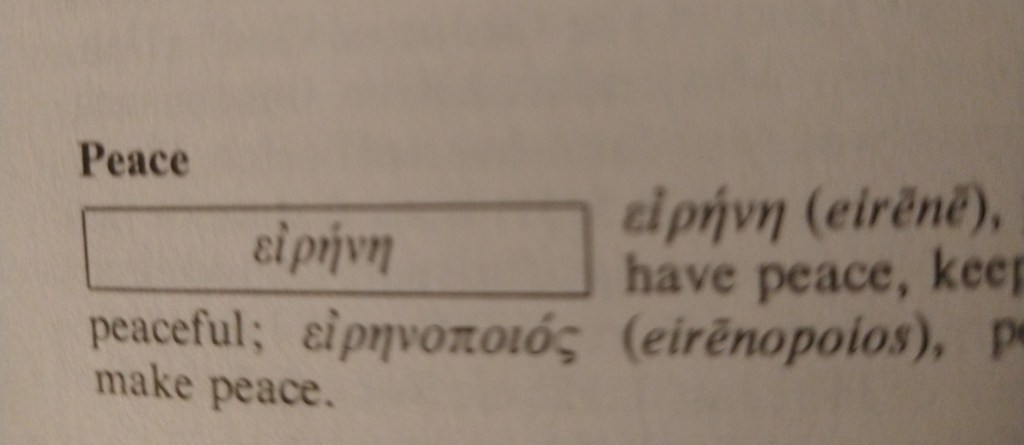
The Greek also has different words that have been translated “peace”.  The word used most often in the New Testament, and the word I find in the Septuagint in my study passage, is eirene (G1515).  This word means “peace, prosperity, quietness, rest, to set at one again” and the Strong’s suggests it comes from the primary verb eiro which means “to join”.  Related to eirene and also translated “peace” are the words eirenopoios (G1518) and eirenopoieo (G1517).  Eirenopoios means “pacificatory, peaceable, peace maker” and eirenopoieo means “to harmonize, make peace.” 

There are four Greek words for “holding one’s peace”.  The first is siopao (G4623) which means “silence, muteness” but is an involuntary stillness or inability to speak.  This word is contrasted with sige (G4602) which is a refusal to speak but sige doesn’t appear in the Strong’s list.  Sigao (G4601) which comes from sige does and means, “to keep silent”.  Phimoo (G5392) appears in Mark 1:25 and Luke 4:35 and means “to muzzle”.  Hesuchazo (G2270) appears in Luke 14:4 where it is translated “held their peace” or “kept silent”.  Jesus has asked the lawyers and Pharisees, “Is it lawful to heal on the Sabbath?” and they kept silent.  The word hesuchazo does mean “to keep still” but this stillness is in the sense of refraining from labor, meddlesomeness of speech, rest.

I find all of this riveting.  It’s not like I don’t know what these passages mean when I read them in English and read the word “peace”: I can glean the meaning from the context.  And yet, I am missing subtleties by not knowing all of these are different Greek and Hebrew words with unique meanings.  Does it really matter?  I think it does.  I have seen written and heard said that scripture “means exactly what it says”.  I have also heard the word “infallible” used when it comes to scripture.  I cannot commit myself to agree with those who claim the aforementioned until I know exactly what they mean.  If they are referring to their English translation, I have to disagree.  Not that I do not value my English translation: I do and I enjoy reading it.  My quibble comes when dogmatic statements are made based on the English translation when it does lack the subtlety and precision of the Hebrew, Greek, and even Aramaic.

Last week I mentioned Jeff A. Benner and his YouTube channel.  In a few of the videos I’ve watched, he puts up a picture of a fast food meal and another of a steak dinner.  He asks if he were to invite us to dinner, which would we choose?  He then compares reading a translation of scripture to the fast food meal and reading it in the original language to the steak dinner.  Both will fill you up and satisfy hunger, but which would you prefer?

As I study, I find I agree.  I have used the word “peace” in all of its meanings throughout my life.  I’ve read scripture and had an intellectual grasp of what the passages meant when I read “peace”.  I understand but it’s a surface understanding and is like a fast food meal: something I’ve grabbed on the run because I don’t have the time to prepare a meal and sit down to consume it.  It satisfies at the moment but is not all the food there is and, stretching this analogy further, a diet of fast food is unhealthy. Studying, questioning, and looking up the different words and their meanings: this feels like the steak dinner with the trimmings (or a lovely lentil and vegetable meal for my vegetarian friends).  It’s not the word consumed on the run but it’s me taking the time to savor the different flavors and textures.  

What about those who cannot study the ancient languages, for whatever reason? I am so grateful for the opportunities I have to study but nothing compares to being in the presence of the risen and ascended Lord Jesus Christ. The best meal of all is the one we partake of in and by the Holy Spirit living and working inside of us. There is no better food than that which comes directly from the hand of He who made it.   

As I move forward in my study, I will be focusing on shalom and eirene, exploring beneath the definitions and usage, and seeing what can be unearthed.  I have seen eirene coming from eiro means “to join” and here I finally see the idea of “to fasten” found in the dictionary.  I am curious if I’ll find the same idea in shalom. 

To be continued…

References

The Holy Bible, New King James Version, Thomas Nelson Publishers, Nashville, Tennessee, 1982

Guralnik, David B., Webster’s New World Dictionary of the American Language, Second College Edition, William Collins + World Publishing Co., Inc., Cleveland•New York, 1970, 1976

Rodale, J.I., The Synonym Finder, Warner Books, Rodale Press, Inc., Emmaus, Pennsylvania, 1978

Strong, James, LL.D., S.T.D., The New Strong’s Exhaustive Concordance of the Bible, Thomas Nelson Publishers, Nashville, Tennessee, 1990

Share this:

  • Print (Opens in new window) Print
  • Tweet
  • Email a link to a friend (Opens in new window) Email
  • Share on Tumblr
Like Loading...

Getting a Grasp on Peace

04 Monday Jul 2022

Posted by Kate in Isaiah 45:7, Studies

≈ Leave a comment

Tags

Bible Study, Biblical Greek, Biblical Hebrew, Book of Isaiah, Christian Life, Holy Spirit, Indwelling Spirit, Isaiah 45:7, Peace, Peace Makers, Peace of God, Peace of Jesus

Image by Avelino Calvar Martinez from Pixabay

Hello and welcome to Renaissance Woman as I continue in my study of Isaiah 45:7: “I form the light and create darkness, I make peace and create calamity; I, the Lord, do all these things.”  I am moving on from my study of the word “make”.  The Hebrew word translated make, asah, is one I do want to look at further but, for now, I am content with what I have already discovered.  God is an artist, The Artist, and He pours His very self into everything He makes.  In Isaiah 45:7, the thing He is making is peace.  What does that mean?  What is peace?

I looked at peace a bit when I was conducting my study on the Fruit of the Spirit.  In that study, I saw peace as something that belongs to Jesus and can only be given by Him.  It is given to each individual believer as we come to see ourselves in Him and Him in us through the Holy Spirit.  It is not something that can be imposed on us from without rather peace becomes our way of being as His life is formed in us.  The peace of Jesus Christ is not something we can impose on others but flows out from us as the springs of His life in us overflow.  Such were my conclusions during that study and, while I still wholeheartedly believe what I wrote, I did not define what peace is. 

As I try to answer that question, some of my favorite scriptures on peace come to mind.  There is John 14:27: ““Peace I leave with you, My peace I give to you; not as the world gives do I give to you.  Let not your heart be troubled, neither let it be afraid.”  There is Isaiah 26:3: “You will keep him in perfect peace whose mind is stayed on You.”  I especially like the Isaiah verse as it states “whose mind is stayed on You” and I have been meditating a great deal on the importance of my thoughts.  Since peace is an aspect of the Fruit of the Spirit, I define it as something internal, something that comes from the life of Jesus Christ within me.  The verse in John does quote Him as saying, “not as the world gives do I give to you,” which tells me His peace is different than the peace I find in the world.  Is the difference between Jesus’ peace and the peace of the world that His is part of the flow of His life and, to the world, peace is something external?

I looked up peace in my New World Dictionary and find the answer to that is yes and no.  The first entries under “peace” are, 1., freedom from or a stopping of war, 2., a treaty or agreement to end war or the threat of war, and 3., freedom from public disturbance or disorder; public security; law and order.  This series of definitions can be summed up as “peace is the absence of conflict” which I admit is how I used to think of peace.  This idea of peace is fragile.  An argument escalates, or a law is opposed and this peace is broken.  This kind of peace is imposed on people from without and such imposition often breeds resentment.

Of course, the peace defined in the dictionary is not always imposed.  The fourth entry under peace says, “freedom from disagreement or quarrels; harmony; concord” and then under “make peace” I read, “to effect a reconciliation with, to end hostilities, settle arguments.”  Two individuals or disparate groups of people can choose to make peace with other, to cease from hostilities, and to settle conflicts.  And yet, there is no need of a heart change for this kind of peace.  It is not imposed from without but neither does it infer those parties ceasing from hostilities are now of one accord or that any restoration of relationship will follow.  This too is an absence of conflict but, just because they may not be acted on, does not mean resentment and bad feeling ceases to exist.

In entries five and six in the dictionary, I finally find peace defined as, “an undisturbed state of mind; absence of mental conflict, serenity, calm, quiet, tranquility”.  These definitions are certainly closer to what I think the peace of Jesus is and yet this peace too can be found in the world without Jesus being mentioned anywhere.  There are religions where the practices are meant to lead to serenity and a tranquil state of mind.  I have met some of the practitioners of these religions and they do seem more calm and confident-more peaceful-than I have ever dreamed of being.  I once watched a documentary where different religious leaders were interviewed and all of them spoke of life being good, peaceful, and blissful.  I listened carefully and Jesus as the source and giver of peace wasn’t mentioned once, even among those leaders who professed to be Christians.  If this is so, if this kind of internal peace can be achieved without Jesus, is He even necessary in our day to day lives?  Is the only bonus to a Christian life that belief in Jesus means you get to escape hell?  What is this peace He promised to leave with us and just how does it differ than that given by the world?

I looked up the Greek word for peace used in the John passage in the Strong’s concordance.  It is eirene (G1515) and means, “peace, prosperity, one, quietness, rest, set at one again.”  The entry in Strong’s Concordance suggests eirene comes from the primary verb eiro which means “to join.”  This same Greek word is used in the Septuagint in place of the Hebrew word translated peace in Isaiah 45:7 which is shalom.  The Strong’s gives a similar definition for shalom (H7965): well, happy, health, prosperity, rest.   

I see these definitions in Ephesians 2:14 where, speaking of Jesus Christ, the Apostle Paul says; “For He Himself is our peace, who has made both one, and has broken down the middle wall of separation”.  Here, peace is unity; being set at one again with no divisions or separations.  I feel this passage sums up most of the definitions of peace I’ve come across but it all happens within the peace that Jesus Christ Himself is.  What is this peace?  I’ve looked up definitions, compared and contrasted, and still don’t feel I have a grasp on it.

In Isaiah 45:7, God declares He is the One who makes peace  and then in Matthew, Jesus declares, “Blessed are the peacemakers, for they shall be called sons of God” (Mt. 5:9).  I feel there is more to this peace than a lack of war, conflict resolution, or a tranquil mind.  Just what more there is, I do not know.  I need to know because I cannot make peace if I do not know just what it is.  My prayer is that in the upcoming weeks the Spirit of Wisdom and Revelation will open my eyes to see what this peace is that God makes, this peace that is Jesus Himself.

Until next time…

Unless noted otherwise, all scriptures are quoted from The Holy Bible Old and New Testaments, The Authorized King James Version, Thomas Nelson, Inc., Printed in Colombia, 2003

References

Guralnik, David B., Webster’s New World Dictionary of the American Language, Second College Edition, William Collins + World Publishing Co., Inc., Cleveland • New York, 1974, 1976

Strong, James, LL.D., S.T.D., The New Strong’s Exhaustive Concordance of the Bible, Thomas Nelson Publishers, Nashville, Tennessee, 1990

Share this:

  • Print (Opens in new window) Print
  • Tweet
  • Email a link to a friend (Opens in new window) Email
  • Share on Tumblr
Like Loading...

In the Midst

23 Monday May 2022

Posted by Kate in Isaiah 45:7, Personal Essays, Studies, Walking in the Way, Writing

≈ Leave a comment

Tags

Bible Study, Book of Isaiah, Christ in Me, Faith, Holy Spirit, Indwelling Spirit, Isaiah 45:7, Jesus is my Life, Learning through Experience, Life in the Spirit, Unity, Walking in the Way, Where is God

My Dad called them “God’s Calling Cards.”  He meant those instances in our lives that are attributed to coincidence but, when seen through the lens of us living and moving and having our being in Jesus Christ; are recognized as God’s Calling Cards.

I have had these little coincidences on my mind over the last few weeks and was discussing them with a co-worker when I remembered my Dad’s term for them.  I’ve continued to meditate on them and have been looking at them in terms of my study on darkness.

But first, some context for these Calling Cards.  I am now recovering from surgery-less than four years after my last one-to remove yet another tumor.  The particular path I’m on started in 2017 when my Primary Care Physician found a lump in my breast.  No doubt a cyst fueled by hormones but it still needed to be looked at.  I started praying immediately.  I know Jesus bore all my sicknesses and iniquities so of course I was healed.  Except I wasn’t.  I was referred to a specialist who ran tests and said the lump didn’t look right which led to another referral and a biopsy.  I then had to wait for the results of that biopsy and I spent days wondering “what if?”  Would it be benign or did I have the C-word?  I wrote about this in my post Just a Butterfly and I will include a link at the bottom of this post in case anyone is interested in reading it.

I didn’t have to have this lump surgically removed but it did seem to be a catalyst for a cascade of tests and procedures culminating in the major surgery in December of 2018.  I had fought for years to avoid it.  I’d tried diet, exercise, prayer…nothing worked.  Once more my concerned PCP referred me to a specialist who was also a surgeon and who ended up removing thirteen fibroids from my abdomen.  It was both a devastating surgery and yet a blessing because I was freed from quite a bit of pain.  I began walking the road to recovery whilst also striving to understand, where was God in all of this?  Where was my healing?  If I’m to expect results when I pray, what results should I be expecting? 

I was sure that surgery in 2018 would be my last.  Then only a year later another growth appeared in a different part of my body.  It also ended up being benign and the procedure to remove it was relatively minor.  Just a snip and a couple days recovery but it did concern me.  This growth could not be attributed to hormone imbalance or endometriosis.  Was my body randomly growing tumors?  What if one grew in my brain?  Was there anything I could do to stop them?

And then, I began experiencing weird pain in my abdomen.  Once more, my concerned PCP sent me for a test then referred me to a specialist who took another test and then went “hmm…that doesn’t look right” and referred me to an Oncologist.  Once more, I’ve had surgery to remove a rather large tumor-or endometrial lesion-and once more I am grateful the growth is benign.  I am again walking the road to recovery but I will say this time it is different.  I do not wonder where God is in all of this: I have seen Him in a series of coincidences.

I intended to discuss my weird pain with my Doctor at an appointment in January of this year but then I contracted the ‘rona and had to postpone.  The earliest I could get was June.  No big deal.  I was sure it was nothing serious.  Then my Doctor’s office called and confirmed my appointment in March.  I didn’t have an appointment in March.  There had to be a cancellation and I had to be penciled in but no one called me to ask if I was available: they called to confirm. The appointment was scheduled for the next day and I had no conflict so I went.  I ended up having a CT scan that afternoon which put me on the referral and tests path I’ve already mentioned.  I met with the Oncologist on a Friday and was scheduled for surgery the following Monday.  I write this two weeks into my recovery and I can’t help but think of all the things that just happened to fall into place so that I am on the road to recovery a full month before that June appointment. 

There has not been a moment when I have not known God with me.  I don’t do well with surgery.  Anesthesia is not my friend and recovery is difficult for me.  Recovery from this last surgery was especially difficult and I ended up having to spend an extra day in the hospital.  This was hard news to take and I had a moment where I thought I might tear out my IV and run screaming.  Or shuffle screaming, as the incision made running impossible.  I clung to God in that moment and knew He was with me.  I was not only aware of His presence but felt His touch in the hands of my care-givers.  I don’t know anything personal about anyone who nursed me: I do know that each person who cared for me showed me kindness, gentleness, and the true meaning of ministry which is to serve. 

What do I expect from God?  He has not come crashing into any of these situations, snapped His fingers, and made any of these growths disappear.  He has not delivered me unless you count sixteen separate growths-not counting moles removed-and not one of them being cancerous as deliverance.  He has not spared me trials on top of the pain and issues I deal with from the car accident.  What He has done is knit Himself to me in the midst of these situations and made me so aware of His presence that I’ve gone through them without fear.  I have not been a paragon of faith:  I may have begged a bit when it became clear I wasn’t going to get to go home but even then, He was with me.  He was faithful every moment.

Faithful every moment.  That is what I see in this study of darkness.  The Hebrew letters spelling darkness-Chet, Shin, and Caph-reveal to me a picture of the God who is Love with me every moment.  Even when it feels the circumstances of my life are chewing me up and spitting me out (Shin), there is nothing I go through alone.  He is not hidden from me nor I from Him but He holds me in the palm of His hand (Caph).  I am not only held but His Spirit is poured out on me and in me and His life is knit to mine (Chet).  I’ve started looking deeper into the word bara which is translated “create” and one of my Teachers told me bara meant “to fill”.  I am looking deeper into that but find that definition beautiful.  He fills my darkness with Himself.

My study of darkness brought me to Psalm 18 and verse 11 in particular. My NKJV begins this verse as, “He made darkness His secret place.”  The New Living says “He shrouded Himself in darkness” and the English Standard Version has, “He made darkness His covering”.  I wondered about this verse because, at first glance, it did seem to be saying that God hides Himself in darkness which didn’t make much sense.  Once I’d looked a little further into the meaning of darkness, looked into the context of the Psalm, and discussed it with two of my Teachers, this passage became so wonderfully clear.  My Bible places this Psalm within the time period of King David’s fleeing from King Saul.  Reading through the Psalm, I can see David was not having a pleasant time: the pangs of death and sorrows of Sheol surround him.  His enemies are too strong for him, he is hated, and he refers to “his day of calamity”.  He is in darkness.

But!  The Lord God comes with darkness under His feet!  He made the darkness His secret place, He fills it, and His brilliance destroys it from within.  The Lord lights the lamp and enlightens the darkness.  I am reminded of what I shared two weeks ago that the eye is referred to as a lamp in the NT.  It is as the eyes of our understanding are enlightened and made single by the Holy Spirit-and the Greek carries the idea of being braided with-that He enlightens our darkness.  This Psalm in particular stayed with me because, throughout this entire process, I could see the truth written in this beautiful Psalm: God armed me with strength, He set me in a broad path, and He upheld me.  Even when I didn’t fully understand why things were happening the way they were, He filled every moment with Himself.

I have “what if” thoughts: I can’t help that.  All I can do is answer every “what if” with the truth “God is with me.”  I mentioned having to stay an extra night in the hospital.  I’d been told my stay would be one night only so, when I couldn’t stop being ill and had to stay that extra night, I panicked a little.  I am a disabled person with no disability benefits (which is a long story in itself) and I only work part time.  On top of dealing with the physical difficulties, I worried about the cost of that extra night, what my insurance would do, and what bills might be coming my way, etc.  A couple of days after being released, I received a letter from my insurance.  The surgeon had submitted me for two days stay and my insurance had approved it.  It’s such a small thing but it’s another one of those little coincidences.  Here I was panicking and feeling like a failure.  If willpower was any sort of power at all, I’d have been able to get better and would never have stayed that extra night.  All I could do was trust that He was bigger than even this and then the letter arrived showing me it had all been taken care of before the surgery began. 

Truly, the Lord Jesus Christ Himself goes before me and is with me.  He never leaves me nor forsakes me.  There is never a circumstance that discourages me or fills me with fear (See Deuteronomy 31: 8, Isaiah 45:2).  He fills not only the darkness but all things (Ephesians 4:10).  In Him I live and move and have my being and, because He lives and lives in me; I can face tomorrow and whatever else might come. 

Hallelujah!  Hallelujah!  Amen.

Just a Butterfly

Unless noted otherwise, all scriptures are quoted from The New King James Version of The Holy Bible, Thomas Nelson, Inc., Nashville, Tennessee, 1982

References

Bentorah, Chaim, Hebrew Word Study: Beyond the Lexicon, Trafford Publishing, 2014, Pages 92, 108, 148

Haralick, Robert M., The Inner Meaning of the Hebrew Letters, Jason Aronson Inc., Northvale, New Jersey, 1995, Pages 113, 161, 293

choshek, “darkness,” strong’s H2822 (alittleperspective.com)

(2) “Darkness” in ancient Hebrew! (Part I) – YouTube

God’s Appointed Times: Aleph Tav Meaning (godsappointedtimes.com)

Share this:

  • Print (Opens in new window) Print
  • Tweet
  • Email a link to a friend (Opens in new window) Email
  • Share on Tumblr
Like Loading...
← Older posts
Newer posts →

Categories

Featured Posts

Isaiah 45:7

When Tradition and I Part Ways

Keep reading
Kate's avatar by Kate November 28, 2022April 28, 2024
Gospel and Letters of John

A New Heart

Keep reading
Kate's avatar by Kate December 7, 2020March 14, 2021
Studies

The Way He Has Made

Keep reading
Kate's avatar by Kate August 7, 2023August 6, 2023

Enter your email address to subscribe to this blog and receive notifications of new posts by email.

Join 210 other subscribers
Follow Renaissance Woman on WordPress.com

Follow Me on Facebook

Follow Me on Facebook

Meta

  • Create account
  • Log in
  • Entries feed
  • Comments feed
  • WordPress.com

Blog at WordPress.com.

  • Subscribe Subscribed
    • Renaissance Woman
    • Join 169 other subscribers
    • Already have a WordPress.com account? Log in now.
    • Renaissance Woman
    • Subscribe Subscribed
    • Sign up
    • Log in
    • Report this content
    • View site in Reader
    • Manage subscriptions
    • Collapse this bar
 

Loading Comments...
 

You must be logged in to post a comment.

    %d