• About Me
  • Study Links

Renaissance Woman

~ Test All Things; Hold Fast What is Good-1 Thessalonians 5:21

Renaissance Woman

Tag Archives: Christ in Me

Being Indestructible

28 Monday Jun 2021

Posted by Kate in Personal Essays

≈ 1 Comment

Tags

Christ in Me, Christ Life, Christian Blog, Christian Life, Indwelling Christ, Indwelling Spirit, Jesus Follower, Jesus is my Life, Jesus the Messiah, Revelation of Jesus

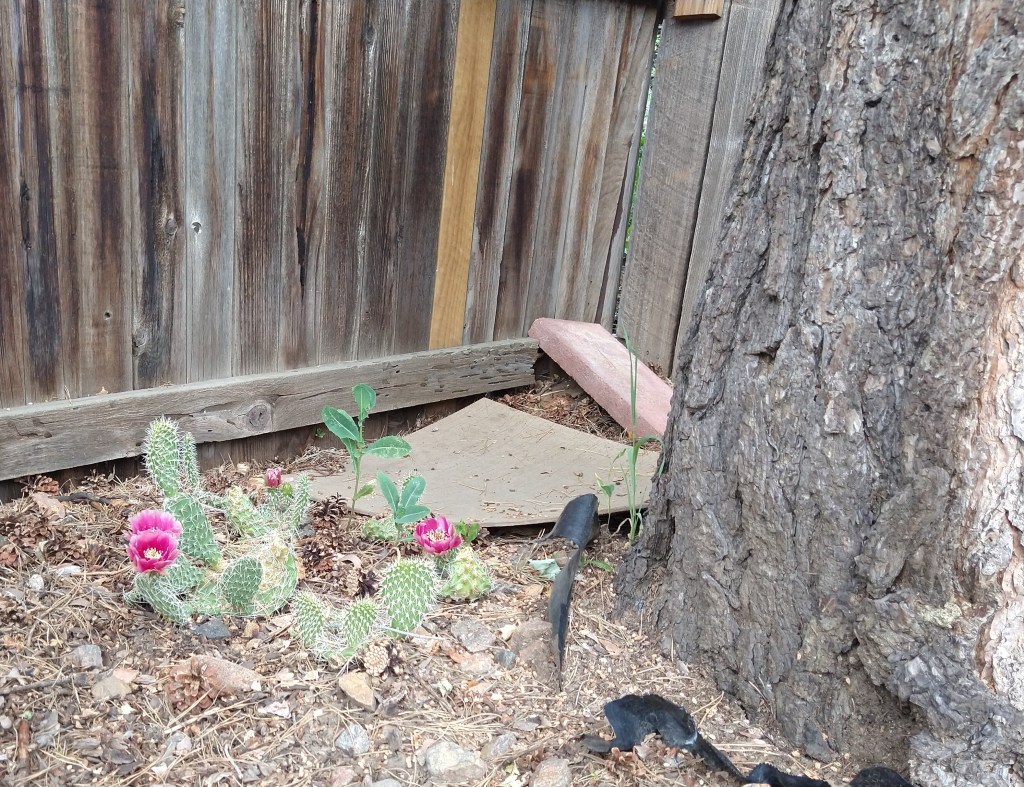
I am going to tell you a story about cactus.  I should not be able to share the photo at the top of this post because the cactus pictured here should be dead.  Instead, it has filled the pot it’s planted in and looks as if it longs to take over the entire backyard.

My mother found this cactus when she accompanied my stepfather on a fishing trip.  The road they were driving down had been graded and the cactus lay along the side, uprooted and left to die.  My Mom-very carefully-picked it up, put it in a box, brought it home, and promptly forgot about it.  It lay in the box for months until she re-discovered it and planted it in the pot to see if it would survive.  Some bits did die but the rest not only survived, it thrived.  It has filled not one but three pots and delights us with the beautiful blooms.

We have feral cats in our neighborhood and they have chosen to use our backyard as their toilet.  We have tried various deterrents but they would just move from one toilet spot to another.  They were beginning to use the space behind our tree and so, about a month ago, my stepfather when out and-very carefully-trimmed off some pieces of cactus which he scattered on the ground around the tree.  Bits of the cactus were once more left to die.

They did not.  They did not need careful planting.  They did not need watering.  They took root, righted themselves, and, though separated from their source still in the pot; bloomed right alongside.  While a bit concerned that it has been set free from the confines of the pot, I can’t help but admire the tenacity of this spiny little plant.  As I consider it, I learn two lessons.

Lesson One has to do with the ground. I have not carefully examined the cactus for sharp pokey reasons.  Perhaps it hasn’t actually rooted.  Perhaps it has bloomed because of the life that was in it from when it was joined to the parent plant still rooted in the pot.  Perhaps, as time passes and it remains cut off from that life; it will use up the vestiges, wither, and die. This reminds me of the Parable of the Sower, specifically the seed that immediately sprang up but had no root and withered away (Matthew 13:5-6).  Whether or not a believer is vitally connected to the life of Jesus is a truth that cannot but manifest itself.  There may be lovely full blooms at the moment but without being rooted deep into His life, those blooms can’t be sustained.  They will wither and die. My highest priority is to keep myself in Him so that He can ensure I am good ground and His Life within me flourishes.

Lesson Two has to do with roots. Perhaps the cactus has rooted and it will continue to bloom for many more seasons.  Despite the intentions of those who tore it from the ground or cut it and scattered it, it has put down roots and is thriving.  I may be pushing the metaphor here but, in this tenacity, I see a picture not only of the strength but the quality of our lives in Christ Jesus. 1 John 3:1 says, “Behold what manner of love the Father has bestowed on us, that we should be called children of God!”  The Amplified has “…what an incredible quality of love”.  I have heard Malcolm Smith speak on this passage and he likens this love of The Father to finding an orchid growing within the Arctic Circle.  It’s an impossible kind of love but yet here it is: we see it in Jesus.

Jesus gives a beautiful description of Himself in Revelation 22:16: “I, Jesus, have sent My angel to testify to you these things in the churches.  I am the Root and the Offspring of David, the Bright and Morning Star.”  I realize this is highly symbolic language yet I like thinking of Jesus as The Root.  The source of my life is The Root.

This being so, what is there to fear? It doesn’t matter if the circumstances of my life are such that it appears my life couldn’t possibly bear fruit.  I died and my life is hidden with Christ in God (Colossians 3:3).  He is The Root and there is nothing in this world that can separate me from Him.  The Father abides in Jesus, Jesus abides in me, and I abide in Him (John 15, John 17:23).  It’s an impossible love.  It’s an impossible life.  It’s indestructible (Hebrews 7:16, NAS) and here it is blooming where it is least expected.

Unless noted otherwise, scriptures are quoted from the New King James Version of the Holy Bible, Thomas Nelson, Inc. 1982

Share this:

  • Print (Opens in new window) Print
  • Tweet
  • Email a link to a friend (Opens in new window) Email
  • Share on Tumblr
Like Loading...

Show Your Work

31 Monday May 2021

Posted by Kate in Walking in the Way

≈ Leave a comment

Tags

Bible Truth, Christ in Me, Christ Life, Christian Life, Christian Living, Good Works, Holy Spirit, Holy Spirit Guidance, Indwelling Christ, Indwelling Spirit, Kingdom of God, Kingdom Truth, Kingdom Work, Lead into Truth, The Kingdom Within

I laughed a little as I chose the title to this post.  I can’t tell you how many times I lost points in math class because I failed to show my work.  I didn’t do it on purpose: I’d do the mental steps and write down the answer.  If I got it right, what did actually writing out the steps matter?  It mattered for many reasons, as any math teacher will tell you.  Doing the work and showing the work is important.  And so, before I post the final study on the fruit of the Spirit, I want to address something I wrote in last week’s post, specifically; rather than doing “good works” I seek to be about The Father’s business and do only what I see Him doing.  I did not mean waiting on God is an excuse to not do anything.  In this post, I want to expand on what I mean when I say “good works” and I want to take a look at James 2:26 and Ephesians 2:8-9. 

James 2:26 says, “For as the body without the spirit is dead, so faith without works is dead.”  Ephesians 2:8-9 says, “For by grace you have been saved through faith, and that not of yourselves; it is the gift of God, not of works, lest anyone should boast.”  In times past, I have looked at these two scriptures and wondered if they didn’t contradict one another.  Someone might say, “Of course not!  It’s obvious!”  I can only speak to my own walk with God and, for a long time, it wasn’t obvious to me. 

These two scriptures appeared to be expressing opposing thoughts regarding works.  That is, of course, even assuming the two Apostles are speaking about the same thing.  Perhaps Paul is speaking merely of Jesus’ death and resurrection while James is speaking directly to how we Christians interact with our fellow men.  And yet, can the two be separated?  Don’t we have a tendency to present God with our good works, almost like a “here’s how Christian I am, aren’t I faithful and good” resume?  Our works are the proof of our faith according to James but then no they aren’t according to Paul. 

Is your head spinning?  I know mine was until my eyes were opened to see that everything comes from God.  I took another look at Ephesians 2: 8-9 and saw that everything mentioned there is a gift of God.  His grace is a gift.  His salvation is a gift.  His faith is a gift.  When I saw that Galatians 2:20 really says “the life I now live in the flesh I live by the faith OF the Son of God” rather than IN the Son of God, it changed James 2:8-9 for me.  I do not have to prove that my faith in Jesus is alive by doing good works.  Rather, it’s because He is alive in me through His Spirit, and because I live by His faith, that I do good works.  The works I do are His works.

Continuing on in Ephesians: “For we are His workmanship, created in Christ Jesus for good works, which God prepared beforehand that we should walk in them” (Eph. 2:10).  This is such a beautiful, exciting verse and one that leads me to rest in Jesus.  It’s never me.  It’s not my works.  It’s not doing what I think is good.  God has prepared specific good works for me and I walk in them.

This is, of course, easier said than done.  First, we must know what these works God has prepared beforehand are and there is a subtle difference between good works and the good works prepared beforehand by God.  There is a fact I have found to be often overlooked by pastors and teachers I have listened to.  I find there are few in Christendom who fail to attribute the existence of evil in the world to the fall of mankind that resulted in the eating of the fruit of the tree of the knowledge of good and evil in the garden.  What I do not hear spoken of often is that the eating of the fruit of the tree resulted in man knowing both good and evil.  We humans are capable of great evil as well as great good. 

Doing good works has very little to do with whether or not we are following after God.  There are people who have no belief in any sort of god at all who have done great good.  There are people who believe in a God who have done great good.  There are people who are devout followers of Jesus who have done great good.  The same is true for doing evil but, for the sake of this post, I am focused on good works. 

There are many scriptures that stress the importance of good works like Titus 3:14: “And let our people also learn to maintain good works, to meet urgent needs, that they may not be unfruitful.”  Romans Chapter 2 stresses the importance of good works especially in verses 6 & 7: “who will render to each one according to his deeds, eternal life to those who by patient continuance in doing good…” Good works are crucial and they are expected in the life of a Christian.

The point I am attempting to make is that, for the Christian, there is a difference between good works done FOR God and good works done out of the life OF God.  There is such a thing as “spiritual burnout”.  I am convinced this happens because we are capable of doing great works, the Bible even spells them out for us, and we expend so much energy in doing Christianity that we eventually burn out.  The Spirit is promised to be a spring of living water, flowing out to others through us.  When the works that we do are the works we see the Father doing, it’s His life in us that enables us to do the works.  There is no spiritual burnout when our works flow from the Spirit within us.  His fruit is love, joy, peace…

Knowing whether our works are the result of what we think/believe is good or whether they are the result of the life of Christ in us is impossible without the guidance of the Holy Spirit.  It requires being still, shutting out every other voice, and listening for His because, “…He will guide you into all truth; for He will not speak on His own authority, but whatever He hears He will speak…” (John 16:13).  Whatever He speaks we must do and we must do only what He speaks.

God has prepared the way for us to walk in.  We are His workmanship: His work is shown in us.  We can be confident that He who began a good work in us will complete it until the day of Jesus Christ (Philippians 1:6, emphasis mine).  We can trust that He watches over His word to perform it (Jeremiah 1:12).  We can trust that the good works expected of us are not a call to busyness and exhaustion but rather a promise that His life in us bears fruit. Let us remember we only bear fruit when we abide in Him.  It’s His life flowing through us that bears fruit and the Father is the husbandman who prunes us that we may bear more fruit.  Let us not fall into the trap of “I ought to be doing this or I should be doing that.”  It is God who works in us both to will and to do for His good pleasure (Philippians 2:13).  He wants our lives to bear fruit and we can trust that He will ensure they do so no matter our circumstances or stations in life. 

If we live in the Spirit, let us also walk in the Spirit! (Galatians 5:25)

Amen.

Share this:

  • Print (Opens in new window) Print
  • Tweet
  • Email a link to a friend (Opens in new window) Email
  • Share on Tumblr
Like Loading...

Leaving It All Behind

10 Monday May 2021

Posted by Kate in Walking in the Way

≈ 1 Comment

Tags

Abide in Christ, Bible Study, Christ in Me, Christ Life, Goodness of God, Holy Spirit Fellowship, Indwelling Christ, Indwelling Spirit, Letting Go, Life in Christ, Moving Forward, New Life, Repentance, Strength for the Journey, Walking in the Way

Over the last week, I had the opportunity to find and read a book I had never read before; a book by one of my favorite authors.  The book was exceptionally written and yet, when I closed the covers for the last time, I was left wondering if I’d enjoyed it.  There was a tone of misery throughout the entire work and I felt a bit down after I’d finished it.  This got me thinking of a previous post where I mentioned trying a book by my favorite author even though the title and description gave me qualms and where I wondered if what I was about to read meant I would have to stop reading this author. 

“Have to stop reading” sounds a bit legalistic now that I think about it and legalism was not at all what I meant to imply.  Life changes as I move forward in the Spirit. Books I used to read are no longer enjoyable.  Television shows I used to watch are no longer entertaining.  Jokes I used to laugh at are no longer funny.  These things are so not because I’m worried about GOD getting mad at me and judging me.  No, these things are so because I AM a new creation in Christ.  I have been born again by His Spirit.  The same mind that was in Christ Jesus is in me.  I have been and am still being transformed by the renewing of my mind.  This transformation has meant leaving behind many things.

I closed last week with the comment: “If our denominations, doctrines, creeds, and knowledge have become a substitute for this living in vital union with Jesus through his Spirit, let us turn from them.”  I want to take this week to expound on that and, while doing so, write more on the goodness of God.  My main scripture passage for this week is Romans 2 verse 4: “Or do you despise the riches of His goodness, forbearance, and longsuffering, not knowing that the goodness of God leads you to repentance?”

What do you think of when you think of repentance?  Whatever the word originally meant, it has come to mean the doing of penance over and over.  If that is the definition we hold in our minds, then this verse also takes on a meaning far different than that intended by the Apostle Paul.  If the end result we Christians are looking for is doing penance over and over, then we need look no further than the religious institutions that define themselves by lists of rules and regulations.  We cannot help but fail if our focus is on not breaking rules and being sure we pray enough and read our bibles enough and attend enough meetings and memorize enough and serve enough.  The guilt that goes along with that sense of failure always ensures there are people flooding the altars on Sunday mornings, repenting, re-dedicating, seeking renewal and hoping enough anointing of the Lord had been received to last through another week.  At least, it always ensured I was doing and hoping so.

What freedom there is in the Spirit!  Some of the truest words ever written are 2 Corinthians 3:17: “Now the Lord is the Spirit; and where the Spirit of the Lord is, there is liberty.”  Liberty.  Freedom.  He does not call us to a life of doing penance over and over.  His goodness leads us to metanoia (G3341) which means “change of mind”1.  Malcolm Smith calls it a radical change of mind and indeed it is.  It is not a changing of our minds about Jesus, it is exchanging our minds for His.  “Let this mind be in you which was also in Christ Jesus” (Philippians 2: 5).  “And do not be conformed to this world, but be transformed by the renewing of your mind, that you may prove what is that good and acceptable and perfect will of God” (Romans 12:2).  As my mind is transformed, so is my entire inward life, and the outward life cannot help but change as well.

The goodness of God that leads us to this radical change of mind is not the agathosune (G19) I wrote about last week.  The Greek word isn’t chrestotes (G5544) either but a related word chrestos (G5543).  This word means “employed, useful, better, easy, good(-ness), gracious, kind”.  There is no harsh edge or admonishment associated with this word.  It is the word translated “easy” in Matthew 11:30: “For my yoke is easy and my burden is light.” 

His yoke is easy and His burden is light.  He does not demand.  Rather, He lives in me and wroughts changes I’m not even aware of until the day comes when I realize I’ve lost the enjoyment I used to have in a thing and He bids me come away from it.  I don’t want to give the impression it’s always easy.  Sometimes it is.  Sometimes there is the realization that I don’t enjoy whatever the thing is anymore and it’s done.  Then there are the times when, even though my enjoyment has fled, I do want to keep reading, watching, or doing it.  These are times when there needs to be a subduing of my flesh but He gives the strength for that as well.  I promise this much is true: there is not one thing I have turned away from that I ultimately miss.  There is nothing I leave behind but He does not give me the greater portion of Himself.

I don’t have to work on myself and clean up my behavior before He’ll come live in me.  No, the good news of the gospel is that “God demonstrates His own love toward us, in that while we were still sinners, Christ died for us” (Romans 5:8). There is no great work I must do but I confess with my mouth the Lord Jesus, I believe in my heart God has raised Him from the dead, and I am saved (See Romans 10:9-10). Truly, He has put His spirit in me.  He causes me to walk in His statutes.  He enables me to keep His judgments and do them.  (See Ezekiel 36:27) I “taste and see that the Lord is good” (Psalm 34:8) and His goodness leads me to metanoia. 

Amen

Unless notes otherwise, scriptures are quoted from the New King James Version of the Holy Bible, Thomas Nelson, Inc. 1982

  1.  Hastings, James, Hastings’ Dictionary of the Bible, Hendrickson Publishers, Inc., Fifth Printing-March 2001, Page 790

Other References:

Strong, James, LLD., S.T.D., The New Strong’s Exhaustive Concordance of the Bible, Thomas Nelson Publishers, Nashville, Tennessee, 1990

Share this:

  • Print (Opens in new window) Print
  • Tweet
  • Email a link to a friend (Opens in new window) Email
  • Share on Tumblr
Like Loading...

Fruit of the Spirit-Goodness

03 Monday May 2021

Posted by Kate in Fruit of the Spirit, Studies

≈ Leave a comment

Tags

Bible Study, Bible Teaching, Biblical Greek, Christ in Me, Christ Life, Christian Life, Community, Fruit of the Spirit, Goodness, Holy Spirit, Holy Spirit Fellowship, Indwelling Christ, Indwelling Spirit, Life in Christ, Union with the Trinity, United with Christ

“But the fruit of the Spirit is…goodness” Galatians 5:22

I have said in earlier installments of this study that each fruit listed in this passage appears to flow one from the other.  That this is true was never made clearer than looking at “goodness” for this week’s post.  I spoke last week on how “kindness” in this passage was translated “goodness” in other scripture passages and I wondered how the “goodness” which comes next in the Apostle Paul’s list differed.  In turns out, that’s not an easy question to answer.

The entry in the Strong’s Concordance does not really elaborate on “goodness”.  The Greek word used by Paul is agathosune (G19) and it has the definition of goodness, virtue or beneficence.  The primary agathos (G18) gives the definition of “good (in any sense, often as a noun)-benefit, good (-s, things), well”.  I don’t know about you but I am left thinking, “Well, good but I’m not seeing anything new here.”  It turns out we’re not alone. 

Richard Chevenix Trench states: “Agathosyne (G19) is one of many words where revealed religion has enriched the later language of Greece.  Agathosyne occurs only in the Greek translations of the Old Testament, in the New Testament, and in writings directly dependent on these.  The grammarians never acknowledged or gave it their stamp of approval and insisted that chrestotes (G5544) should always be used in its place…The difficulty in precisely defining agathosyne occurs primarily because there are no helpful passages in classical Greek literature where the word is used.  Although classical usage can never be the absolute standard by which we define the meaning of words in Scripture, we feel a loss when there are no classical instances to use for comparison. It is prudent first to consider chrestotes.  After determining its range of meaning, it will be easier to ascertain what agathosyne means.”1 

I conducted a study on chrestotes (G5544) last week so will not repeat that work here.  Trench does go on to quote Jerome saying: “…the Stoics define it thus: chrestotes is a virtue willingly ready to do good.  Agathosyne is not much different, for it also seems ready to do good.  But it differs in that it can be more harsh and with a countenance wrinkled by strict standards for one to do well and to excel in what is demanded, without being pleasant to associates and attracting crowds by its sweetness.”2

Trench uses the illustration of Jesus driving the money lenders from the temple (Mat 21:13) and speaking harshly to the scribes and Pharisees (Mat 23:1-39) as agathosune.  Trench contrasts these examples of what he calls “righteous indignation” with Jesus’ reception of the penitent woman (Luk 7:37-50) and in all his other gracious dealings with the children of men which illustrate chrestotes.

I did not find this helpful.  Interesting, to be sure, but there was still no revelation.  I checked each occurrence of agathosune in the New Testament to see if usage could help me understand.  There are four: Romans 15:14, Galatians 5:22, Ephesians 5:9, and 2 Thessalonians 1:11.  I looked up each one and had to read all of the 5th chapter of Ephesians in attempt to get a grasp on what Paul is saying.  I still had no revelation and ended my study for the night utterly confused as to what this goodness is.  I was so confused I couldn’t express myself to my mother who, looking equally confused after I’d spoken with her, told me to wait on the Spirit who would give me revelation.  Always good advice.  After all, if I believe Scripture is god-breathed (2 Timothy 3:16), and I do, who better to tell me what it means than He who inspired it? 

I started this post by pointing out how each of the fruit listed in this passage flows one from the other.  That is true but it isn’t the entire truth.  There is only one fruit.  The Greek word here is singular, not plural.  Each word listed by the Apostle Paul reveals more of The Fruit of the Spirit within us which is the very person of Jesus Christ.  All of them are a revelation of who He is and who He is in us.  As I meditated on the meaning of agathosune and waited on the Holy Spirit, I had Zoom Church and Bishop Malcolm Smith shared a message that showed me what true admonishment from someone filled with the fruit of the Spirit looked like (Romans 15:14). This goodness could be defined as “let us speak the truth in love (agape)” (Ephesians 4:15).

I saw an online study that said the speaking the truth in love the Apostle Paul talked about was speaking that which is doctrinally correct.  I do not agree.  Jesus is the truth (John 14:6) and this fixation on correct doctrine and the subsequent bickering between denominations has nothing to do with the fruit of the Spirit.  Ephesians 5: 8-11 says, “For you were once darkness, but now you are light in the Lord.  Walk as children of light (for the fruit of the Spirit is in all goodness, righteousness, and truth), finding out what is acceptable to the Lord.  And have no fellowship with the unfruitful works of darkness but rather expose them.”  Romans 15:14 says, “Now I myself am confident concerning you, my brethren, that you also are full of goodness, filled with all knowledge, able also to admonish one another.”  As this goodness is found only in the Indwelling Christ, so is the necessary knowledge.  I am convinced we cannot truly know what is acceptable to the Lord unless we know the Lord through His Spirit. 

I am reading a book right now that, after listening to that message, I realized also illustrates agathosune.  It’s called “The Power of the Spirit” and is a collection of writings by William Law.  As he speaks on the knowledge that comes from institutions of learning and institutions of religion he writes; “Let no one here imagine that I am writing against all human literature, arts, and sciences, or that I wish the world to be without them.  I am no more an enemy of them than of the common useful labors of life.  It is the application to the things of the Spirit of God of the same methods of learning and wisdom used by worldly scholars in earthly pursuits that I charge with folly and mischief.”3  

William Law goes on to say, “Consider first of all that true deliverance from sin is nowhere to be found for fallen man, but in these two points: (1) A total childlike faith in gospel salvation through the death and resurrection of Christ for man; and (2) A total resignation to, and sole dependence upon, the continual operation of the Holy Spirit in man.  Through Him, Christ becomes our never-ceasing light, teacher, guide, and living power whereby we can walk in all the ways of virtue in which He Himself walked in the flesh.  All beside this, call it by what name you will, is but dead work, a vain labor of the old man to recreate himself.  For nothing else is meant or taught by the gospel, but a total dying to self (called taking up the cross to follow Christ) that a new creature (called Christ in us) may be born into the purity and perfection of a vital life-union with God.

“Let the Christian world forget or depart from this true gospel salvation; let anything else be trusted but the cross of Christ and the Spirit of Christ; and then, though churches and preachers and prayers and sacraments are everywhere in plenty, nothing can come of them but a Christian kingdom of pagan vices, along with a mouth-professed belief in the Apostle’s Creed and the communion of saints.  To this sad truth all Christendom both at home and abroad bears full witness.  Who need be told that no corruption or depravity of human nature, no kind of pride, wrath, envy, malice, and self-love; no sort of hypocrisy, falseness, cursing, gossip, perjury, and cheating; no wantonness of lust in every kind of debauchery, foolish jesting, and worldly entertainment, is any less common all over Christendom, both popish and Protestant, than towns and villages.  What vanity then, to count progress in terms of numbers of new and lofty cathedrals, chapels, sanctuaries, mission stations, and multiplied new membership lists, when there is no change in this undeniable departure of men’s hearts from the living God.  Yea, let the whole world be converted to Christianity of this kind, and let every citizen be a member of some Protestant or Catholic church and mouth the creed every Lord’s day; and no more would have been accomplished toward bringing the kingdom of God among men than if they had all joined this or that philosophical society or social fraternity.”4

Harsh words?  Consider the words of Jesus in Matthew 7: “Not everyone who says to Me, ‘Lord, Lord,’ shall enter the kingdom of heaven, but he who does the will of My Father in heaven.  Many will say to Me in that day, ‘Lord, Lord, have we not prophesied in Your name, cast out demons in Your name, and done many wonders in Your name?’ And then I will declare to them, ‘I never knew you; depart from Me, you who practice lawlessness!’ (verses 21-23)  Some translations have “workers of iniquity” in this passage. 

This is so important.  We must be filled with the Spirit.  Our lives must be lived in unceasing intimacy with Jesus Christ. If our denominations, doctrines, creeds, and knowledge have become a substitute for this living in vital union with Jesus through his Spirit, let us turn from them.  May we be full of His goodness, filled with His knowledge, and then may we speak the truth in His love.

Amen.

Unless notes otherwise, scriptures are quoted from the New King James Version of the Holy Bible, Thomas Nelson, Inc. 1982

  1. Walker, Allen G., The New Koine Greek Textbook Series Supplements, 2019, Richard Chevenix Trench’s Synonyms, Page 139
  2. Walker, Allen G., The New Koine Greek Textbook Series Supplements, 2019, Richard Chevenix Trench’s Synonyms, Page 139-140
  3. Law, William, The Power of the Spirit, The Wisdom of This World Denies the Spirit, CLC Publications, Fort Washington, Pennsylvania, 1971, Page 56
  4. Law, William, The Power of the Spirit, The Wisdom of This World Denies the Spirit, CLC Publications, Fort Washington, Pennsylvania, 1971, Page 56-57

Other References:

“Fruit of the Spirit” Not “Fruits.” | Clint’s Corner (pastorclinthogrefe.blogspot.com)

The Comparative Study Bible, The Zondervan Corporation, Grand Rapids, Michigan, 1984

Strong, James, LLD., S.T.D., The New Strong’s Exhaustive Concordance of the Bible, Thomas Nelson Publishers, Nashville, Tennessee, 1990

Check out Bishop Malcolm Smith

Unconditional Love Fellowship | The Ministry of Malcolm Smith

Share this:

  • Print (Opens in new window) Print
  • Tweet
  • Email a link to a friend (Opens in new window) Email
  • Share on Tumblr
Like Loading...

Fruit of the Spirit-Longsuffering

19 Monday Apr 2021

Posted by Kate in Fruit of the Spirit, Studies

≈ Leave a comment

Tags

Bible Student, Bible Study, Bible Truth, Biblical Greek, Biblical Hebrew, Christ in Me, Fruit of the Spirit, Indwelling Christ, Indwelling Spirit, Jesus is my Life, Life in Christ, Patience, Spirit Life, Spirit of the Lord, Spirituality

“But the fruit of the Spirit is…longsuffering” Galatians 5:22

Longsuffering made for an interesting study.  I’m an avid reader and I can’t count how many times I’ve read the phrase, “a longsuffering sigh.”  To me, longsuffering carries the connotation of deep sighs, eye rolls, biting one’s tongue, and attempting to control one’s temper.  Longsuffering does not immediately equal fruit of the Spirit in my mind. 

Different translations of the Bible translate this word in different ways.  The King James has “longsuffering” while the Amplified has “patience” and expands that with “even temper, forbearance”.  Both the New American Standard and New International have “patience” while my New International Version Journal Bible has “forbearance”.  I can’t say forbearance is any more appealing to me than longsuffering and neither is patience, really.  I can’t shake the feeling of negativity associated with these words.  Whenever I think of longsuffering, forbearance, and patience; I picture someone stiff, almost frowning.  Why?

I find the beginning of an answer to that in The New World Dictionary’s entry for patience.  After the definition, I found a section on synonyms which states: patience implies the bearing of suffering, provocation, delay, tediousness, etc. with calmness and self-control…endurance stresses the capacity to bear suffering or hardship…forbearance implies restraint under provocation or a refraining from retaliation for a wrong…stoicism suggest such endurance of suffering without flinching as to indicate an almost austere indifference to pain or pleasure.

Austere is a good word and that helps me to understand what I’m picturing.  While I read the words patience, longsuffering, forbearance, I am actually thinking stoicism.  This is why I find study so necessary to my Christian life.  I bring preconceived meanings to scripture when I read it and I often find words do not mean what I think they mean.  I did not find any surprises in the definitions for the Greek word translated patience but was able to begin looking at it in a different way.  I did unearth some buried treasure as I dug deeper into the word which I’ll get to in a moment.

Impatience is something I struggle with.  I did not think my struggle was having patience with people although, while conducting this study, I am thinking the Holy Spirit does have some work yet to do in this arena.  I do struggle with being patient with God’s process.  It takes such a long time.  There have been many times I have been frustrated with God because His will is that I know him, my will is that I know Him, let’s get on with it!  Zero to Overcomer in less than 60 seconds.  He is not a God of the Zaps.  No, He is a God of process.  (See 2 Corinthians 3:18)

One of the most difficult words I receive from my Heavenly Father is “Wait.  Be still.”  It is especially difficult when I’ve been waiting years for some answers and His response is still “Wait.  Be Still.”  Obedience to My Father can become a burden rather than my delight and I am relieved when I realize patience is something that flows out of His life within me because it is not something I am capable of having on my own. 

The meanings of “wait” and “be still” are a help to patience bearing fruit.  “Wait” and “Be still” are not commands to thumb-twiddling.  The “wait” as in “Wait on the Lord; Be of good courage, and He shall strengthen your heart; Wait, I say on the Lord!” (Psalm 27:14) is the Hebrew word qavah (H6960) and means “to bind together by twisting, to expect”.  “Be still” as in “Be still and know that I am God” (Psalm 46:10) is the Hebrew word raphah (H7503) and means “slacken, abate, cease…let alone…be slothful”.  That does sound a bit like thumb-twiddling but that’s not the picture I see.  I see a letting go of my need for things to happen in my NOW and, instead, I focus on entering into Jesus’ rest.  I choose to look at the waiting time as opportunity to be knit together with Jesus through the work of His Spirit and the time is not spent in idleness.  I see that patience is not passive, neither is it stoic.

Now, for the buried treasure:

I tracked the Greek word for patience (makrothumia G3115) to its root words and found makros (G3117) and thumos (G2372).  Under Strong’s entry for thumos was the suggestion to compare with 5590.  I did so and found 5590 in the Strong’s concordance is the Greek psuche.  There is a long line of definitions for psuche but, put simply, it means breath.  This struck me because of how closely an even temper and patience is associated with the breath.  Even as I read the entry, I couldn’t help taking a deep breath.  I caught myself doing it and thought, “That’s exactly what I do when I’m keeping my temper.”

I recently completed a round of Physical Therapy and my therapist wanted me to focus on diaphragmatic breathing.  She told me I could do a lot for pain management if I focused on my breath.  I remembered that as I was struck by the connection between breath and patience.  I can change what’s happening in my body and how I’m feeling by changing my breath.  When it comes to fruit of the Spirit like patience, it isn’t my breath I need.

1 Corinthians 15: 45 says, “And so it is written, ‘The first man Adam became a living being.’ The last Adam became a life-giving spirit.”  The word for “being” is sometimes translated “soul” and is the Greek word psuche.  Genesis 2:7 tells me how this was done: “And the Lord God formed man of the dust of the ground, and breathed into his nostrils the breath of life; and man became a living being.”  Jesus breathed on the apostles after His resurrection and then said, “Receive the Holy Spirit” (John 20:22).  The word used for the Holy Spirit is pneuma (G4151) and, while it doesn’t mean exactly the same thing as psuche, it does carry the meaning of breath.

The Newsboys have a song titled “Father, Blessed Father” on their album Adoration.  The song contains the lyrics, “Breathe on me, Breathe Oh breath of God.  Breathe on me, ‘til my heart is new.”  That is my prayer as I wrap up this study and walk into a new week.  Breathe on me, Oh Spirit of the Living God.  Be my very breath. Create in me a clean heart and may your patience bear fruit in my life.

Amen.

References:

Unless notes otherwise, scriptures are quoted from the New King James Version of the Holy Bible, Thomas Nelson, Inc. 1982

The Comparative Study Bible, The Zondervan Corporation, Grand Rapids, Michigan, 1984

Guralnik, David B., Webster’s New World Dictionary of the American Language, 2nd Edition, William Colling + World Publishing Company, 1976

Strong, James, LLD., S.T.D., The New Strong’s Exhaustive Concordance of the Bible, Thomas Nelson Publishers, Nashville, Tennessee, 1990

Share this:

  • Print (Opens in new window) Print
  • Tweet
  • Email a link to a friend (Opens in new window) Email
  • Share on Tumblr
Like Loading...
← Older posts
Newer posts →

Categories

Featured Posts

Isaiah 45:7

When Tradition and I Part Ways

Keep reading
Kate's avatar by Kate November 28, 2022April 28, 2024
Gospel and Letters of John

A New Heart

Keep reading
Kate's avatar by Kate December 7, 2020March 14, 2021
Studies

The Way He Has Made

Keep reading
Kate's avatar by Kate August 7, 2023August 6, 2023

Enter your email address to subscribe to this blog and receive notifications of new posts by email.

Join 210 other subscribers
Follow Renaissance Woman on WordPress.com

Follow Me on Facebook

Follow Me on Facebook

Meta

  • Create account
  • Log in
  • Entries feed
  • Comments feed
  • WordPress.com

Blog at WordPress.com.

  • Subscribe Subscribed
    • Renaissance Woman
    • Join 169 other subscribers
    • Already have a WordPress.com account? Log in now.
    • Renaissance Woman
    • Subscribe Subscribed
    • Sign up
    • Log in
    • Report this content
    • View site in Reader
    • Manage subscriptions
    • Collapse this bar
 

Loading Comments...
 

You must be logged in to post a comment.

    %d