• About Me
  • Study Links

Renaissance Woman

~ Test All Things; Hold Fast What is Good-1 Thessalonians 5:21

Renaissance Woman

Tag Archives: Christ Life

Let’s Put A Pin in That

23 Tuesday Aug 2022

Posted by Kate in Walking in the Way

≈ Leave a comment

Tags

Bible Study, Chosen, Christ in Me, Christ Life, Christian Life, Clothed in Righteousness, Garments, Gospel of Matthew, Holy Spirit, Indwelling Spirit, Parable of the Wedding Feast, Parables of Jesus

Hello and welcome to another post on Renaissance Woman.

I do intend to move on to looking at the Hebrew letter Mem but, before I do that, I have come across another side path I have found it necessary to take.  I hope to be back to my main study track next week but we’ll have to see how it goes.

In last week’s post, I wrote; “The call to all mankind now is ‘Come!’” and included the scripture references Matthew 11:27-29, John 7:37-38, and Revelation 22:17.  To these three I ought to perhaps have added John 12:32 which says, “And I, if I am lifted up from the earth, will draw all peoples to Myself” which is a spectacular scripture I would love to hear more teaching on as I have only come across one.  There are other passages of scripture I could include but I think these four make clear that the call to return to the heart of God does go out to all mankind.  Perhaps though, as you read last week’s post, a passage popped into your head and you wondered, if it is true the call to Come! is to all mankind, then what does this passage mean?  It certainly popped into my head but I did not have the space to address it in last week’s post.  I am doing so this week and thus my brief foray down this side path.

The passage that popped into my mind was Matthew 22:14: “For many are called but few are chosen”. It is Jesus’ closing statement to the parable of the Marriage of the King’s Son.  You can read the parable in Matthew Chapter 22 verses 1-14 but, briefly, it is this: A king has arranged a marriage for his son and he sends his servants out to call those who were invited to the wedding.  The invited ones were not willing to come so his servants went to them a second time telling them all was ready.  Again, those invited refused to come.  Some busied themselves with tasks and others abused and killed the servants.  The king is angry and, after dealing quite harshly with those invited, tells his servants to go out and gather all they could find and bring them to the wedding.  The servants do so and verse 10 says “both bad and good” were brought to the wedding hall.  The king comes out to see the guests and finds one man who did not have on a wedding garment.  The king asks how the man managed to get in without a wedding garment and the man has nothing to say.  The king tells his servants to “bind him hand and foot, take him away, and throw him into outer darkness; there will be weeping and gnashing of teeth” (verse 13).  Then, Jesus ends the parable by saying “For many are called, but few are chosen.”

I read through the parable and found the act of choosing was all on the side of both those invited and those gathered by the servants.  The parable is not describing auditioning for the kingdom of heaven as in the call goes out and so we come with our very best ideas of what we think the caller wants and then he decides if we get the part or not based on how close we came to the ideal.  In describing Jesus’ statement in verse 14, the Abingdon Bible Commentary says, “This is a detached saying.  By it Jesus could only have meant that while many hear the word calling to repentance it is only a few who respond to the call.”1  I have a quibble with the word “repentance” but I’ll address that in a bit.  I do see that whether or not one was chosen was based on how they responded.

There is so much to be learned from this parable but I don’t want to stray too far from the main path of my Isaiah 45:7 study.  I will thus put a pin in this parable and will perform an in depth study at a later time.  In this post, I want to look at the responses of the various parties and especially at the one man who was found without a wedding garment.  Those who were of the invited ones chose not to come.  Those gathered from the highways by the servants came but would have had no time to procure a wedding garment.  Both the Abingdon Commentary and the commentary on this parable in The Passion Translation point this out.  The Passion Translation says, “Those invited to come from the streets had no opportunity to buy wedding clothes.  This wedding robe is a picture of the garment of righteousness that grace provides for us.  The man without the wedding garment had one provided but he didn’t want to change into new clothes.  A change is necessary, for our King provides garments of white linen for us to wear, our wedding garments” and then references Isaiah 52:1, Revelation 19:8 (TPT).2

Ellicot’s Bible Commentary describes how this providing of a wedding garment was a custom of the day: “The framework of the parable probably presupposes the Oriental custom of providing garments for the guests who were invited to a royal feast.  Wardrobes filled with many thousand garments form part of the wealth of every Eastern prince (6:19; Jas. 5:2), and it was part of his glory (II Kings 10:22), to bring them out for use on state occasions.  On this assumption, the act of the man who was found “not having a wedding garment” was one of willful insult.  The “wedding garment” is nothing less than the “holiness” without which no man shall see the Lord (Heb. 12:14), and that holiness, as in the framework of the parable and in the realities of the spiritual life, Christ is ever ready to impart to him who truly believes”.3

I don’t know about you but, whenever I come across scripture references used to back up a statement, I look them up.  As I looked at the scriptures referenced in Ellicot’s Bible Commentary, I did not see that providing a wedding garment was indeed an ancient custom.  That cannot be inferred from those specific scriptures.  I checked through my history books and could not find a reference to that custom.  My history books do have examples of garments being given as gifts and there are examples of this in scripture as well.  (See Genesis 45:22, 2 Kings 5:22, Esther 8:15).  The internet did not help me as I searched for examples of kings providing wedding garments.  I was unable to find one but I did find that this was indeed a custom is a belief almost universally held.  That’s good enough for me at this moment.  I will continue to look into it-and if anyone does know of a reference, please let me know-but, for now, I put a pin in that as well.

That the wedding garment was provided is, I think, inferred by the parable.  That the man was expected to be in a wedding garment is clear and, when questioned, the man had no defense.  If there had been any way to appease the king, no doubt the man would have done so.  I accept the servants offered a garment to the man and he refused.  Vincent’s Word Studies speaks on the man not having a garment saying, “It is hardly possible to convey the subtle sense of the negative particle to the English reader.  A different word for not is used in the preceding verse, expressing an outward, objective fact which attracted the king’s notice.  The man had not a wedding garment.  When the king addresses the guest, he is thinking not so much of the outward token of disrespect, as of the guest’s mental attitude toward the proprieties of the occasion….It implies, as Dr. Morison observes, that the man was conscious of the omission when he entered and was intentionally guilty of the neglect.”4

Both the Abingdon Commentary and The Passion Translation point out the universality of the king’s call.  The Passion Translation says, “Many are called.  This can be understood to be a Semitic figure of speech that universalizes the invitation.  See also Matt. 20:28” (TPT)5 while the Abingdon Commentary says, “The deep universal note of the gospel sounds forth clearly in this parable.”6  I am fascinated by the fact that Matthew’s gospel says “both good and bad” were brought to the feast.  There was no distinction between the guests.  The right to stay and enjoy the king’s celebration was based entirely on whether or not they chose to wear the appropriate garment.  Just what is this garment?

I concur with all of the writers I’ve read who say it is the garment of Jesus’ righteousness.  I do not concur with those who speak of this garment as something external to us.  I hear teachers saying things along the lines of, “God doesn’t see your sin because He sees you through his Son” like we believers are wearing Jesus suits and that makes us acceptable to God.  God doesn’t see our sin because the blood of Jesus Christ cleanses us from all sin (1 John 1:7).  The parable is not explicit but I think washing is implied.  If those the servants brought in from the highways had no time to procure a wedding garment, neither would they have had time to bathe.  I cannot imagine a wedding garment would have been put over smelly stinking skin and then the guests sent in to the feast where their aroma would fight it out with the aromas of the food the king had had prepared.  I think this parable points to the fact that we are cleansed by the blood of Christ and we are presented to Him glorious, without spot or wrinkle or blemish by the washing of water by the word (Ephesians 5:26-27).  Not only are we cleansed but clothed in fine linen which is the righteous acts of the saints: not self-righteousness which is as filthy rags (Isaiah 64:6) but the righteousness we now are in Jesus Christ (2 Corinthians 5:21). 

The call is to each one of us and it is not to repentance.  The fact that the Greek word metanoia has been translated “repentance” in our Bible is, I think, a travesty.  Repentance at its core means to do penance over and over and over and anyone caught in that loop does not know the truth: that Jesus Christ has put away sin by the sacrifice of Himself and did so one time for sins forever.  (Hebrews 10: 26, 10:12, 7:27).  Instead of repentance, metanoia! Change your mind! That Jesus Christ did live and die and rise again thus putting away sins is not dependent on our belief.  It was done long before any of us lived though He acted as and for all mankind and we living today were included.  The life it is possible to live is ours because Jesus our Saviour is self-giving love and whether or not we believe it doesn’t change what is.  However, it is impossible to live in the freedom that is ours in Christ Jesus without believing it.  Let’s remove the pin and no longer keep this life in Christ something to think about at a later time.  Heed His call!  Respond! Ask the Holy Spirit to open your eyes and change your mind!  Come and live a life where there is no guilt or condemnation.  Walk according to His Spirit rather than the flesh because the law of the Spirit of life in Christ Jesus has made us free from the law of sin and death! (See Romans 8:1-2) 

That is something to celebrate!

  1. Eiselen, Frederick Carl, Edwin Lewis, and David G. Downey, editors., The Abingdon Bible Commentary, The Abingdon Press, Inc., Nashville • New York, 1929, Page 988
  2. Passion and Fire Ministries, The Passion Translation, 2020 Edition, Broadstreet Publishing Group, LLC, 2020, Page 65
  3. Ellicot, Charles John, Ellicot’s Bible Commentary, Zondervan Publishing, Grand Rapids, Michigan, 1971, Pages 733-734
  4. Vincent, Marvin R., D.D., Vincent’s Word Studies in the New Testament, Volume I, Hendrickson Publishers, Peabody, Massachusetts, Pages 120-121
  5. Passion and Fire Ministries, The Passion Translation, 2020 Edition, Broadstreet Publishing Group, LLC, 2020, Page 65
  6. Eiselen, Frederick Carl, Edwin Lewis, and David G. Downey, editors., The Abingdon Bible Commentary, The Abingdon Press, Inc., Nashville • New York, 1929, Page 988

Unless noted otherwise, all Scriptures are quoted from The Holy Bible, New King James Version, Thomas Nelson Publishers, Nashville, Tennessee, 1982

More Reading on the Wedding Garment:

The Wedding Garment (gracegems.org)

He Got Kicked Out Of The Wedding! – Michael A. Verdicchio (confidenceandjoy.com)

My previous post on our thoughts being our garments:

https://renaissancewoman.blog/2022/06/20/hey-what-are-you-wearing/

Share this:

  • Click to print (Opens in new window) Print
  • Tweet
  • Click to email a link to a friend (Opens in new window) Email
  • Share on Tumblr
Like Loading...

Pathways of Peace

22 Monday Aug 2022

Posted by Kate in Isaiah 45:7, Studies

≈ Leave a comment

Tags

Bible Study, Biblical Hebrew, Book of Isaiah, Christ Life, Christian Life, Holy Spirit, Indwelling Spirit, Isaiah 45:7, Lamed, Peace

Good morning!  Welcome-or welcome back-to Renaissance Woman where I am continuing my study of Isaiah 45:7 specifically the word “peace” which is the Hebrew word shalom.  Shalom is spelled Shin (ש) Lamed (ל) Mem (ם) and, this week, I am continuing to look at the Lamed.

The word Lamed means “to learn, study, become familiar with” and also means “to teach”.  Over the past few weeks, I have written about the importance of having the Holy Spirit as our teacher.  Teachers, Pastors, and Church Leaders are important but it is the Holy Spirit alone who leads us into the truth that is Jesus Christ (See John 16:13, John 14:6).  Jessica Hottle recently posted to her social media “let Jesus guide you. Not people!” and that made me chuckle.  She made the same point I’ve been trying to make over multiple posts and thousands of words but she managed to do it in six. No one has ever accused me of brevity!  I agree: let Jesus be our guide.  In Matthew 11:29 He bids us come to Him and learn of Him and, as I’ve meditated on the meaning of the Lamed, I’ve been wondering just how in this day and age we learn from Jesus.

Interesting, the word Lamed spelled Lamed (ל) Mem (מ) Dalet (ד) but pronounced Lim-mood means “a disciple, one who is taught, a follower”.  I have heard people lament the age in which they have been born and heard them wish they’d been alive during Jesus’ day.  What would it have been like to walk with him on the shores of the Sea of Galilee! Oh, to sit at his feet, to walk with Him, to listen to His words as He spoke them!  Oh, to be one of His disciples!

I have a book on everyday life and customs during Bible Times and, out of curiosity, I looked up what it would have meant to be a disciple.  I read: “In Old Testament times, young men had the chance to become pupils of the prophets and priests.  Samuel, for example, was given to Eli while he was a small boy and trained by the priest.  The prophet Isaiah gave private teaching to a group of disciples.  These disciples lived with their masters, learning from them throughout the course of the day.  They sometimes sat at their feet, learning by lecture and discussion.  At other times they learned by their teacher’s example, or from object lessons that presented themselves throughout the day.  They would quiz their students, checking to see if any light bulbs were going on in their heads.  This one-on-one relationship was the best way to instill learning in the next generation…when Jesus walked upon the earth, he called disciples to his side, and for three and a half years they lived at his side and learned from his teachings.  Sometimes they sat at his feet (Luke 10:39), or learned from his example (John 13:15).  Many object lessons were presented to them (Mark 4:2), and Jesus quizzed them to see if they understood what was spoken (Luke 9:20). 

I laughed a little at the anachronism of “light bulbs going on in their heads” but zeroed in on the necessity of the one-on-one relationship.  I understand the desire to have been there in person at the beginning but I cannot help thinking how limited walking with the man Jesus would have been.  He couldn’t have a one-on-one relationship with all of his disciples at the same time.  I read through the gospels and find the crowds getting smaller and smaller until it’s just the Twelve.  Of the Twelve, only Three saw His transfiguration and, of the Three, only One laid with his head on Jesus’ breast.  Not everyone experienced the same level of closeness so I personally do not look on the days when Jesus walked this earth as a man as halcyon days.  Indeed, Jesus Himself said: “Nevertheless I tell you the truth.  It is to your advantage that I go away; for if I do not go away, the Helper will not come to you; but if I depart, I will send Him to you” (John 16:7).

Those days of Jesus’ ministry were limited to a tiny segment of the planet and, even if I’d been alive and living there and then, it would have been impossible to choose to be His disciple.  I don’t necessarily mean my gender would exclude me but rather that the custom of the day was a disciple would choose which Rabbi he wished to follow.  Not so with Jesus: He did the choosing.  It’s better to be alive in this moment because now we live in a day of no limitation.  The call to all mankind now is “Come!” (Matthew 11:27-29, John 7:37-38, Revelation 22:17). We don’t have to run after Him and ask Him where He’s staying because we know He sits at the right hand of the Father and we know we are in Him. 

 Luke 6:40 says, “A disciple is not above his teacher but everyone who is perfectly trained will be like his teacher.” What an amazing thing it would be if all we had today was the same as that possessed by Old Testament and Jesus’ disciples.  We can read the Red Letters in our Bibles and learn from the very words of Jesus.  What an example He left for us to emulate!  How tremendous that His words and example are not all we have!  We do not live alongside Him but abide in Him and we know He abides in us because of His Spirit (1 John 3:24).  We do not have to strive to follow His example for His very life is in us and it is no longer we who live but Christ who lives in us.  We do not have to try to be like Him because His Spirit is the first fruits within us and we can know His promise is sure: when He is revealed, we shall be like Him. 

While studying the Lamed, I watched a video on the Shivimpanim channel.  The Rabbi mentioned the Hallel which are special prayers said on Holy Days and pointed out there are two Lameds within the word.  Hallel is also one of the root words that comprise Hallelujah, a phrase that means “Praise the Lord!”  The Lameds in the word Hallelujah are a beautiful lesson.  I know that I will be like my Teacher Jesus Christ because I see Him.  I see Him because His Spirit is within me opening my eyes.  With my eyes opened to behold Him, I cannot but shout, ”Hallelujah!” because I see Him, I know Him, and I have learned from Him.  This learning and knowing is at the very center of my peace.

Hallelujah!  Hallelujah!  Amen.

Unless noted otherwise, all Scriptures are quoted from The Holy Bible, New King James Version, Thomas Nelson Publishers, Nashville, Tennessee, 1982

Spiritual Mentor and Christian Life Coach – Jessica Hottle

 References

Everyday Living: Bible Life and Times, MJF Books, Thomas Nelson Publishers, New York, New York, 2006

(3) Secret of the Hebrew letter Lamed – YouTube

(3) LAMED – Secrets of the Hebrew Letters – YouTube

Share this:

  • Click to print (Opens in new window) Print
  • Tweet
  • Click to email a link to a friend (Opens in new window) Email
  • Share on Tumblr
Like Loading...

My Feet Are on the Rock

08 Monday Aug 2022

Posted by Kate in Isaiah 45:7, Personal Essays, Studies, Writing

≈ Leave a comment

Tags

Bible Study, Christ in Me, Christ Life, Christian Life, Doctrine, Hebrew Letters, Holy Spirit, Indwelling Spirit, Relationship, Revelation, Revelation of Jesus, Unity, Wisdom

Happy Monday and welcome to another post on Renaissance Woman.

Does anyone remember the poem The Blind Men and the Elephant by John Godfrey Saxe?  It’s a poem about six blind men who seek out an elephant so that, by observation, they might understand the creature.  Each of the six men encounter a different part of the elephant and liken it to something familiar: a wall, a snake, a fan, etc.  The last stanza of the poem states, “So, oft in theologic wars/The disputants, I ween/Rail on in utter ignorance/Of what each other mean/And prate about an Elephant/Not one of them has seen!”

Last week I posted on the Hebrew letters that comprise Shin ש and how I’ve come across two schools of thought on that.  One is that the letter is comprised of Vavs and Yods and the other is that the letter is a Yod, a Vav, and a Zayin.  Which is correct?  I don’t care one way or the other because, as I followed both paths, I found myself in the same place: 3 Vavs and 4 Yods give me the number 7 which is Spiritual Perfection and the number of the Zayin is 7 which is Spiritual Perfection.  I found value in looking at both but the study did get me thinking.   

I cannot count how many times over the past weeks and months I’ve heard believers of various denominations stress the importance of “sound doctrine.”  I have found “that’s not sound doctrine” is used as the final hammer strike on the last nail in the coffin of another person’s argument but there are times when the speaker will explain just what they believe sound doctrine to be.  I listen and sometimes agree and other times disagree.  This made me wonder, just who decides what “sound doctrine” is?  I see one denomination convinced what they teach is the soundest doctrine of all unlike this denomination whose teachings are based on false interpretations of scripture and definitely not like this other denomination whose teachings are a delusion of Satan.  I must infer then, that by “sound doctrine” what they actually mean is, “what our denomination teaches.”

What is doctrine?  The definition of the word is, “something taught, teachings, something taught as the principles or creed of a religion, political party, etc.; tenet or tenets; belief; dogma, a rule, theory, or principle of law.”  There is nothing in this definition that suggests a personal knowing and relationship is necessary.  Such is also what I find in those insisting everyone have sound doctrine: there is only a rare mention of knowing God for yourself.  I am not concerned with sound doctrine.  I am concerned with knowing the Father because knowing Him and knowing Jesus Christ is the very definition of eternal life.  “And this is eternal life, that they may know You, the only true God, and Jesus Christ whom You have sent” (John 17:3). 

I recently read a book called Evidence Not Seen by Darlene Deibler Rose.  When the author married her first husband, Rev. C. Russell Deibler, she and her husband both knew they were called to the Mission Field and, specifically, the Philippines.  Mrs. Deibler was several years younger than her husband and had just graduated from school.  She relates in her book that, before the Church would allow her to accompany her husband to the Philippines, they tested her in doctrine and theology.  She passed the tests and was allowed to go.  While in the Philippines, World War II broke out and Japan took over the islands.  Mrs. Deibler and her husband were interred in separate camps where her husband died.  Mrs. Deibler spent four years in various camps and I was struck by how it was not doctrine or theology that sustained her: it was the vitality of her relationship with Jesus Christ.  Mrs. Deibler-Rose writes, “Experientially, I was learning to understand the comfort of the Holy Spirit.  Sometime during the dark hours I slept.  The sword of sorrow had pierced deep within me, but He had bathed the sword in oil.”  

This book gave a graphic picture of the difference between having doctrine-which is by definition a lifeless thing-and having a vital relationship with the Living God.  To me, those quibbling over whether or not someone’s doctrine is sound are like the blind men quibbling over the elephant.  Not one of them was wrong per se but neither were any of them correct.  Not one of them had fully seen. 

There is a passage in Colossians I’ve been meditating on for some time: “Let no one cheat you of your reward, taking delight in false humility and worship of angels, intruding into those things which he has not seen, vainly puffed up by his fleshly mind, and not holding fast to the Head, from whom all the body, nourished and knit together by joints and ligaments, grows with the increase that is from God” (Colossians 2:18-19).  Our reward is Christ Jesus.  He is our very Life.  In Him, we are made one with the Father.  Everything the Father has belongs to Jesus.  Everything Jesus has is ours because His Spirit lives within us and declares it to us.  (See John 16:13-15)

I know this not only because the Bible tells me so but because I KNOW HIM!  He is real!  He is alive!  He is alive in me right now!  This is not something reserved for the future.  It is not something I earn if I follow Jesus’ example and live a moral life.  He freely gives Himself to me, teaches me who He is, and brings me into relationship with Himself.  There is no substitute for knowing Him and this knowing is my litmus test.  I don’t compare what I hear from others with any doctrine: the Spirit within me guides me into all truth.  Jesus Himself is that absolute living truth and, as He has joined me to Himself, I am one spirit with Him.

Let none of us allow ourselves to be cheated of our reward by anyone who has not seen.  Let us hold fast to the Head who is Christ Jesus.  Let us test everything and hold fast to what is true.  “Therefore, leaving the discussion of the elementary principles of Christ, let us go on to perfection…” and, finally, let us “no longer be children, tossed to and fro and carried about with every wind of doctrine by the trickery of men in the cunning craftiness of deceitful plotting, but, speaking the truth in love, may grow up in all things into Him who is the head-Christ…” (Hebrews 6:1, Ephesians 4:15)

Amen.

All Scriptures are quoted from The Holy Bible, New King James Version, Thomas Nelson Publishers, Nashville, Tennessee, 1982

References

The poems of John Godfrey Saxe/The Blind Men and the Elephant – Wikisource, the free online library

Guralnik, David B., Webster’s New World Dictionary of the American Language, Second College Edition, Williams Collins + World Publishing Co., Inc., Cleveland • New York, 1970, 1974

Rose, Darlene Deibler, Evidence Not Seen: A Woman’s Miraculous Faith in the Jungles of World War II, A Ruth Graham Dienert Book, Harper San Francisco, Harper Collins Publishers, New York, New York, 1988

Share this:

  • Click to print (Opens in new window) Print
  • Tweet
  • Click to email a link to a friend (Opens in new window) Email
  • Share on Tumblr
Like Loading...

Mindful of Meaning

18 Monday Jul 2022

Posted by Kate in Isaiah 45:7, Studies

≈ Leave a comment

Tags

Bible Study, Biblical Languages, Book of Isaiah, Christ Life, Classical Hebrew, Definitions, Greek, Hebrew, Holy Spirit, Indwelling Spirit, Isaiah 45:7, Koine Greek, Meaning, Peace

Hello and welcome back to Renaissance Woman!

This week I am continuing my study of Isaiah 45:7 looking specifically at the meaning of peace.  Since I have begun focusing my attention on not only the meaning of peace but its nature, I realize how often I have used the word peace without taking time to think about what exactly I meant.

For instance, over the last week, there was a situation I did not have peace about and yet I held my peace.  I saw others involved keep the peace-despite provocation-and strive to make peace.  I am using the same word to say what I mean and yet I mean different things each time.  I’ve been pondering the six definitions of peace in the dictionary.  Each definition is not diametrically opposed to the other: the dictionary tells me “peace” comes from the Latin pax (pacis, pangere) which means to fasten and the Latin pacisci to confirm an agreement. 

The first four entries under “peace” in the dictionary are, freedom from war, a treaty or agreement to end war, freedom from public disturbance, and freedom from quarrels.  Each one of these reflects that idea of confirming an agreement but, as I previously shared, does not necessarily mean the parties are in accord; merely the parties have agreed not to fight.  Entries five and six-an undisturbed state of mind, absence of mental conflict, calm, quiet, and tranquility-do not conform as well to the idea of confirming an agreement.  It made me wonder if it didn’t make more sense to use different words for these concepts.

Out of curiosity, I checked my thesaurus to see what words I could find to better express the substance of my thoughts.  I could say:  I was upset and uneasy when I found myself confronted with a situation ripe for conflict.  I remained silent and watched while others refused to be provoked, responded amicably, sought accordance and reconciliation rather than discord, and averted hostilities.  While my mind is still not tranquil, I find the more I offer the situation up to Jesus the closer I come to ataraxia. 

I admit I got a bit carried away at the end there but, as a side note, ataraxia is a great word and I am now going to practice interjecting it into my everyday conversation.  I do think my second description is more precise than the first where I only used “peace”.  As I began to study “peace” in the Hebrew and Greek, I found both languages to be equally precise.

I looked up “peace” in the Strong’s Concordance and took a look at the list of Hebrew and Greek words.  Holding one’s peace is charash (H2790) which has a range of meanings.  It does mean “to be silent” or “to let alone” but also, oddly, means “to scratch, to engrave, plow”. Leviticus 10:3 which records Aaron as “holding his peace” uses the word damam (H1826).  This word means “to be dumb…astonished…to cease…quiet self…tarry”.  2 Kings 2:3, Psalm 39:2, and Isaiah 42:14 (among others) use the root chashah (H2814) for holding one’s peace while Nehemiah 8:11 and Zephaniah 1:7 use the root hacah (H2013).  Both of these words mean “hush, keep quiet”.

The other words translated peace all come from the same family. “Making peace” or “being at peace” is the root shalam (H7999) except for Joshua 9:15 where Joshua makes peace and a covenant with the inhabitants of Gibeon.  The Strong’s has shalom (H7965) listed here.  The word for “peace offerings” is shelem (H8002).  Shalom then is the word translated “peace” the most often except for two instances in Daniel (4:1 and 6:25) where the word shelam (H8001) is used. 

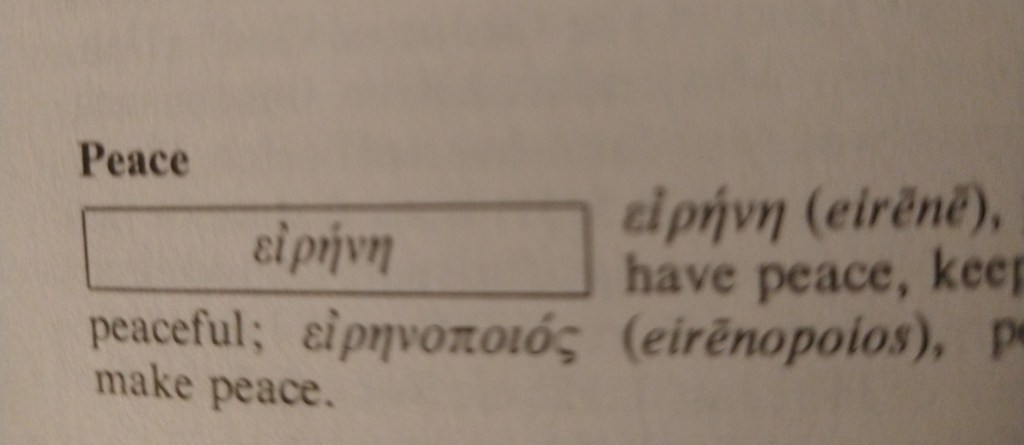
The Greek also has different words that have been translated “peace”.  The word used most often in the New Testament, and the word I find in the Septuagint in my study passage, is eirene (G1515).  This word means “peace, prosperity, quietness, rest, to set at one again” and the Strong’s suggests it comes from the primary verb eiro which means “to join”.  Related to eirene and also translated “peace” are the words eirenopoios (G1518) and eirenopoieo (G1517).  Eirenopoios means “pacificatory, peaceable, peace maker” and eirenopoieo means “to harmonize, make peace.” 

There are four Greek words for “holding one’s peace”.  The first is siopao (G4623) which means “silence, muteness” but is an involuntary stillness or inability to speak.  This word is contrasted with sige (G4602) which is a refusal to speak but sige doesn’t appear in the Strong’s list.  Sigao (G4601) which comes from sige does and means, “to keep silent”.  Phimoo (G5392) appears in Mark 1:25 and Luke 4:35 and means “to muzzle”.  Hesuchazo (G2270) appears in Luke 14:4 where it is translated “held their peace” or “kept silent”.  Jesus has asked the lawyers and Pharisees, “Is it lawful to heal on the Sabbath?” and they kept silent.  The word hesuchazo does mean “to keep still” but this stillness is in the sense of refraining from labor, meddlesomeness of speech, rest.

I find all of this riveting.  It’s not like I don’t know what these passages mean when I read them in English and read the word “peace”: I can glean the meaning from the context.  And yet, I am missing subtleties by not knowing all of these are different Greek and Hebrew words with unique meanings.  Does it really matter?  I think it does.  I have seen written and heard said that scripture “means exactly what it says”.  I have also heard the word “infallible” used when it comes to scripture.  I cannot commit myself to agree with those who claim the aforementioned until I know exactly what they mean.  If they are referring to their English translation, I have to disagree.  Not that I do not value my English translation: I do and I enjoy reading it.  My quibble comes when dogmatic statements are made based on the English translation when it does lack the subtlety and precision of the Hebrew, Greek, and even Aramaic.

Last week I mentioned Jeff A. Benner and his YouTube channel.  In a few of the videos I’ve watched, he puts up a picture of a fast food meal and another of a steak dinner.  He asks if he were to invite us to dinner, which would we choose?  He then compares reading a translation of scripture to the fast food meal and reading it in the original language to the steak dinner.  Both will fill you up and satisfy hunger, but which would you prefer?

As I study, I find I agree.  I have used the word “peace” in all of its meanings throughout my life.  I’ve read scripture and had an intellectual grasp of what the passages meant when I read “peace”.  I understand but it’s a surface understanding and is like a fast food meal: something I’ve grabbed on the run because I don’t have the time to prepare a meal and sit down to consume it.  It satisfies at the moment but is not all the food there is and, stretching this analogy further, a diet of fast food is unhealthy. Studying, questioning, and looking up the different words and their meanings: this feels like the steak dinner with the trimmings (or a lovely lentil and vegetable meal for my vegetarian friends).  It’s not the word consumed on the run but it’s me taking the time to savor the different flavors and textures.  

What about those who cannot study the ancient languages, for whatever reason? I am so grateful for the opportunities I have to study but nothing compares to being in the presence of the risen and ascended Lord Jesus Christ. The best meal of all is the one we partake of in and by the Holy Spirit living and working inside of us. There is no better food than that which comes directly from the hand of He who made it.   

As I move forward in my study, I will be focusing on shalom and eirene, exploring beneath the definitions and usage, and seeing what can be unearthed.  I have seen eirene coming from eiro means “to join” and here I finally see the idea of “to fasten” found in the dictionary.  I am curious if I’ll find the same idea in shalom. 

To be continued…

References

The Holy Bible, New King James Version, Thomas Nelson Publishers, Nashville, Tennessee, 1982

Guralnik, David B., Webster’s New World Dictionary of the American Language, Second College Edition, William Collins + World Publishing Co., Inc., Cleveland•New York, 1970, 1976

Rodale, J.I., The Synonym Finder, Warner Books, Rodale Press, Inc., Emmaus, Pennsylvania, 1978

Strong, James, LL.D., S.T.D., The New Strong’s Exhaustive Concordance of the Bible, Thomas Nelson Publishers, Nashville, Tennessee, 1990

Share this:

  • Click to print (Opens in new window) Print
  • Tweet
  • Click to email a link to a friend (Opens in new window) Email
  • Share on Tumblr
Like Loading...

Interlude

07 Monday Feb 2022

Posted by Kate in Poetry, Writing

≈ Leave a comment

Tags

Christ in Me, Christ Life, Christian Life, Christian Writer, Holy Spirit, Indwelling Spirit, Inspiration, Inspired Poetry, Poem, Poems about Jesus, Poet, Poetry

Photo by Walter Strong
Interlude
I went out walking
Late at night
The moonlight
Was so bright
My shadow walked beside me.
I needed time for thinking
And I sought
A good spot
But I could not
Make out the stars above me.
Too many lights glowing
Mankind's tries
To lighten skies
Blinding my eyes
To the beauty I might see.
It set me wondering
Of thoughts enshrined
By a Darkened Mind
In attempt to find
An image of who we might be.

If You're a sun burning
Living Fire
We can desire
But would expire
If we dared to approach You;
Are we the moon hanging
High overhead
Utterly dead
Our light instead
One that is endued?
Or are we stars shining
Containers of light
Pinpricks in the night
Scattered but bright
Each with our own hue?

I see the day dawning
No more night
To our sight
You the light
The only one we can see.
A glimmer of understanding
What is true
Us made anew
An image of You
Our light born in unity.

Haste this Day's coming
With all restored
In one accord
And You adored
O, Great Father of lights!


Share this:

  • Click to print (Opens in new window) Print
  • Tweet
  • Click to email a link to a friend (Opens in new window) Email
  • Share on Tumblr
Like Loading...
← Older posts
Newer posts →

Categories

Featured Posts

Isaiah 45:7

When Tradition and I Part Ways

Keep reading
Kate's avatar by Kate November 28, 2022April 28, 2024
Gospel and Letters of John

A New Heart

Keep reading
Kate's avatar by Kate December 7, 2020March 14, 2021
Studies

The Way He Has Made

Keep reading
Kate's avatar by Kate August 7, 2023August 6, 2023

Enter your email address to subscribe to this blog and receive notifications of new posts by email.

Join 210 other subscribers
Follow Renaissance Woman on WordPress.com

Follow Me on Facebook

Follow Me on Facebook

Meta

  • Create account
  • Log in
  • Entries feed
  • Comments feed
  • WordPress.com

Blog at WordPress.com.

  • Subscribe Subscribed
    • Renaissance Woman
    • Join 169 other subscribers
    • Already have a WordPress.com account? Log in now.
    • Renaissance Woman
    • Subscribe Subscribed
    • Sign up
    • Log in
    • Report this content
    • View site in Reader
    • Manage subscriptions
    • Collapse this bar
 

Loading Comments...
 

You must be logged in to post a comment.

    %d