
• About Me
  • Study Links

Renaissance Woman

~ Test All Things; Hold Fast What is Good-1 Thessalonians 5:21

Renaissance Woman

Category Archives: Studies

Safe From Harm

10 Monday Jul 2023

Posted by Kate in Studies, Whole Armor of God

≈ Leave a comment

Tags

Bible Study, Defense, God my Defender, Indwelling Spirit, Life in the Spirit, Protected, Refuge, Spiritual Warfare, Victory, Whole Armor of God

Hello and welcome-or welcome back-to Renaissance Woman where, this week, I am continuing my study on the Whole Armor of God.

The passage I am studying is Chapter Six verses 10-18a of Paul’s Epistle to the Ephesians.  The New King James Version of the Bible renders these verses as: “Finally, my brethren, be strong in the Lord and in the power of His might.  Put on the whole armor of God, that you may be able to stand against the wiles of the devil.  For we do not wrestle against flesh and blood, but against principalities, against powers, against the rulers of the darkness of this age, against spiritual hosts of wickedness in the heavenly places.  Therefore take up the whole armor of God that you may be able to withstand in the evil day, and having done all, to stand.  Stand therefore, having girded your waist with truth, having put on the breastplate of righteousness, and having shod  your feet with the preparation of the gospel of peace; above all, taking the shield of faith with which you will be able to quench all the fiery darts of the wicked one.  And take the helmet of salvation, and the sword of the Spirit, which is the word of God; praying always with all prayer and supplication in the Spirit…”

There is a vast amount of subject matter in this passage.  I needed a starting place and while I was meditating on this passage and listening for what would resonate with me, I listened to Malcolm Smith’s teaching Spiritual Warfare.  The study series focuses on the Armor of God and, in the first hour, Mr. Smith said two things.  The first was that Paul was looking at a Roman Soldier when he wrote this epistle but it was not a soldier readying himself to go onto the battlefield but one prepared to defend.  The second thing Mr. Smith said was the Whole Armor of God is God Himself.  Mr. Smith quoted Isaiah 59:17: “For He put on righteousness as a breastplate, and a helmet of salvation on His head; He put on the garments of vengeance for clothing, and was clad with zeal as a cloak” and made the point that, as God is Spirit and doesn’t need to wear a breastplate, helmet, garments, or a cloak, this passage is describing His attributes in images the human mind can understand.

I agree with Mr. Smith’s points.  One reason is because of this verse in Be Thou My Vision (one of my favorite hymns!): “Be Thou my breastplate, my sword for the fight, be Thou my whole armor, be Thou my true might, be Thou my soul’s shelter, be Thou my strong tower, Oh raise Thou me heavenward, great power of my power.”  I realized what Mr. Smith was saying was not a new concept: that God Himself was our armor and protection was a truth I was singing on an almost daily basis without giving any real thought to the words. 

A second reason is how seamlessly the whole armor of God being God Himself flows into the idea of defense*.  I was curious about the Hebrew and Greek words for “defense” and “defend” so I looked them up in the Strong’s concordance.  I was not at all surprised to find multiple words-more in the Hebrew than the Greek-translated as “defense” and “defend”.  I did think it significant that “defense” is used exclusively for one Hebrew word throughout the Psalms.  It is also translated once as “defense” in Isaiah.  This word is misgab (H4869) and means “a cliff or other lofty or inaccessible place, altitude, a refuge, defense, high fort or tower”.   

For example, misgab appears three times in Psalm 59: “I will wait for You, O You his Strength; for God is my defense…But I will sing of Your power; Yes, I will sing aloud of Your mercy in the morning; for You have been my defense and refuge in the day of my trouble.  To You, O my Strength, I will sing praises; for God is my defense, My God of mercy” (verses 9, 16, 17).  The passage in Isaiah says, “He will dwell on High; His place of defense will be the fortress of rocks; Bread will be given him, His water will be sure” (Isa. 33:16). 

God as our defense is something I want to look at in more detail so, for the sake of this post, I will move on to my third reason for agreeing with Mr. Smith.  This is the presence of the little Greek word του (pronounced too) which appears in this passage.  It is often translated as “of” but the word means “of this person, his”.  I suppose the fact the Whole Armor of God is spiritual is an obvious one.  Still, how we think of the Whole Armor of God meaning something belonging to Him or His as an attribute, is important.  There is a story in 1 Samuel where David is going to face Goliath and King Saul gives the young man his armor to wear.  David could not walk in the armor and had to remove it before facing the enemy (See 1 Samuel 17:32-40).

The Whole Armor of God is not like that of King Saul.  It is not a spiritual armor that belongs to God that He loans to believers in order to help us face an enemy and we make the best use of it as we can.  Looking at the armor as God Himself protecting, defending, and strengthening us for the fight is important because then we can see the armor is exactly suited to us and our situation.  Jesus has partaken of our flesh and blood.  He is not unable to sympathize with us but has been tested in every respect the same as us (Hebrews 4:15).  In Him we live and move and have our being which means He is not only our armor protecting and defending us but His life in us imparts the power and might we need to be able to stand.

I see what I can only describe as a disconnect in my fellow believers.  I see my precious brothers and sisters exhausting themselves fighting battles; ones which, tragically, they seem to have no hope of winning.  They appear to have forgotten that every aspect of our Christian lives flows out of God Himself.  I found a passage in Steve McVey’s book Grace Walk which describes the state of a great many Christians today: “In the natural world, trying harder is commendable and often effective.  But God’s ways aren’t our ways.  Sometimes they seem to be opposite from ours.  In the spiritual world, trying harder is detrimental.  That’s right.  Trying harder will defeat you every time. 

“No Christian has a problem with the previous paragraph as it relates to salvation.  If an unsaved person were to suggest to you that he was trying hard to become a Christian, what would you tell him?  You would probably make it clear that he could not be saved by trying, but by trusting.  You would tell him that there is absolutely nothing he could do to gain salvation.  It has all already been done.  Salvation is a gift to be received, not a reward to be earned.  A person who tries even a little bit to gain salvation by works cannot become a Christian.  As Paul said about salvation, “If by grace, then it is no longer of works; otherwise grace is no longer grace.  But if it is of works, it is no longer grace; otherwise work is no longer work” (Romans 11:6).  In other words, it has to be either grace or works.  We are saved by grace and, and trying hard has absolutely nothing to do with it.

But many Christians who understand that trying is detrimental to becoming a Christian somehow think that it is essential to living in victory after salvation.  The truth is that victory is not a reward but a gift.  A person does not experience victory in the Christian life by trying hard to live for God.  It just won’t work!” (McVey, page 18).

When he was explaining why he thought Paul’s description of a defending rather than attacking soldier important, Malcolm Smith said our spiritual warfare is an odd one because we are not fighting to defeat an enemy or claim ground.  We stand in Christ’s victory and conduct our warfare from the security and steadfastness we have in Jesus Christ Himself.  So real is His victory that, borrowing again from the Apostle Paul, we do not fight like those who beat the air (1 Corinthians 9:26).

I hope to take a more extensive look at this in the upcoming weeks.  Until next week, “Finally, my brethren, be strong in the Lord and in the power of His might…that we may be able to withstand in the evil day.” 

Amen.

*The Strong’s has “defence” rather than “defense”.  I will continue to use the spelling “defense”.

Unless noted otherwise, all Scriptures are quoted from The Holy Bible, New King James Version, Thomas Nelson Publishers, Nashville, Tennessee, 1982

References

Be Thou My Vision | Hymnary.org

Unconditional Love Fellowship – Ministry of Malcolm Smith

Green, Jay P., The Interlinear Greek-English New Testament, Volume 4, Revised Second Edition, Authors For Christ, Inc., Lafayette, Indiana, 2007

McVey, Steve, Grace Walk, Harvest House Publishers, Eugene, Oregon, 1995

Strong, James, LL.D., S.T.D., The New Strong’s Exhaustive Concordance of the Bible, Thomas Nelson Publishers, Nashville Tennessee, 1990

Share this:

  • Print (Opens in new window) Print
  • Tweet
  • Email a link to a friend (Opens in new window) Email
  • Share on Tumblr
Like Loading...

A Quality of Life

03 Monday Jul 2023

Posted by Kate in Studies, Whole Armor of God

≈ Leave a comment

Tags

Bible Study, Christ in Me, Darkness and Light, Hearing the Word, Indwelling Spirit, Self-Talk, Spiritual Warfare, Whole Armor of God

This post marks the first in my new study series on the Whole Armor of God as described in the 6th chapter of Paul’s Epistle to the Ephesians.  The Armor is mentioned twice in this chapter.  In verse 11 we are instructed to put on the whole armor of God and in verse 13 we are instructed to take up the whole armor of God.  The words translated “put on” and “take up” are different in the Greek and I plan to take a look at them later in the study.  But where to begin? 

Despite it being the first mention of the Full Armor of God, picking up the study in Ephesians 5:11 felt like I was beginning in the middle of a thought.  While the entire Epistle is important to my understanding of the verses I will focus on, I decided on verse 10 as my starting point:  “Finally, my brethren, be strong in the Lord and in the power of His might.”  The latter half of that passage, “be strong in the Lord and in the power of His might” has been foremost in my mind over the past week.  They have taken on a special meaning for me as I have watched my backyard bloom.

In a previous post titled “Being Indestructible”, I told the story of my Mom rescuing some cactus pieces that had been uprooted and left lying by the side of the road.  Those cactus pieces have not only survived but thrived and the title of that older post was apt: they are all but indestructible.  At the writing of that pervious post, my stepdad had VERY carefully trimmed pieces of the abundant cactus and scattered them around the base of the tree to prevent wildlife from using the spot as a bathroom.  I watched and waited to see what these pieces would do.  Would they too, take root and thrive like their parent plant or would they wither and die?  The answer is, both.  Some have withered and died but others have taken root and are beginning to grow and thrive.

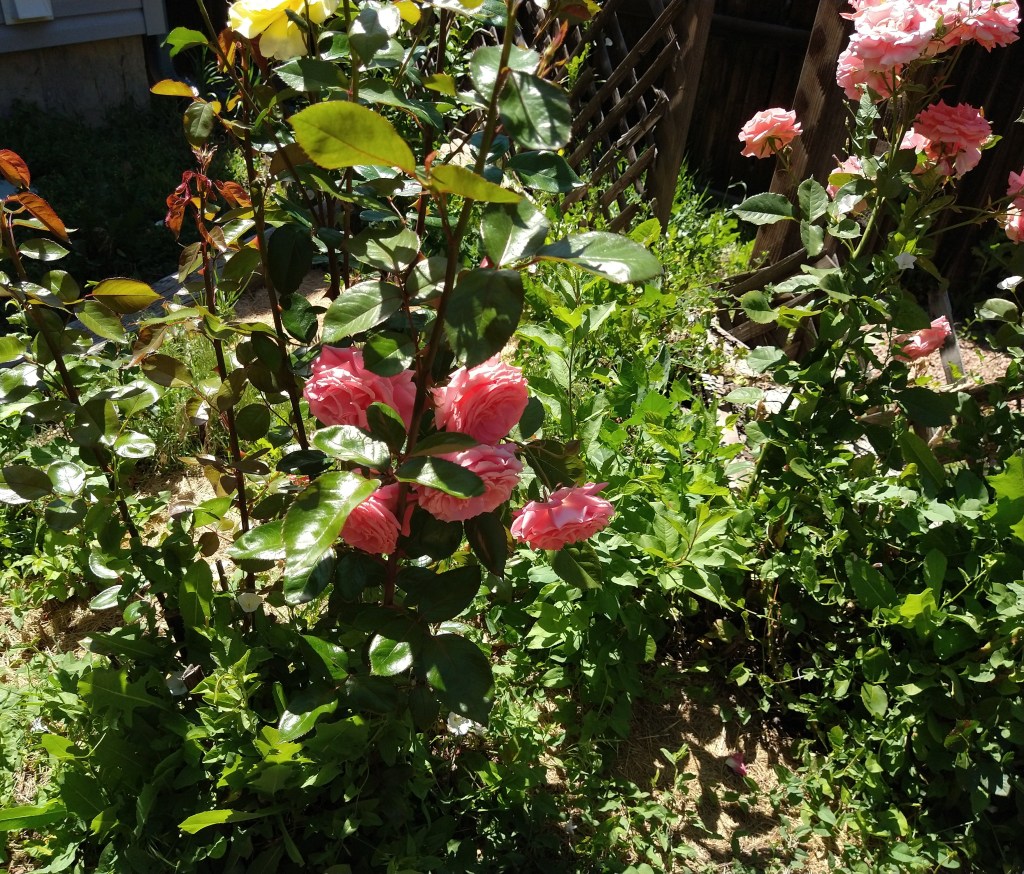
Just a few weeks ago, my stepdad was back at work in the backyard this time trimming my Mom’s rosebushes.  The bushes were thought to be dead and my stepdad was ruthless in his pruning.  His ruthlessness paid off because the bushes erupted in the most gorgeous blooms.  There was life in them after all.  As I spent last week preparing myself for what I hope will be an in-depth study on the Whole Armor of God, I meditated on the words from verse 10 and thought about the cactus and the roses.  Here they both were bursting with life when there was no reason to think life was in them.  It made me realize how our Christian lives were like that: circumstances might not appear suited to sustain life but we have a life within us that can never die.

This is a truth that must not only be guarded but kept in the forefront of our minds.  Over recent weeks I had been aware of, but hadn’t been paying close attention to, the effect the goings on in the world around me was having on my mental health.  It all came to a head when a particular headline brought me to tears and I realized how I was feeling.  I was angry and sad.  I was terribly afraid particularly that my loved ones were going to suffer.  I had no hope for any sort of future.  After all, terrible things had happened in the past so what was to stop the atrocities of history from being repeated?  I despaired.  The darkness was too vast and too powerful and there was no hope of standing against it.  The moment I realized the state of mind that had crept up on me, I had to act.

Fortunately, I have walked with the Lord Jesus Christ for years now and knew what to do.  First, I needed to be alone with Him with no other voices to distract me.  Second, I needed to give myself a good talking to.  Who was my God?  Did I really believe the darkness was anything compared to Him?  Of course not!  But, I had been bombarded by words which had no life in them and I needed to counteract them with words full of truth and life.  Words like John 1:5; “And the light shines in the darkness, and the darkness did not comprehend it”, and Paul’s prayer in Ephesians 1:

“Therefore I also, after I heard of your faith in the Lord Jesus and your love for all the saints do not cease to give thanks for you, making mention of you in my prayers: that the God of our Lord Jesus Christ, the Father of glory, may give to you the spirit of wisdom and revelation in the knowledge of Him, the eyes of your understanding being enlightened; that you may know what is the hope of His calling, what are the riches of the glory of His inheritance in the saints, and what is the exceeding greatness of His power toward us who believe, according to the working of His mighty power which He worked in Christ when He raised Him from the dead and seated Him at His right hand in the heavenly places, far above all principality and power and might and dominion, and every name that is named, not only in this age but also in that which is to come” (Verses 15-21).

As I quoted Paul’s beautiful prayer, my mind grasped hold of the words “in the knowledge of Him,” and I remembered another prayer of Paul’s in the same epistle: “For this reason I bow my knees to the Father of our Lord Jesus Christ from whom the whole family in heaven and earth is named that He would grant you, according to the riches of His glory, to be strengthened with might through His Spirit in the inner man, that Christ may dwell in your hearts through faith; that you, being rooted and grounded in love, may be able to comprehend with all the saints what is the width and length and depth and height-to know the love of Christ which passes knowledge; that you may be filled with all the fullness of God” (Ephesians 2:14-19). 

I do not think the importance of the knowledge of God can be understated.  Knowing Him is the very definition of eternal life (John 17:3, 1 John 5:20).  The weapons of our warfare are wielded against every argument and high thing that exalts itself against the knowledge of God (2 Corinthians 4-5).  I recently finished reading Andrew Murray’s Commentary on the Book of Hebrews and wanted to share something he wrote on the importance of knowing God:

“’Consider…Jesus.’ The one sure and effectual remedy the epistle offers for all the prevailing feebleness and danger of the Christian life, we know.  It has been said to us, “You do not know Jesus aright.’  The knowledge that sufficed for conversion does not avail for sanctification and perfection.  You must know Jesus better.  Consider Jesus!  As God!  As the Man!  In His sympathy! In His obedience!  In His suffering!  In His blood!  In His glory on the throne; opening heaven; bringing you in to God; breathing the law of God and the Spirit of heaven into your heart as your very life!  As little as you can reach heaven with our hand can you, of yourself, live such a heavenly life.  And yet, it is possible because God has borne witness to the Gospel of His Son with the gift of the Holy Spirit.  The Priest-King, on His ascension to the throne, sent down the Holy Spirit into the hearts of His disciples and, with Him, returned Himself to dwell in those who, in the power of His heavenly life, they might live with Him.  Consider Jesus, and you will see that you can live in the heavenlies with Him because He lives in you!” (Murray, 566)

That truth, that we are now seated with Jesus in heavenly places, is one of the most powerful weapons in our arsenal.  God, rich in mercy and because of His great love with which He loved us has made us alive together with Christ, raised us up together, and made us sit together in the heavenly places in Christ Jesus (Ephesians 2:4-6).  All authority in heaven and earth is His (Matthew 28:18) and anything the darkness might say to the contrary is a lie.

I was talking to my Mom about all of this and she described a video she’d seen which I think is a wonderful picture of what I am trying to say: a woman was painting her wall but there was a stain on it.  It didn’t matter how many coats of paint she used, she could not paint over that stain and her frustration grew.  Then, the camera pulls back and it’s revealed the stain is actually a shadow.  There is a staircase across the room and, because of how the light strikes, the shadow of the bannister is cast on the wall.  There is nothing there to paint over.

The darkness is like that.  Like the banister, it is very real.  However, there was no stain and nothing prohibiting the woman from completing the work that had been put in her hand to do: the stain was an illusion.  Being powerless against the darkness is also an illusion.  We do not have any ability when we rely on our own strength but we are strong in the Lord and in the power of His might. 

This is, I think, where Spiritual Warfare begins.  The Kingdom of God is within us and that is also where the battle rages.  It is a battle for the mind and part of the fighting of it is speaking the truth out loud to ourselves so our ears hear them.  Darkness covers the earth and gross darkness the people but we see Jesus.  He is the strength of our lives.  It doesn’t matter where we might be scattered or what our lives look like to an outside observer: Christ lives in us and His life is endless and indestructible.  Therefore, I will not fear!

Unless noted otherwise, all Scriptures are quoted from The Holy Bible, New King James Version, Thomas Nelson Publishers, Nashville, Tennessee, 1982

Read about the cactus here:

https://renaissancewoman.blog/2021/06/28/being-indestructible/

References

Murray, Andrew, Holiest of All: A commentary on the Book of Hebrews, Whitaker House, New Kensington, PA, 1996, 2004, Page 566

Share this:

  • Print (Opens in new window) Print
  • Tweet
  • Email a link to a friend (Opens in new window) Email
  • Share on Tumblr
Like Loading...

With Perfect Hatred

26 Monday Jun 2023

Posted by Kate in Studies, Walking in the Way

≈ Leave a comment

Tags

Bible Languages, Biblical Hebrew, Heart of God, Indwelling Spirit, Kingdom of God, Kingdom of Heaven, Love and Hate, Loving kindness

Image by Egonetix_xyz from Pixabay

Hello Readers and welcome-or welcome back-to Renaissance Woman where, this week, I am taking another look at the Hebrew word sane (saw-nay) which is often translated in scripture by the English word “hate”.

An interesting passage in Psalm 139 kicked off this study.  I read in verses 21-22: “Do I not hate them, O Lord, who hate You?  And do I not loathe those who rise up against You?  I hate them with perfect hatred; I count them my enemies.”  King David appears to be saying his hate is a good thing and something that honors God.  How can this be especially since the words of Jesus in Luke 6 conflict?  “Love your enemies,” Jesus instructs.  “Do good to those who hate you, bless those who curse you, and pray for those who spitefully use you” (Luke 6:27-28).  I do not believe the Bible contradicts itself.  I believe when and if passages appear to contradict each other, it is my understanding that is incomplete.  What then, did I understand about hate?  Was there ever a time when hate might be considered a good thing?  What is meant by “perfect hatred?”

The definition of “hate” in my New World Dictionary didn’t help in my attempt to find an answer.  The English word hate means “to have strong dislike or ill will for, loathe, despite, bear malice toward.”  I read through some scriptures containing the word sane and it did seem as though that definition was accurate.  Consider these passages:

Deuteronomy 19:11: “But if anyone hates his neighbor, lies in wait for him, rise against him and strikes him mortally, so that he dies…”

1 Kings 22:8 (also 2 Chronicles 18:7): “so the king of Israel said to Jehoshaphat, ‘There is still one man, Micaiah the son of Imlah, by whom we may inquire of the Lord; but I hate him, because he does not prophesy good concerning me, but evil.’”

Psalm 25:19: “consider my enemies, for they are many; And they hate me with cruel hatred.”

Psalm 41:7: “All who hate me whisper together against me; Against me they devise my hurt.”

Each one of these passages, and others like them, appear to bear up the definition of “ill will, strong dislike, malice” and it is obviously not considered to be a good thing. But then, in contrast to each one of these passages, there are others where sane/hate is considered to be a good thing.  Consider:

Psalm 97:10: “You who love the Lord, hate evil!”

Psalm 101:3: “I will set nothing wicked before my eyes; I hate the work of those who fall away; It shall not cling to me.”

Proverbs 8:13: “The fear of the Lord is to hate evil; Pride and arrogance and the evil way and the perverse mouth I hate.”

Ecclesiastes 3: 1, 8: “To everything there is a season…a time to love and a time to hate.”

As I have studied the Hebrew word sane, I have found various scholars who say “hate” is not an appropriate choice to translate sane.  A better one would be “reject” or “turn aside.”  I read through the Strong’s concordance listing of scriptures containing sane with that definition in mind and…okay; I can see where that definition might be appropriate.  And yet I am not satisfied.  Few of the passages accurately represented what I think of when I hear the word “reject” in that the ones “hated” were not ostracized or left utterly alone. 

One article I came across said something that struck me and which I have been pondering all this week.  The article is posted on the Light of the World blog and says, “The original Hebrew Picture shows us what Hate does, not how it feels.”  The author quotes Psalm 139:22 and says, “Our English definition of Hate does make it appear that King David Detests, abhors, and Despises, בוז Buz his enemies.”  She then quotes Proverbs 14:21 which says, “But he who despises his neighbor sins; But he who has mercy on the poor, happy is he.”  The author points out, “He (King David) would have known that it is Sin to Despise your Neighbor because it missed the Mark of the Commandment to Love your Neighbor: ‘You shall not take vengeance or bear a grudge against the sons of your own people, but you shall Love your Neighbor as yourself: I am YHVH’ Leviticus 19:18.  This means שנא Sane cannot include the emotion of Despising anyone.  In context, we see that he parallels Turning Aside, סור Sur, With Hate, שנא Sane, Psalm 139:19.” 

 The Light of the World blog compares Exodus 20:12, “Honor your Father and Mother” with Luke 14:26, “If anyone comes to Me and does not Hate his Father and Mother…”  The author writes, “Apparent contradictions like this one should alert us to our misunderstanding of the original meaning.  With the meaning of Hate being to Turn Aside, it is possible to Honor our parents, while Turning Aside From the lies they have inherited, in order to Obey the Commandments of our Eternal Creator.”

I can see how defining sane as “to turn aside” could work and yet it doesn’t entirely fit especially when it comes to God.  His promise to never leave nor forsake stands and His turning aside never meant utter abandonment.  As I look at the Hebrew letters comprising sane which are ש Sin נ Nun and א Aleph, I see the picture of a fire rooted and emerging from God.  The ש Shin carries the meaning of a process of destruction and consumption until completion.  Hebrews 12:29 states “our God is a consuming fire” and I am convinced the love and hate of God are two aspects of the fire that He is. 

There is an idea circulating that the love of God is this saccharine thing: that He is some ancient drooling entity confined to a celestial rocking chair where He bestows vacant grins on His children and just loves them.  No.  He is alive and passionate and because He loves so utterly and completely, He hates.  Last week I quoted a bit of Romans 2 from the Message and I like how this is rendered: “God is kind, but he’s not soft.  In kindness he takes us firmly by the hand and leads us unto a radical life-change” (MSG).  Hebrews 12:5-6 quotes Proverbs 3: 11-12 saying, “My son, do not despise the chastening of the Lord, Nor be discouraged when you are rebuked by Him; for whom the Lord loves He chastens, and scourges every son whom He receives.”  There is a dark side to the love of God, for lack of a better word.  Certainly there are experiences that don’t feel all that great but they can be endured because we know He loves us and the consuming fire that He is only destroys those things that would hinder us from growing into His image.  The ש Shin is a comfort here in that the process repeats itself over and over.  In His love and mercy, He doesn’t burn through our lives all at once.  He is, above all things, agape and His lovingkindness endures forever.

As creatures made in the image of God, we are capable of hate and it is right that we are.  Hate burns within us when we see a loved one suffering from a disease or when we see pain and injustice.  Hatred burns within as a “No!  These things shall not be!”  That fire within us burns the apathy out of us and we are roused to take action.  I think hatred only becomes a bad thing when it causes us to sin and fall short of the glory of God.  I think of the Apostle Paul’s letter to the Ephesians where he quotes Psalm 4:4; “’Be angry and do not sin’: do not let the sun go down on your wrath, nor give place to the devil” (Ephesians 4:26-27). 

It is so important that we realize that God, in his ultimate hatred, cried “No!  These things shall not be!” and that this hatred looks like Jesus. “For God so loved the world, He gave His only begotten Son, that whoever believes in Him should not perish but have everlasting life.  For God did not send His Son into the world to condemn the world, but that the world through Him might be saved” (John 3:16-17).  What did Jesus do?  “…once, at the end of the ages, He has appeared to put away sin by the sacrifice of Himself” (Hebrews 9:26).  Jesus Christ is “Himself the propitiation for our sins, and not for ours only but also for the whole world” (1 John 2:2).  “…For this purpose the Son of God was manifested, that He might destroy the works of the devil” (1 John 3:8) and “through death He might destroy him who had the power of death, that is, the devil” (Hebrews 2:14). 

The cry of “It is finished” heard from the cross echoes through the ages.  It was the ultimate victory and it is now made a reality in our lives through the processings we experience.  We know these processings are not to utterly destroy us but are necessary so that Jesus Christ present us, The Church, to Himself not having any spot or wrinkle but are presented holy and without blemish (See Ephesians 5:27).  We embrace the consuming fire that He is knowing when He has tried us we shall come forth as gold!

Just as He is so are we in this world.  We have the same mind in us that was in Christ Jesus (See Philippians 2:5) and therefore, because Jesus Christ is alive in us, we love as He love and hates as He hates.  We hate with perfect hatred.  We go out into the world and we make war.  What is crucial to remember is “we wrestle not against flesh and blood but against principalities, against powers, against the rulers of the darkness of this age, against spiritual hosts of wickedness in the heavenly places” (Ephesians 6:12).  It is also crucial to remember we do not conduct our warfare after the way of this world.  “For though we walk in the flesh, we do not war according to the flesh.  For the weapons of our warfare are not carnal but mighty in God for pulling down strongholds, casting down arguments and every high thing that exalts itself against the knowledge of God, bringing every thought into captivity to the obedience of Christ” (2 Corinthians 10:4-5).

We seek to know Him as we are known and then, with our confidence in the finished work of Jesus Christ, we take up the full armor of God.

Unless noted otherwise, all Scriptures are quoted from The Holy Bible, New King James Version, Thomas Nelson Publishers, Nashville, Tennessee, 1982

Scripture notations marked MSG are taken from THE MESSAGE, copyright © 1993, 2002, 2018 by Eugene H. Peterson.  Used by permission of NavPress.  All rights reserved.  Represented by Tyndale House Publishers, Inc.

Quotes in this post are taken from the Light of the World blog at:  Hate (Sane), the Ancient Hebrew Meaning – Light of the World (wordpress.com)

References

Guralnik, David B., Webster’s New World Dictionary of the American Language, Second College Edition, William Collins + World Publishing Co., Inc., Cleveland • New York, 1972, 1976

Haralick, Robert M., The Inner Meaning of the Hebrew Letters, Jason Aronson Inc., Northvale, New Jersey, 1995

Peterson, Eugene H., The Message: The Bible in Contemporary Language, NavPress, The Navigators, Colorado Springs, Colorado, 1993, 2002, 2018

Strong, James, LL.D., S.T.D., The New Strong’s Exhaustive Concordance of the Bible, Thomas Nelson Publishers, Nashville Tennessee, 1990
Share this:

  • Print (Opens in new window) Print
  • Tweet
  • Email a link to a friend (Opens in new window) Email
  • Share on Tumblr
Like Loading...

No Field Lies Fallow

05 Monday Jun 2023

Posted by Kate in Studies

≈ Leave a comment

Tags

Christian Life, Double-Minded, Holy Spirit, Indwelling Spirit, Kingdom Life, Kingdom of God, Kingdom of Heaven, Truth

Image by Marion from Pixabay

Hello, Readers, and welcome to a new post on Renaissance Woman!

I ended last week’s post by asking how did all I had said in that post relate to the Parable of the Wheat and the Tares?  If you have not read last week’s post, A Vast Inheritance, I recommend doing so before continuing on.  If you are ready for my answer to that question, my answer is “Fruit”.  More specifically, the life of Jesus Christ manifested in us His people of which “fruit” in the scriptures is representative.

Let me explain.

First, I must review some bits of Dora Van Assen’s interpretation of this parable which kicked off my study.  Ms. Van Assen points out Matthew 13:35 quotes Psalm 78:2 saying, “I will open My mouth in parables; I will utter things kept secret from the foundation of the world”.  It is her conviction that, in the Parable of the Wheat and the Tares, Jesus is describing what happened in the Garden of Eden when sin entered into the plan of God.  Ms. Van Assen says the wheat in the parable represents the good thoughts and spiritual understanding planted in the mind of Adam by the Spirit of God while the tares represent evil thoughts and carnal understanding sown into the mind of Adam by the Adversary.  Ms. Van Assen goes on to say these two types of thoughts caused a duality within the mind of Adam which led him to fall into a carnal mind.  This dual mind was capable of bringing forth a harvest of a certain kind of man.  Ms. Van Assen stresses that the “battlefield is in the mind!” (See Kingdom Bible Studies article linked below).

I’ve been meditating on this for weeks now and a passage in James came to the forefront of my mind: “If any of you lacks wisdom, let him ask of God, who gives to all liberally and without reproach, and it will be given to him.  But let him ask in faith, with no doubting, for he who doubts is like a wave of the sea driven and tossed by the wind.  For let not that man suppose that he will receive anything from the Lord; he is a double-minded man, unstable in all his ways” (James 1:5-8).

This has always been a difficult passage for me to understand although I have obeyed the command in it and asked God for wisdom.  I am convinced the wisdom we need is immediately ours, after all it is the Spirit of Wisdom and Revelation who lives in us.  And yet, I am also convinced that, in some cases; that wisdom takes time to be fully realized.  Like building a house, strong foundations must first be laid.  That was my experience with this passage.  There have been glimmers of understanding as I have studied other passages and then, during the weeks of this study on The Parable, I came across a teaching by Don Keathley called “You Ain’t Double-Minded”.  I was instantly uncomfortable because that title seemed to be refuting the Book of James but I was also curious.  I clicked the link. (It’s excellent: I’ve linked Part One below)

Within the first few minutes, Mr. Keathley said something that grasped my attention.  He was describing the Garden of Eden and the various trees growing in it, especially the Tree of Life and the Tree of the Knowledge of Good and Evil.  He pointed out there was only one Garden.  There were two Trees growing in it but they grew together in the same Garden.  This is the same picture as both wheat and tares growing in the same field and it made me wonder just what “double-minded” really meant in the Greek.

The Greek word used in James 1:8 is dipsuchos (G1374) and means “two-spirited, vacillating (in opinion or purpose), double-minded”.  The word is formed of dis (G1364) meaning “twice, again” and psuche (G5590) which means “breath, spirit, life, mind, soul”.  The Greek Lexicon of the New Testament defines it as “double-headed people who stagger helplessly here and there in their thinking” and “to be uncertain about the truth of something, doubting, hesitating.” 

 I have heard this passage used against those who doubt their belief in God.  The encouragement is to trust your leader and don’t ask questions.  I am convinced this is not what James is saying.  He begins his sentence with “if anyone lacks wisdom let him ask of God”.  A knowing and trusting of God must already be in place before anyone dares ask Him anything and that knowing and trusting is what James is telling us not to doubt. If we carry around false ideas of who God is and do not think He is trustworthy, odds are we won’t ask Him anything at all. If we did, how could we possibly receive anything from Him because, would we even recognize it? It all comes down to which spiritual influences we are allowing to sow seeds in the fields of our minds.  We must take care because there are many false ideas of who God is and many willing and waiting to sow those ideas in our minds. 

The Knowledge of the nature of God is what I believe is represented by the wheat and the tares.  My studies have brought me across some interesting facts about the darnel which is believed to the tare mentioned in Jesus’ parable.  The seeds of the darnel are poisonous.  Small quantities do actually have some medical benefit and have been used internally to treat dizziness, insomnia, and stomach problems and externally as a poultice to treat skin problems like shingles and ulcers.  The official name of the darnel, L. temulentum comes from a Latin word for “drunk” and, although bread made with darnel seed mixed with wheat is bitter to the taste, both bread and beer have been made with darnel deliberately included to give a special kick.  It’s a dangerous seed to play with though consumption of the darnel in greater quantities causes some of the same symptoms it has been used to treat and can be deadly.  It is a soporific poison causing a sleep that results in death.  It can also cause convulsions leading to death.

The seeds of the darnel are almost indistinguishable from wheat in seed form.  No one deliberately sows darnel in a wheat field and its presence in the field is often not known until the stalks produce fruit.  Then, the wheat and tares are so clearly distinguishable one from the other that a child can go into a field and separate one from the other.  When Don Keathley’s message got me thinking about the Garden of Eden, I remembered the lie used by the Serpent to deceive Eve.  It wasn’t encouragement to lie or cheat or steal or murder or drink or smoke cigarettes or anything else deemed a “sin” by various religious denominations.  The lie that brought sin into the plan of God was to believe a wrong thing about God.  The lie suggested He wasn’t trustworthy and that humankind was better off determining good and evil for themselves.  This same lie is present with us today and such false ideas about God are often difficult to discern because there is a touch of truth to them.   

A passage I’ve quoted portions of in a couple previous posts is 1 John 5.  The last verse of Chapter 5 and thus the entire Epistle, is “Little children, keep yourselves from idols.  Amen.”  Jonathan Mitchell’s New Testament renders this verse as, “Little children (born ones) keep yourselves in custody (or: guarded)!-away from the idols (the external appearances; the forms; or: = false concepts)!  Going back to the passage in James, “such a man is double-minded, unstable in all his ways.”  Keeping false ideas of God in our minds might feel good and even exciting but their fruit is death.

How do we guard ourselves from false concepts of God when the wheat and the tares in seed form are indistinguishable from each other?  How do we know whether or not the ones we are listening to are false teachers?  Jesus answered this in Matthew 7:15: “You will know them by their fruits.” 

An article I found on the Jewish Virtual Library says the darnel seed, while harmful to humans, is not harmful to birds, especially doves.  I tried to verify this with other articles and, while I did find a few that mentioned the seeds not being harmful to birds such as ducks or chickens, the original article (quoting the Mishnah in Kilayim) is the only source stating specifically the darnel seed is not harmful to doves.  I still found it interesting because it is the Holy Spirit is often represented as a dove in the Bible.  This thought brings me such comfort because, no matter how many times tares have been sown into the field of my life, they have not harmed the Spirit within me nor hindered His work in any way.

There have been many times when I have found myself in a situation where the seeds sown in the field of my life have been a mix of wheat and tares: false concepts of God that appeared to be the truth and I could not separate between the two.  At first, I could not distinguish between the fruit either and I ate of mixed bread.  There was euphoric moments I thought were proof of the moving of the Holy Spirit but these moments were always mixed with bitterness.  As I have continued to be guided by the Holy Spirit and have tasted His fruit, which is love, joy, peace, longsuffering, kindness, goodness, faithfulness, gentleness, and self-control-I quickly became able to distinguish the fruit of the tares from that of the wheat.

That is, of course, not good enough.  No field lies fallow and discerning what type of fruit is growing in the field does nothing to increase either the health of the field or the field’s yield. I want there to be no tares at all sown in the field of my life but the fact remains the seeds of one are almost indistinguishable from the other: I cannot prevent tares on my own.  No matter: the seeds of the tares do not harm the dove who is the Holy Spirit.  He is the Spirit of Wisdom and Revelation lavished upon us by a God of Love who pours out His Spirit even before we ask.  We ask knowing our God, trusting in His love, and assured that what we ask for is ours already.  He is our guide within and He alone reveals to us Jesus who is the Face of God. The Holy Spirit is the only way to distinguish the seed of the wheat from that of the tare.

He guides us into all Truth and we can trust that the One who began a good work in us will complete it until the day of Jesus Christ.

Hallelujah!  Amen. 

Unless noted otherwise, all Scriptures are quoted from The Holy Bible, New King James Version, Thomas Nelson Publishers, Nashville, Tennessee, 1982

References

KINGDOM BIBLE STUDIES: THE FIRSTFRUITS, THE HARVEST, AND THE VINTAGE by J. Preston Eby (godfire.net)

What Does Tares Mean? Bible Definition and References (biblestudytools.com)

Tares – WebBible Encyclopedia – ChristianAnswers.Net

Tares (jewishvirtuallibrary.org)

Darnel Ryegrass Plant Care & Growing Basics: Water, Light, Soil, Propagation etc. | PlantIn (myplantin.com)

A Short Summary on our Botanical Knowledge of Lolium Temlentum L.

Bearded Darnel – Medicinal Herb Info

Bearded Darnel – Medicinal Herb Info

 You Ain’t Double Minded – Don Keathley – YouTube

Danker, Frederick William, Walter Bauer’s A Greek-English Lexicon of the New Testament and Early Christian Literature, Third Edition, The University of Chicago Press, Chicago and London, 1957, 2000

Green, Jay P. Sr., The Interlinear Bible, Volume 4, Authors For Christ, Inc., Lafayette, Indiana, 1976, 1985

Mitchell, Jonathan, The New Testament, Harper Brown Publishing, 2019

Strong, James, LL.D., S.T.D., The New Strong’s Exhaustive Concordance of the Bible, Thomas Nelson Publishers, Nashville Tennessee, 1990

Share this:

  • Print (Opens in new window) Print
  • Tweet
  • Email a link to a friend (Opens in new window) Email
  • Share on Tumblr
Like Loading...

A Vast Inheritance

29 Monday May 2023

Posted by Kate in Studies

≈ 1 Comment

Tags

Bible Study, Daily Life, Day to Day, Eternal Life, Holy Spirit, Indwelling Spirit, Inheritance, Kingdom of God, Kingdom of Heaven, Living

Welcome, Everyone, to this week’s new post on Renaissance Woman!

I had thought He Loves the World would be the last in my current study on the Parable of the Wheat and the Tares and would also serve as a good segue into my study on the Full Armor of God.  And yet, when I looked at my notes, I found I had more to say.  Therefore, this week I am continuing my look at the Parable of the Wheat and the Tares and Jesus’ explanation of the parable as found in the 13th Chapter of Matthew’s Gospel.

Last week I looked at the Greek word translated “world” in Jesus’ words: “The field is the world.”  That word is kosmos and I shared a few passages of scripture where the word kosmos occurs.  One such passage was 1 Corinthians 11:32 which says, “But when we are judged, we are chastened by the Lord, that we may not be condemned with the world (kosmos).”  The Apostle Paul is speaking specifically of the Lord’s Supper when he writes this but I do want to take a look at the ideas of judgment and condemnation within the context of other scriptures.

The main interpretations of the Parable of the Wheat and the Tares say the Wheat and Tares represent two different types of people who are being left alone to grow together-either within the church itself or the world-until some future day when the tares are gathered together to be burned in the furnace and the wheat is gathered into the barn.  Sometimes declared but always inferred is some far off day of judgment where unbelievers are condemned and believers receive their reward.  My biggest problem with this is that the Nowness of our day to day lives is utterly ignored. 

Let us consider John 3:18-21 which says, “He who believes in Him is not condemned; but he who does not believe is condemned already, because he has not believed in the name of the only begotten Son of God.  And this is the condemnation, that the light has come into the world (kosmos) and men loved darkness rather than light, because their deeds were evil.  For everyone practicing evil hates the light and does not come to the light, lest his deeds should be exposed.  But he who does the truth comes to the light that his deeds may be clearly seen, that they have been done in God.”

This is not a passage I have ever heard a sermon on nor do I hear it quoted by fellow believers.  The message is clear.  Those who do not believe are condemned already.  The words Jesus spoke were true for everyone who listened to Him then and they are true for us now.  And, we are not left to wonder what He meant by condemnation: “and this is the condemnation, that light has come into the world and men loved darkness rather than light because their deeds were evil.”

There is an echo of this statement later in John’s Gospel in the record of Jesus’ conversation in the upper room before his betrayal and crucifixion.  Speaking of the Holy Spirit, He says, “And when He has come, He will convict the world of sin, and of righteousness, and of judgment: of sin, because they do not believe in Me; of righteousness, because I go to My Father and you see Me no more; of judgment, because the ruler of this world is judged” (John 16:8-11).  There is a “not yet but in the immediate future” idea to these words of Jesus because the Spirit was not yet given because He had not been glorified (See John 7:39).  That future Jesus was referring to was NOW during the day of Pentecost.  Peter quotes the Prophet Joel in Acts 2 saying “I will pour out of My spirit on all flesh”.  The Spirit has been poured out, continues to be poured out, and the time to which Jesus was referring began then and continues into our now.  The Holy Spirit is here and now the very presence of God on the earth and He is convicting the world of sin, righteousness, and judgment. 

Sin, righteousness, judgment, condemnation…all of these are concepts deserving of devoted studies.  The point I am attempting to stress is the truth of Now.  So much of what I see and hear coming out of Christendom pushes everything off until some far off future.  This is only possible because of the marginalization-and in some cases outright denial-of the active presence of the Holy Spirit in the newness of our lives.  There is a circulating doctrine that the activity of the Spirit has ceased.  Any gifts were merely to authenticate the ministry of the Apostles and, once the Bible was completed, there was no more any use for them or, indeed, the Holy Spirit Himself (See article linked below).  I suppose that is why the best some denominations have to offer is a promise that, if you believe in Jesus now; you get to go to heaven when you die.

Does the Bible really say that?  I haven’t been able to find a passage issuing me that promise.  What I have found is 1 John 5:10-12: “He who believes in the Son of God has the witness in himself; he who does not believe God has made Him a liar, because he has not believed the testimony that God has given of His Son.  And this is the testimony; that God has given us eternal life, and this life is in His Son.  He who has the Son has life; he who does not have the Son of God does not have life.”  This sounds like a Now promise to me: not one I have to wait until some far off second coming nor experience physical death before I can claim it.

There are also passages like 1 Peter 1:3-9 which says, ““Blessed be the God and Father of our Lord Jesus Christ, who according to His abundant mercy has begotten us again to a living hope through the resurrection of Jesus Christ from the dead, to an inheritance incorruptible and undefiled and that does not fade away, reserved in heaven for you, who are kept by the power of God through faith for salvation ready to be revealed in the last time.  In this you greatly rejoice, though now for a little while, if need be, you have been grieved by various trials, that the genuineness of your faith, being much more precious that gold that perishes, though it is tested by fire, may be found to praise, honor, and glory at the revelation of Jesus Christ, whom having not seen you love.  Though now you do not see Him, yet believing, you rejoice with joy inexpressible and full of glory, receiving the end of your faith-the salvation of your souls.” 

This passage-and others like it-do speak of a future date of perfection, fullness, receiving a body like His, the restitution of all things, an inheritance reserved in heaven, etc.  It’s obvious we don’t have everything promised now because how many of us are walking around in bodies that can’t die?  I do agree there is so much yet to come but that doesn’t mean we stagnate now.  We believers are not a group of thumb-twiddlers waiting for some far off day when ZAP! Fullness of God is ours.  Our inheritance might be reserved in heaven but that doesn’t mean it doesn’t already exist in its entirety and, I would point out, we are of One Spirit with Jesus Christ and we are seated with Him in Heavenly places.  Who is to say this inheritance is not ours now to appropriate and enjoy?

Jesus also says of the Holy Spirit that, when He comes, He will both “honor and glorify Me, because He will take of (receive, draw upon) what is Mine and will reveal (declare, disclose, transmit) it to you” (John 16:14, Amplified).  What is the “mine” that Jesus is speaking of? Let us read verse 15 also: “Everything the Father has is Mine.  That is what I meant when I said the He will take the things that are Mine and will reveal (declare, disclose, transmit) them to you” (Amplified).  Wow!  If that is true, and I would not dare call my Savior a liar, then just what are the limits to how we can live now?  What if there aren’t any?

You may be wondering how all of this relates to the Parable of the Wheat and the Tares and, to answer that, I need another post.

Until then, let us not be robbed of what is ours now but may the Spirit of Wisdom and Revelation, in the knowledge of Jesus Christ, open the eyes of our understanding that we may know the hope if His calling, the riches of the glory of His inheritance in us, the Saints, and the exceeding greatness of His power towards us who believe.  May we understand that He is light and life.  In Him, we have eternal life and we have it right now.

To be continued…

References

Understanding Cessationism from a… | Zondervan Academic

Greek Tenses Explained – Ezra Project

Hellenistic Greek: Lesson 9: The First Aorist

The Comparative Study Bible, The Zondervan Corporation, Grand Rapids, Michigan, 1984

Share this:

  • Print (Opens in new window) Print
  • Tweet
  • Email a link to a friend (Opens in new window) Email
  • Share on Tumblr
Like Loading...
← Older posts
Newer posts →

Categories

Featured Posts

Isaiah 45:7

When Tradition and I Part Ways

Keep reading
Kate's avatar by Kate November 28, 2022April 28, 2024
Gospel and Letters of John

A New Heart

Keep reading
Kate's avatar by Kate December 7, 2020March 14, 2021
Studies

The Way He Has Made

Keep reading
Kate's avatar by Kate August 7, 2023August 6, 2023

Enter your email address to subscribe to this blog and receive notifications of new posts by email.

Join 210 other subscribers
Follow Renaissance Woman on WordPress.com

Follow Me on Facebook

Follow Me on Facebook

Meta

  • Create account
  • Log in
  • Entries feed
  • Comments feed
  • WordPress.com

Blog at WordPress.com.

  • Subscribe Subscribed
    • Renaissance Woman
    • Join 169 other subscribers
    • Already have a WordPress.com account? Log in now.
    • Renaissance Woman
    • Subscribe Subscribed
    • Sign up
    • Log in
    • Report this content
    • View site in Reader
    • Manage subscriptions
    • Collapse this bar
 

Loading Comments...
 

You must be logged in to post a comment.

    %d