• About Me
  • Study Links

Renaissance Woman

~ Test All Things; Hold Fast What is Good-1 Thessalonians 5:21

Renaissance Woman

Tag Archives: Koine Greek

Receiving What’s Mine

11 Monday Sep 2023

Posted by Kate in Studies, Uncategorized, Whole Armor of God

≈ Leave a comment

Tags

Abundant Life, Alive in Christ, All in All, Bible Study, Biblical Greek, Holy Spirit, Indwelling Spirit, Koine Greek, Life of Christ, Whole Armor of God

Image by Gerd Altmann from Pixabay

Hello Readers and welcome-or welcome back-to Renaissance Woman where, this week, I continue my study of The Whole Armor of God as described by the Apostle Paul in Ephesians 6:10-18a. 

In last week’s post, I looked at the Greek word translated “take up” in Ephesians 6:13.  The word is analambano (G353) and is defined in the Strong’s as “to take up-receive up, take (in, unto, up).” Analambano is a compound word formed of ana (G303) and lambano (G2983).  The Strong’s defines Ana as “properly up but (by extension) used (distributively) severally, or (locally) at:–and, apiece, by, each, every (man), in, through.  In compounds (as a prefix) it often means (by implication) repetition, intensity, reversal.”  Lambano is defined as “to get hold of, accept, be amazed, assay, attain, bring, when I call, catch, come on (unto), forget, have, hold, obtain, receive (after), take (away, up).” 

As I attempted to take all of the entirety of the definitions into consideration, I wondered if analambano couldn’t be defined as “to constantly take hold of that which we have received in our inner being.”  I see no problem with that definition based on what I found in the Strong’s.  However, my definition needed to be tested both by looking analambano up in other resources and by seeing how it is used in other passages of scripture.  According to The New Koine Greek Textbook, analambano appears 13 times in scripture.  I’ll include a list at the end of this post in case anyone is interested in looking up the occurrences.  The Strong’s said that ana, when used in compounds as a prefix, often meant repetition, intensity, or reversal.  I found no sense of repetition as I looked up the other occurrences of analambano: intensity and reversal where another matter.

Five of the passages containing analambano had to deal with Jesus being “received” or “taken up” into heaven or, as 1 Timothy 3:16 has it, “received up into glory”.  I can only imagine how intense of a time this was for the disciples.  So intense was it that two men clad in white had to come to them and ask why they were just standing staring up into heaven (see Acts 1).  There is also a sense of reversal here though I wonder if the Disciples were fully aware of it until the giving of the Holy Spirit on the Day of Pentecost.

There were other passages where I could see the idea of reversal.  Analambano is used to describe the Apostle Paul traveling on foot but then being “taken up” into a ship.  Perhaps “reversal” is too strong of a word to describe the usage here but, at the very least, there was a change in how Paul was travelling.  Analambano also appears in the story of Peter’s vision before he goes to see the Centurion Cornelius (see Acts 10:16).  The vessel in his vision is “received up” into heaven.  This was definitely a reversal in how Peter was to think and act toward those who were previously excluded under the Law of Moses but were now included in the Life of Christ.    

I discovered something else I found interesting.  Analambano is the word used in Ephesians 6:16: “above all taking (or having taken up) the shield of faith”.  It is NOT the Greek word translated as “take” in verse 17: “and take the helmet of salvation…” That word is dechomai (G1209) and, in order to understand the subtle difference in definition, I looked up both words in the Greek-English Lexicon (BDAG).  Here, analambano is defined as, “to lift up, carry away, take up, to take up in order to carry, to make something someone’s own by taking, with a focus on moral or transcendent aspects, to take to one’s self, adopt, take someone along on a journey, to take something up for scrutiny, take in hand” (BDAG, Page 66).  Dechomai is defined as, “to receive something offered or transmitted by another, to take something in hand, to be receptive of someone, to overcome obstacles in being receptive, to indicate approval or conviction by accepting” (BDAG, Page 221,222). 

My attention was focused on “to make something someone’s own” as opposed to “to receive something offered or transmitted by another.”  I wrote last week on how I pay attention to the mental pictures that form during studies.  When it comes to the helmet of salvation and the sword of the Spirit, I picture a soldier standing clad in the full armor.  A fellow soldier stands alongside and hands the first soldier both the helmet and sword and then the first heads into battle.  I want to spend more time exploring this as I look at the pieces of armor.  For now, I hope I am making clear the difference in intensity.  Both words do mean “to take up” or “to receive” but there is a difference in taking in hand something another offers to you and making something your own by taking it to yourself.

This is a massive subject I will be meditating on in the upcoming days: perhaps for years.  I am still a bit gob smacked that the same word used to describe the receiving of Jesus into heaven is the same word used to describe our taking up the whole armor of God.  There are depths here I have only begun to plumb.  I am also meditating on the Strong’s definition of ana: specifically repetition and reversal.

I have already experienced a reversal in my understanding of the Whole Armor of God.  I have always thought it something I had to mentally arm myself with before I left my house in the morning.  It was Christ Himself, of course, but still something external from me I had to attain to.  And, perhaps saddest of all, there was always the fear of; could I really consider myself clad in the whole armor of God if I didn’t quote that passage every day?  This passage was invoked like a talisman against evil.  I don’t remember every being taught to rest in the covenant I participated in by sheer gift and trust that Jesus Christ who is my armor would be my protection no matter what I faced. 

I have experienced a reversal in the direction of Spiritual Warfare.  Instead of going out and engaging who or whatever I perceive my enemy to be in attempt to advance the Kingdom of God here on earth, I rest in the finished work of Christ, I live out of His victory, and trust I am made more than a conqueror through Him who loves me. 

Perhaps there is no sense of repetition in the way analambano is used in my study passage.  After all, Christ died once for all and all authority in heaven and earth is His so the armor that He is isn’t ever going to change in composition or intensity.  However, there is a repetition in that, as my understanding changes, so is there a return and a reclamation and a receiving of all that is mine.  I can only receive to the extent my eyes have been opened to understand who Jesus Christ is, who He is in me, and who I am in Him.  As that understanding deepens, so too do I once more take up the Whole Armor of God and make it even more my own.  In this sense, I do constantly take hold of that which I have received in my inner being.

There is a passage in Revelation I will close with.  It is Revelation 22:12: “And behold, I am coming quickly, and My reward is with Me, to give to every one according to his work.”  The Greek words for “coming quickly” are erchomai tachy.  Erchomai is a verb and its tense in this passage is present indicative.  Present is self-explanatory: it means NOW!  Indicative means it is telling a fact.  Translating tachy as “quickly” is perfectly fine although it is important to know it means “speedily” and “without delay”.  I have heard it said this passage could be rendered as “And, Behold, I am ever coming to you…” which I find beautiful.

Constancy is a better word than repetition and so is faithfulness.  He is ever coming to us.  He dwells within us by His Spirit.  Repetition can be a limiting idea-generating the mental picture of some sort of spiritual hamster wheel-and there is no limit in Jesus Christ: the steadfast love of the Lord never ceases; His mercies never come to an end, they are new every morning.

Great is His faithfulness!

Unless noted otherwise, all Scriptures are quoted from The Holy Bible, New King James Version, Thomas Nelson Publishers, Nashville, Tennessee, 1982

List of passages containing analambano: Mark 16:19, Acts 1:2, Acts 1:11, Acts 1:22, Acts 7:43, Acts 10:16, Acts 20:13, Acts 20:14, Acts 23:31, Ephesians 6:13, Ephesians 6:16, 1 Timothy 3:16, 2 Timothy 4:11

References

livelingua.com/blog/present-indicative-english/#:~:text=Indicative means to tell the,in all the basic tenses.

Danker, Frederick William, A Greek-English Lexicon of the New Testament and Other Early Christian Literature, Third Edition (BDAG), The University of Chicago Press, Chicago and London, 1957, 2000

Green, Jay P., The Interlinear Hebrew-Greek-English Bible, Volume 4, Authors for Christ, Inc. Lafayette, Indiana, 1796, 2000

Strong, James, LL.D., S.T.D., The New Strong’s Exhaustive Concordance of the Bible, Thomas Nelson Publishers, Nashville Tennessee, 1990

Walker, Allen G., The New Koine Greek Textbook, Volumes II/III, 2014-2019

Share this:

  • Click to print (Opens in new window) Print
  • Tweet
  • Click to email a link to a friend (Opens in new window) Email
  • Share on Tumblr
Like Loading...

Alive in the Fire

15 Monday May 2023

Posted by Kate in Studies

≈ Leave a comment

Tags

Bible Study, Biblical Greek, Eternal, Everlasting, Fire, Hell fire, Holy Spirit, Indwelling Spirit, Koine Greek, Parable of the Wheat and the Tares, Parables, Parables of Jesus

Image by Adina Voicu from Pixabay

Hello and welcome to another post on Renaissance Woman!

This week I am continuing my study of the Parable of the Wheat and the Tares and Jesus’ explanation thereof.  The Parable is found in Matthew Chapter 13 verses 24-30 and the explanation is found in verses 36-43 of the same chapter.  There are two mainstream interpretations of both the parable and the explanation.  Both say the wheat and the tares represent believers and unbelievers, the end of the age is whenever Jesus comes again, the angels who reap the harvest are angelic beings, the believers are gathered into the barn which represents heaven, and the unbelievers are taken away to be burned which represents the eternal torment that awaits in hell.  The only respect in which these two interpretations differ is a belief as to where the wheat people and tare people are located.  One group say the wheat and the tares are the people within the Church.  They sit side by side with each other and it’s impossible to tell them apart until the time comes to reap the harvest.  The second group says the wheat people and tare people are believers and unbelievers in the world.

There is a third interpretation which is not as widely accepted.  I first came across it in an article by J. Preston Eby where he was quoting Dora Van Assen.  As I went looking, I found echoes of it in a few Bible Commentaries (there’s a link to Barclay’s Study Bible below) but there are very few lending this interpretation any weight.  Even so, the more I study this parable and Jesus’ explanation, it is the interpretation I believe is true.  The wheat and tares are not separate groups of people but are rather thoughts planted in our minds.  The good seed is sown by the Son of God and the bad seed sown by the Enemy.  Both grow together and come to fruition in the same field.  I have written in depth on this interpretation in previous studies so won’t repeat myself here but did want to share at least this much so you know where I’m coming from in this week’s post.

I do want to devote a post to the meaning of Jesus’ words “the field is the world” and why this statement is a major reason why I believe the seeds as thoughts rather than people interpretation is correct: I plan to do that next week.  I have already written posts on why I don’t think there is any reason to insist “the end of the age” Jesus speaks of in His interpretation has to be pushed into some far-off future.  I have also written on why there is also no need to think of the “angels” in this passage as heavenly beings when Jesus tells His followers many times to pray for laborers to go into the field and even calls His disciples reapers (See John 4:35-38).  In this week’s post, I want to show why there is no reason to think of the tares being burned in the furnace of fire as a symbol for eternal torment in hell.

For one thing, the Greek word translated as “eternal” or “everlasting”, as in “eternal life” or “everlasting fire” or “everlasting punishment” is aionios.  It is the adjective form of the word aion and doesn’t appear anywhere in this passage.  Aion does and the more accurate translations have the English word “age” as the translation for it: “the harvest is the end of the age (aion)” and “so it will be at the end of this age (aion).  The argument can be made that, because the terms “everlasting fire” do appear in passages like Matthew 18:8 and 25:41, it’s what Jesus meant in His explanation.  I agree: the word aionios is used to describe fire in these two passages.  It does not appear in the parable or the explanation of it. My argument is let us look at all of the many other passages describing “fire” before attempting to determine what Jesus meant in His explanation of the parable.  There are many mentions of “fire” in the New Testament and it is obvious none of these passages mean “fire” to be in any way negative.

John the Baptizer is speaking of Jesus and describes Him as the One who will “baptize you with the Holy Spirit and fire” (Matthew 3:1, Luke 3:16).  Luke’s gospel records Jesus saying, “I came to send fire on the earth, and how I wish it were already kindled!” (Luke 12:49).  This cannot possibly be referencing eternal torment in hell because firstly, it is a fire that burns on the earth; and secondly, it is a fire that Jesus is excited about.  I cannot see the same Jesus who loved each one of us so deeply He chose the cross being thrilled with the idea of certain people burning in Hell for all eternity (see Hebrews 12:2).  No, these passages have to mean something else and I am convinced they are speaking of a fire which none of us is exempt from passing through.

The 9th Chapter of Mark is fascinating as a great deal happens in it.  Jesus is transfigured before Peter, James, and John, He casts out the mute spirit, makes His eye-opening statement about little children, and then speaks of the fire that will not be quenched.  Verse 49 is the last verse in the chapter and it begins with Jesus saying, “For everyone will be seasoned with fire, and every sacrifice will be seasoned with salt.”

This same concept is found later in the New Testament.  Paul writes to the Corinthians that, “each one’s work will become clear; for the Day will declare it, because it will be revealed by fire; and the fire will test each one’s work, of what sort it is.  If anyone’s work which he has built on it (the foundation of Jesus Christ, see verse 11) endures, he will receive a reward.  If anyone’s work is burned, he will suffer loss; but he himself will be saved, yet so as through fire” (Verses 13-15).  Revelation 21:8 says, “But the cowardly, unbelieving, abominable, murderers, sexually immoral, sorcerers, idolaters, and all liars shall have their part in the lake which burns with fire and brimstone, which is the second death.”

“That’s hell” some insist but I don’t see how the lake which burns with fire and brimstone can possibly be hell because both death and hell are cast into it as related in Revelation 20:14.  And, Revelation 21:8 says this lake which burns with fire and brimstone is the second death.  Revelation 2:11 records Jesus saying, “He who has an ear, let him hear what the Spirit says to the churches.  He who overcomes shall not be hurt by the second death.”  There are great promises to the overcomers in these letters to the churches but, even so, they are not spared the second death which is later revealed to be the lake which burns with fire and brimstone.  Rather, they are not hurt by it.

Fire is used to describe God Himself.  Hebrews 12:29 states, “Our God is a consuming fire.”  Jesus’ eyes are described like a flame of fire in Revelation 1:14, 2:18, and 19:12.  Revelation 19:13 says “His name is called the Word of God” and Jeremiah 23:29 records God saying, “Is not My word like fire…”  Malachi 3:3 describes Jesus as the One who “is like a refiner’s fire and like launderers’ soap.  He will sit as a refiner and a purifier of silver.”  When the Holy Spirit was poured out He appeared as tongues of fire (Acts 2:3).  Oftentimes, when the New Testament is speaking of fire, it is speaking of the living fire that is the presence of God in our lives now testing, purifying, and refining each one of us.  His fire burns away the dross and we can say like Job that, “when He has tried me, I will come forth as gold” (Job 23:10).

There will, of course, be those who remain unconvinced.  That’s okay, it’s the Holy Spirit’s job to convince each one of us of the truth.  I do hope that I have shown there are enough passages of scripture that give reason to doubt the mainstream interpretation of this parable and its explanation.  Question whether the meaning you’ve been given is in fact true.  Look up the scriptures that speak of fire for yourself.  Dare to believe this parable is speaking of the Kingdom within us and that which burns is everything in us that is not of Him.  Dare to believe that the Bible we read is telling us the truth.  Believe that God made Jesus “who knew no sin to be sin on our behalf so that in Him we might become the righteousness of God” (2 Corinthians 5:21).  Let us remember that the Chapters and verses were put in by the translators and, if we just read a bit further, we find Paul writing, “Behold, now is the accepted time; behold, now is the day of salvation” (2 Corinthians 6:2b).  Let us realize that now is when “as he is so are we in this world” (1 John 4:17).  Let us dare to believe that we don’t have to wait for some far off future date but, even as the fire of His life burns in us now, we are the righteous who will shine forth as the sun in the kingdom of our Father (Matthew 13:43).

Behold, we are the light of the world! (Matthew 5:14). 

Hallelujah!  Hallelujah!  Amen!

Unless noted otherwise, all Scriptures are quoted from The Holy Bible, New King James Version, Thomas Nelson Publishers, Nashville, Tennessee, 1982

References

Matthew 13 – Barclay’s Daily Study Bible – Bible Commentaries – StudyLight.org

KINGDOM BIBLE STUDIES: THE FIRSTFRUITS, THE HARVEST, AND THE VINTAGE by J. Preston Eby (godfire.net)

Strong, James, LL,D., S.T.D., The New Strong’s Exhaustive Concordance of the Bible, Thomas Nelson Publishers, Nashville, Tennessee, 1990

Share this:

  • Click to print (Opens in new window) Print
  • Tweet
  • Click to email a link to a friend (Opens in new window) Email
  • Share on Tumblr
Like Loading...

When Tradition and I Part Ways

28 Monday Nov 2022

Posted by Kate in Isaiah 45:7, Studies

≈ Leave a comment

Tags

Bible Student, Bible Study, Biblical Greek, Biblical Hebrew, Book of Isaiah, Christ Alone, Christian Life, Evil, Indwelling Spirit, Isaiah 45:7, Koine Greek, Tradition

“I have to go downstairs and study ‘evil’.” 

I heard myself say those words to my family and laughed when the responses I received were “okay” and “sounds good”.  Only within the context of a Bible Study can someone announce he or she is going to study evil and no one wonders at it!

I am continuing my study of “evil” this week.  In Isaiah 45:7, God says, “I create evil”.  I’ve already posted a series of studies on the Hebrew word translated “create” in this passage-which is bara-so will not repeat myself but will say I have learned enough to question what is being said here.  “To make something out of nothing” is not an accurate definition of “create” and bara is used often enough in the OT where something new came into being out of already existing materials that we do not have to automatically assume God is saying He is the source of evil.  What then is this passage saying?  In the 45th chapter of Isaiah, God is making it clear He alone is God.  There is no evil power equal to Him so-looking at this passage alone-it could be He is claiming to be the source of evil.  And yet, the text allows the equally valid interpretation that God alone is God and even evil becomes part of the working out of His will: He will come inside it, make it new, and turn it into His good.

I cannot make a determination based on this single passage of scripture.  I hear that done so often: a single verse or at times a fragment of a verse is taken and entire doctrines are built upon it.  Any passage that refutes the established doctrine is either refuted in turn or utterly ignored.  I have seen the truth of the words spoken by the Lord Jesus Christ: “Well did Isaiah prophesy of you hypocrites, as it is written: ‘This people honors Me with their lips, But their heart is far from Me.  And in vain they worship Me, Teaching as doctrines the commandments of men.’  For laying aside the commandment of God, you hold the tradition of men-the washing of pitchers and cups, and many other such things as you do…All too well you reject the commandment of God that you may keep your tradition” (Mark 7:6-9, Isaiah 29:13). 

And so, because I do not want to keep hold of what the traditions I have been part of have told me evil is and how it came into being, I began first by checking which Hebrew word is translated “evil” in Isaiah 45:7.  It is ra and the Strong’s number is 7451.  I then checked whether the word was the same in Genesis 2 for the Tree of the Knowledge of Good and Evil and, when I saw it was, I decided to read each passage containing the word ra and see what I could see.  I had barely begun when I wondered which Greek words the Septuagint had in place of ra in both in Isaiah 45:7 and in Genesis 2:9.  I had read that it was impossible to show a difference between kakos and poneros which are the two Greek words used to translate “evil” most often in the NT, so I checked the two passages in the OT to see if the same Greek word was used both times.  It is not.  Isaiah 45:7 has kaka which is the nominative/accusative/vocative plural neuter of kakos.  Genesis 2:9 has poneros.  I had to ask myself, why use two different Greek words to translate the same Hebrew word?

I mentioned before I had read that it was impossible to differentiate between kakos and poneros.  I read that statement in the New International Dictionary of New Testament Theology.  The first paragraph in the entry for Evil, Bad, Wickedness states: “The two main NT terms for expressing the shortcomings or inferiority of a thing (i.e. bad) and the ethically negative and religiously destructive character of a person or thought (i.e. evil) are kakos and poneros.  In the NT kakos occurs 50 times and the linguistically later poneros 78 times though the LXX uses it only 50 times compared to the 300 cases of kakos.  Unlike the terms dealt with under –Good, it is impossible to show any difference between these two terms.  Both are used even for the personification of evil in the devil or men” (Brown, 561).

Is it impossible to show any difference between the two terms?  Perhaps it is so merely looking up the different passages in our English translations.  It is not impossible if we look up the meanings of the words.  The full definition the Strong’s gives kakos (G2556)is: “apparently a primary word; worthless (intrinsically whereas 4190 (poneros-addition mine) properly refers to effects) i.e. (subjectively) depraved, or (objectively) injurious-bad, evil, harm, ill, noisome, wicked.”  The Strong’s defines poneros (G4190) as: “from a derivate of 4192; hurtful i.e. evil (properly in effect of influence and thus differing from 2556, which refers rather to essential character, as well as from 4550 which indicates degeneracy from original virtue); figuratively, calamitous, also (passively) ill, i.e. diseased; but especially (morally) culpable, i.e. derelict, vicious, facinorous; neuter (singular), mischief, malice, or (plural) guilt; masculine (singular) the devil or (plural) sinners:-bad, evil, grievous, harm, lewd, malicious, wicked (-ness).”

 For the sake of clarification, the Greek word under 4550 in the Strong’s is sapros and means “rotten, worthless, bad, corrupt”.  I had to look up “facinorous” and found it means “atrociously wicked: infamous”.  I admit there isn’t a massive difference between the two definitions as I’ve shared them but I found the difference becomes more obvious as I traced kakos through its familial words and poneros to its root.  The root of poneros is ponos (G4190) and it means, “toil, anguish, pain.”  Ponos can be traced further to penes or peno (G3993) which means, “to toil for daily subsistence, starving, indigent, poor.” 

I won’t share every definition of the Greek words related to kakos: they are numbers 2549-2561 in the Strong’s concordance should anyone wish to look them up.  There isn’t a great variation in meaning which is expected.  What I found interesting is the Greek word kakωs (G2560).  This word is the adverbial form of kakos, is pronounced kakooce, and means, “badly (physically or morally), amiss, diseased, evil, grievously, miserably, sick, sore.”

I find it utterly fascinating that the Septuagint chose poneros for the Tree of the Knowledge of Good and Evil.  In Genesis chapter 3, the ground is cursed for Adam’s sake and God says to him: “in toil you shall eat of it all the days of your life” (verse 17) and poneros has the root meaning of “toil.”  Kakos, on the other hand, has the meaning of “illness, affliction.”  It is obvious to me these two words do not mean the same thing and, if word choice by the writers of the New Testament was deliberate, the passages where these words occur were meant to be read with these definitions in mind.  What the different choices in Genesis 2:9 and Isaiah 45:7 mean is something to be looked at in upcoming weeks.

It is a difficult thing to leave tradition behind and look at the scripture without any preconceived bias and be led entirely by the Holy Spirit.  It can be uncomfortable to “test everything”.  I have already come across some difficult passages which I do not want to shrink from nor dismiss out of hand.  They have been recorded in scripture for a reason.  They are important to understand.  I do not want to continue to interpret them as I’ve always been told they ought to be interpreted and I am not satisfied to settle for the vague answers I find in some commentaries.  I want to know the truth and so I continue to pray, “Holy Spirit, Spirit of the Living God, Spirit of wisdom and revelation, continue to teach and guide me.  Renew my mind and open the eyes of my heart that I might see You, Jesus, the One who is the Truth.”

Amen.

Unless noted otherwise, all Scriptures are quoted from The Holy Bible, New King James Version, Thomas Nelson Publishers, Nashville, Tennessee, 1982

 Notes:

Whenever I have typed kakos I am referring to the Greek word spelled with an omicron: number 2556 in the Strong’s Concordance

LXX is the abbreviation for the Septuagint

References:

κακά – Wiktionary

Septuagint | biblical literature | Britannica

Facinorous Definition & Meaning – Merriam-Webster

Brown, Colin, The New International Dictionary of New Testament Theology, Volume I, Regency Reference Library, Zondervan Publishing House, Grand Rapids, Michigan, 1967, 1986, Page 561

Lanier, Gregory R., and William Ross, Septuaginta: A Reader’s Edition, Volumes I & II, Hendrickson Publishers, Peabody, Massachusetts, 2018

Strong, James, LL.D., S.T.D., The New Strong’s Exhaustive Concordance of the Bible, Thomas Nelson Publishers, Nashville, Tennessee, 1990

Share this:

  • Click to print (Opens in new window) Print
  • Tweet
  • Click to email a link to a friend (Opens in new window) Email
  • Share on Tumblr
Like Loading...

You Need a Good Shoe

01 Monday Aug 2022

Posted by Kate in Isaiah 45:7, Studies

≈ Leave a comment

Tags

Armor of God, Bible Study, Biblical Greek, Biblical Hebrew, Book of Isaiah, Christian Life, Hebrew Letters, Indwelling Spirit, Isaiah 45:7, Koine Greek, Languages of the Bible, Peace, Shin, Zayin

Hello!  Welcome to a new month and a new post on Renaissance Woman!

I am continuing in my study of Isaiah 45:7: “I form the light and create darkness, I make peace and create calamity; I, the Lord do all these things.”  I have made it to “peace” in my study which in the Hebrew is shalom and in the Greek eirene.  I had planned for my next study step to be an in-depth look at the Hebrew letters comprising shalom and did touch on the Shin last week.  However, I have come across something in my study of the Shin that must be looked at so, this week, I am going down one of those little side tracks I do usually try so hard to avoid.

In my previous studies of the Shin, I came across two teachers who described the shape of the letter as being comprised of other Hebrew letters.  The Shin is like a flame with the three flame parts being Vavs, the tops of the Vavs are Yods, and the base is a Yod.  Four Yods and three Vavs total seven parts to the Shin and seven is the number of Spiritual Perfection. 

This is not the description Mr. Bentorah gives in his book.  He writes, “The letter Shin is shaped with a base that has three arms extending upward.  Jewish tradition teaches that the right arm of the Shin ש is a Yod י which teaches that we receive wisdom from heaven, the left side is a Zayin ז which teaches that from the left side there flows a weapon of defense to bring peace and the center of the Shin is the Vav ו which connects us with heaven.  Thus the Shin brings the Zayin, Vav, and Yod into balance and harmony.  The Shin teaches us that the peace of the Zayin, the wisdom of God, and the connection with heaven will bring us into harmony with God.”1

Mr. Bentorah speaks specifically to the Hebrew word shalom: “The left arm of the Shin is the Zayin which is a weapon to bring peace.  The Shin is the first letter of shalom which means peace.  Shalom has a wide range of meanings, not just an absence of strife, but the presence of wholeness and prosperity.”2

This idea of a weapon that brings peace sounds like an oxymoron to me.  Never in any history I have read-of any age in any place-has a true peace resulted from warfare.  While reading The Middle Sea, I was struck at how a battle would be fought because of the anger and resentment built during a previous battle which would then lead to another battle because an entirely different group of people would be outraged and then another battle, and another…any “peace” was merely a cessation of the actual killing.  There was no peace in the sense of harmony or covenant friendship.  I can think of no instance where a weapon of any sort brought a genuine peace.

I couldn’t think the idea was a scriptural one either.  Doesn’t the Apostle Paul say, “The weapons of our warfare are not carnal but mighty in God for pulling down strongholds…?” (2 Corinthians 10:4)  The list of the Armor of God in Ephesians 6 does mention peace but not as a weapon.  Paul does say, “having shod your feet with the preparation of the gospel of peace” but the actual weapons are the shield of faith and the sword of the Spirit which is the word of God (Ephesians 6: 13-17).  Peace isn’t a weapon here, defensive or otherwise.

The only scripture I could think of where peace might be thought a weapon of defense is Philippians 4:7: “and the peace of God, which surpasses all understanding, will guard your hearts and minds through Christ Jesus.”  The Greek word translated “guard” in this passage (“keep” in the KJV) is phroureo (G5432) and means, “to be a watcher in advance, to mount guard as a sentinel, to hem in, protect, keep with a garrison”.  I know of no culture where a Watch would be set without that Watch being armed: not to attack but to defend from attackers.  Here, I can see the idea of peace as a defensive weapon but, wondering what more I might learn, I took a look at the Zayin.

There isn’t anything that immediately stands out.  I look up the Zayin in both Mr. Bentorah’s and Mr. Haralick’s books and both tell me the Zayin is the seventh letter of the Hebrew Alphabet and has a numerical value of seven.  The word Zayin (spelled Zayin ז Yod י Nun ן) means “arms” or “weapons”.  Both books tell me the Zayin is even shaped like a sword with the top being the hilt and the vertical part being the blade. 

Mr. Bentorah distinguishes between weapons and arms by writing, “Weapons are used to bring peace from those who are opposing peace.  Arms are used to settle conflict over possessions, something like land, resources, or food.”  He then goes on to write, “the Zayin reminds us that God has provided all we need when He created this world, He will sustain us or protect us.  Thus the Zayin also means to protect and sustain.  As a sword the letter Zayin is a symbol of power.  It is the power of God that will protect us and sustain us.”3

Both books point out the Zayin’s numerical value is seven and the seventh day is the Sabbath or the Day of Rest.  Elaborating on this idea of rest, Mr. Haralick writes, “True rest occurs when the desire to receive for ourself alone is at rest.  For work can be viewed as the activity we do to fulfill and feed the desire to receive for ourself alone.  When the work activity ceases, that is, when the desire to receive for ourself alone is put to rest, a stress-free state emerges.  In this stress-free state we are able to take a cosmic view, seeing ourselves as part of and connected to and identified with Godliness rather than separated and fragmented from Godliness.”4

My Mother commented on last week’s post that she saw the peace of God as rest.  In the Zayin, I definitely see the connection between peace and rest.  Yet the letter Zayin also stands for movement so this letter appears to be a letter of opposites.  It’s an active rest and it’s a peaceful warfare.  Such opposites are only reconciled inside the person of Jesus Christ and by understanding life lived in the Holy Spirit.  Jesus Christ is our rest and His rest is made real to us by the Holy Spirit living in us.  Yet the Holy Spirit is described as wind and living water in the scripture: always moving, increasing, and bringing refreshment and revitalization.  This rest is a dynamic rest.  Then, there is no denying our Christian lives are filled with warfare.  And yet, we do not make war as the world does.  We have no need to fight for resources:  God Himself is sufficient and “my God shall supply all your need according to His riches in glory by Christ Jesus” (Philippians 4:19). 

I think it’s interesting that Ephesians speaks of having our feet shod by the preparation of the gospel of peace.  Assuming the Apostle Paul has a Roman Legionary in mind when he is describing the armor of God, these warriors of Rome did a great deal of marching and carried heavy packs while they were at it.  Good footwear was important and Roman Legionaries wore heavy soled hobnailed sandal-boots called caligae.  The hobnails gave the wearer good traction on most surfaces.  Reliable footwear was probably one of the most important parts of a Legionary’s military kit and it makes me look at the passage in Ephesians in an entirely new light.

The peace with which our feet are shod is the peace of God: union, harmony, completeness, wholeness, well-being, tranquility, and abundance.  With this peace as our foundation, we stand on the solid ground that is Christ Jesus and we cannot be moved.  We are protected and sustained with Jesus Christ Himself as our defense.  When we do move, it is not in a state of warfare to claim more ground and resources or because we seek to put an enemy down.  When we move, it is because we are pressing toward the goal for the prize of the upward call of God in Christ Jesus.  Our steps are sure because Jesus is also the way and our feet are shod with the preparation of the gospel of His peace.

  1. Bentorah, Chaim, Hebrew Word Study Beyond the Lexicon, Trafford Publishing, USA, 2014 Page 149
  2. Ibid., Page 150
  3. Ibid., Page 90
  4. Haralick, Robert M., The Inner Meaning of the Hebrew Letters, Jason Aronson Inc., Northvale, New Jersey, 1995, Page 106

All Scriptures are quoted from The Holy Bible, New King James Version, Thomas Nelson Publishers, Nashville, Tennessee, 1982

Other References

Matyszak, Philip, Legionary: the Roman Soldier’s Unofficial Manual, Thames & Hudson, Ltd., London, UK, 2009, Page 52-54

Norwich, John Julius, The Middle Sea: A History of the Mediterranean, Vintage Books, Random House, New York, New York, 2006

Strong, James, LL.D., S.T.D., The New Strong’s Exhaustive Concordance of the Bible, Thomas Nelson Publishers, Nashville, Tennessee, 1990

Share this:

  • Click to print (Opens in new window) Print
  • Tweet
  • Click to email a link to a friend (Opens in new window) Email
  • Share on Tumblr
Like Loading...

Mindful of Meaning

18 Monday Jul 2022

Posted by Kate in Isaiah 45:7, Studies

≈ Leave a comment

Tags

Bible Study, Biblical Languages, Book of Isaiah, Christ Life, Classical Hebrew, Definitions, Greek, Hebrew, Holy Spirit, Indwelling Spirit, Isaiah 45:7, Koine Greek, Meaning, Peace

Hello and welcome back to Renaissance Woman!

This week I am continuing my study of Isaiah 45:7 looking specifically at the meaning of peace.  Since I have begun focusing my attention on not only the meaning of peace but its nature, I realize how often I have used the word peace without taking time to think about what exactly I meant.

For instance, over the last week, there was a situation I did not have peace about and yet I held my peace.  I saw others involved keep the peace-despite provocation-and strive to make peace.  I am using the same word to say what I mean and yet I mean different things each time.  I’ve been pondering the six definitions of peace in the dictionary.  Each definition is not diametrically opposed to the other: the dictionary tells me “peace” comes from the Latin pax (pacis, pangere) which means to fasten and the Latin pacisci to confirm an agreement. 

The first four entries under “peace” in the dictionary are, freedom from war, a treaty or agreement to end war, freedom from public disturbance, and freedom from quarrels.  Each one of these reflects that idea of confirming an agreement but, as I previously shared, does not necessarily mean the parties are in accord; merely the parties have agreed not to fight.  Entries five and six-an undisturbed state of mind, absence of mental conflict, calm, quiet, and tranquility-do not conform as well to the idea of confirming an agreement.  It made me wonder if it didn’t make more sense to use different words for these concepts.

Out of curiosity, I checked my thesaurus to see what words I could find to better express the substance of my thoughts.  I could say:  I was upset and uneasy when I found myself confronted with a situation ripe for conflict.  I remained silent and watched while others refused to be provoked, responded amicably, sought accordance and reconciliation rather than discord, and averted hostilities.  While my mind is still not tranquil, I find the more I offer the situation up to Jesus the closer I come to ataraxia. 

I admit I got a bit carried away at the end there but, as a side note, ataraxia is a great word and I am now going to practice interjecting it into my everyday conversation.  I do think my second description is more precise than the first where I only used “peace”.  As I began to study “peace” in the Hebrew and Greek, I found both languages to be equally precise.

I looked up “peace” in the Strong’s Concordance and took a look at the list of Hebrew and Greek words.  Holding one’s peace is charash (H2790) which has a range of meanings.  It does mean “to be silent” or “to let alone” but also, oddly, means “to scratch, to engrave, plow”. Leviticus 10:3 which records Aaron as “holding his peace” uses the word damam (H1826).  This word means “to be dumb…astonished…to cease…quiet self…tarry”.  2 Kings 2:3, Psalm 39:2, and Isaiah 42:14 (among others) use the root chashah (H2814) for holding one’s peace while Nehemiah 8:11 and Zephaniah 1:7 use the root hacah (H2013).  Both of these words mean “hush, keep quiet”.

The other words translated peace all come from the same family. “Making peace” or “being at peace” is the root shalam (H7999) except for Joshua 9:15 where Joshua makes peace and a covenant with the inhabitants of Gibeon.  The Strong’s has shalom (H7965) listed here.  The word for “peace offerings” is shelem (H8002).  Shalom then is the word translated “peace” the most often except for two instances in Daniel (4:1 and 6:25) where the word shelam (H8001) is used. 

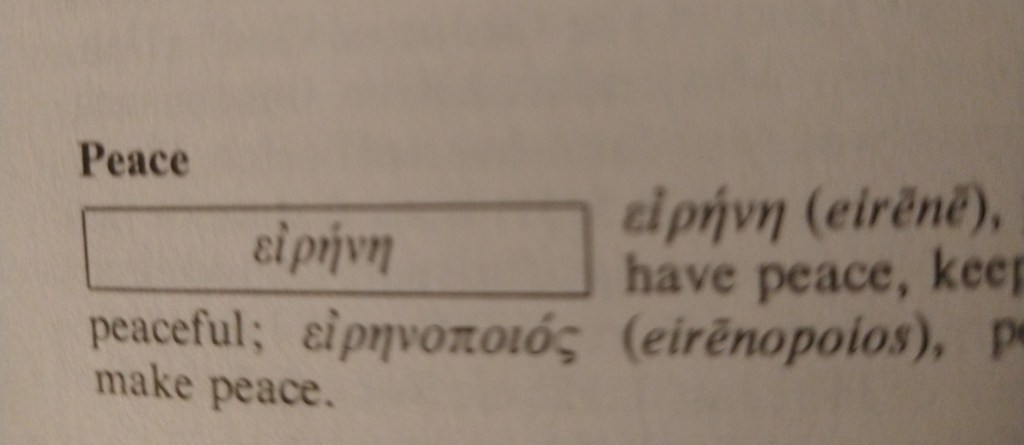
The Greek also has different words that have been translated “peace”.  The word used most often in the New Testament, and the word I find in the Septuagint in my study passage, is eirene (G1515).  This word means “peace, prosperity, quietness, rest, to set at one again” and the Strong’s suggests it comes from the primary verb eiro which means “to join”.  Related to eirene and also translated “peace” are the words eirenopoios (G1518) and eirenopoieo (G1517).  Eirenopoios means “pacificatory, peaceable, peace maker” and eirenopoieo means “to harmonize, make peace.” 

There are four Greek words for “holding one’s peace”.  The first is siopao (G4623) which means “silence, muteness” but is an involuntary stillness or inability to speak.  This word is contrasted with sige (G4602) which is a refusal to speak but sige doesn’t appear in the Strong’s list.  Sigao (G4601) which comes from sige does and means, “to keep silent”.  Phimoo (G5392) appears in Mark 1:25 and Luke 4:35 and means “to muzzle”.  Hesuchazo (G2270) appears in Luke 14:4 where it is translated “held their peace” or “kept silent”.  Jesus has asked the lawyers and Pharisees, “Is it lawful to heal on the Sabbath?” and they kept silent.  The word hesuchazo does mean “to keep still” but this stillness is in the sense of refraining from labor, meddlesomeness of speech, rest.

I find all of this riveting.  It’s not like I don’t know what these passages mean when I read them in English and read the word “peace”: I can glean the meaning from the context.  And yet, I am missing subtleties by not knowing all of these are different Greek and Hebrew words with unique meanings.  Does it really matter?  I think it does.  I have seen written and heard said that scripture “means exactly what it says”.  I have also heard the word “infallible” used when it comes to scripture.  I cannot commit myself to agree with those who claim the aforementioned until I know exactly what they mean.  If they are referring to their English translation, I have to disagree.  Not that I do not value my English translation: I do and I enjoy reading it.  My quibble comes when dogmatic statements are made based on the English translation when it does lack the subtlety and precision of the Hebrew, Greek, and even Aramaic.

Last week I mentioned Jeff A. Benner and his YouTube channel.  In a few of the videos I’ve watched, he puts up a picture of a fast food meal and another of a steak dinner.  He asks if he were to invite us to dinner, which would we choose?  He then compares reading a translation of scripture to the fast food meal and reading it in the original language to the steak dinner.  Both will fill you up and satisfy hunger, but which would you prefer?

As I study, I find I agree.  I have used the word “peace” in all of its meanings throughout my life.  I’ve read scripture and had an intellectual grasp of what the passages meant when I read “peace”.  I understand but it’s a surface understanding and is like a fast food meal: something I’ve grabbed on the run because I don’t have the time to prepare a meal and sit down to consume it.  It satisfies at the moment but is not all the food there is and, stretching this analogy further, a diet of fast food is unhealthy. Studying, questioning, and looking up the different words and their meanings: this feels like the steak dinner with the trimmings (or a lovely lentil and vegetable meal for my vegetarian friends).  It’s not the word consumed on the run but it’s me taking the time to savor the different flavors and textures.  

What about those who cannot study the ancient languages, for whatever reason? I am so grateful for the opportunities I have to study but nothing compares to being in the presence of the risen and ascended Lord Jesus Christ. The best meal of all is the one we partake of in and by the Holy Spirit living and working inside of us. There is no better food than that which comes directly from the hand of He who made it.   

As I move forward in my study, I will be focusing on shalom and eirene, exploring beneath the definitions and usage, and seeing what can be unearthed.  I have seen eirene coming from eiro means “to join” and here I finally see the idea of “to fasten” found in the dictionary.  I am curious if I’ll find the same idea in shalom. 

To be continued…

References

The Holy Bible, New King James Version, Thomas Nelson Publishers, Nashville, Tennessee, 1982

Guralnik, David B., Webster’s New World Dictionary of the American Language, Second College Edition, William Collins + World Publishing Co., Inc., Cleveland•New York, 1970, 1976

Rodale, J.I., The Synonym Finder, Warner Books, Rodale Press, Inc., Emmaus, Pennsylvania, 1978

Strong, James, LL.D., S.T.D., The New Strong’s Exhaustive Concordance of the Bible, Thomas Nelson Publishers, Nashville, Tennessee, 1990

Share this:

  • Click to print (Opens in new window) Print
  • Tweet
  • Click to email a link to a friend (Opens in new window) Email
  • Share on Tumblr
Like Loading...
← Older posts

Categories

Featured Posts

Isaiah 45:7

When Tradition and I Part Ways

Keep reading
Kate's avatar by Kate November 28, 2022April 28, 2024
Gospel and Letters of John

A New Heart

Keep reading
Kate's avatar by Kate December 7, 2020March 14, 2021
Studies

The Way He Has Made

Keep reading
Kate's avatar by Kate August 7, 2023August 6, 2023

Enter your email address to subscribe to this blog and receive notifications of new posts by email.

Join 210 other subscribers
Follow Renaissance Woman on WordPress.com

Follow Me on Facebook

Follow Me on Facebook

Meta

  • Create account
  • Log in
  • Entries feed
  • Comments feed
  • WordPress.com

Blog at WordPress.com.

  • Subscribe Subscribed
    • Renaissance Woman
    • Join 169 other subscribers
    • Already have a WordPress.com account? Log in now.
    • Renaissance Woman
    • Subscribe Subscribed
    • Sign up
    • Log in
    • Report this content
    • View site in Reader
    • Manage subscriptions
    • Collapse this bar
 

Loading Comments...
 

You must be logged in to post a comment.

    %d