I have begun looking at the word “Truth” as I continue my study on the Whole Armor of God with particular focus on “having girded your waist with truth”.
Unfortunately, circumstances were such that I could not devote the time I had planned to study. Therefore, there isn’t a blog post ready this week.
I hope to continue in my study and have something for next but, until then, I invite you to read a post from 2021.
One of My Mom’s Acrylic Pours! Used With Permission
Hello Readers and welcome-or welcome back-to Renaissance Woman where, this week, I return to my study of the Whole Armor of God described by the Apostle Paul in Ephesians 6:10-18.
I previously mentioned I was reading The Christian in Complete Armour by William Gurnall as part of conducting this study. In his book, William Gurnall asks, “What is this armour?” and then answers his question as follows:
“By armour is meant Christ. We read of putting on the ‘Lord Jesus,’ Ro. Xiii, 14, where Christ is set forth under the notion of armour. The apostle doth not exhort them for rioting and drunkenness to put on sobriety and temperance, for chambering and wantonness [to] put on chastity, as the philosopher would have done, but bids, ‘put he on the Lord Jesus Christ;’ implying thus much [that] till Christ be put on, the creature is unarmed…The graces of Christ, these are armour, as ‘the girdle of truth, the breast-plate of righteousness’ and the rest. Hence we are bid also [to] ‘put on the new man’, Ep.iv. 24, which is made up of all the several graces as its parts and members. And he is the unarmed soul, that is the unregenerate soul, not excluding those duties and means which God hath appointed the Christian to use for his defence. The phrase thus opened, the point is, to show that to be without Christ is to be without armour.” (Gurnall, 45)
That the Whole Armor of God is Jesus Christ is my belief as well, though I do try not to draw conclusions until a study is complete. Still, I don’t suppose there are believers who would disagree with me or with William Gurnall so I take a brief moment to ask myself if it is necessary to dig further. The moment is definitely brief because knowing the Whole Armor of God is Jesus Christ doesn’t do much to help me understand how and what the armor enables me to be in the world. Thus, or hence (borrowing from William Gurnall) I will continue to dig into this passage until I am satisfied.
I am looking for a complete picture to form in my mind. I have been thinking about communication, understanding, and how language forms pictures in our minds. This has been especially true over the last couple of weeks when I read a study by a Bible Teacher I admire and usually agree with. I did not agree with the conclusions he drew in the particular study I read. What he said would have made sense to me and I never would have thought to question it had I not already conducted a study on the passage he was using and therefore understood the meaning of the Greek, and had nothing but my English translation of the Bible to aid me. I realized how easy it is to draw erroneous conclusions as I almost did so when studying Paul’s admonition to “stand” in the Ephesians passage.
It seems so clear reading the English translations. “Stand” means just that: stand firm, unmovable. The picture that had formed in my mind was that of believers as Spiritual Warriors, clad in the whole armor of God, strengthened in the Lord Jesus Christ to hold our ground, defend it to the uttermost, and not surrender even one iota to the enemy. Then, I looked at the Greek word translated “stand” (histemi) and saw it did mean “made to stand” but carried also the idea of covenant and my mental picture disintegrated. I could have put my conclusions into words, described my mental picture to the best of my ability, and there may have been those of you who would have agreed with me. My conclusions would not have been totally inaccurate but neither would they have been correct. I have to wonder how much harm a partially accurate bible study can do…
I do not want to get involved in arguments over the accuracy and validity of the various translations of the Bible. However, I will say it is important to take care what pictures are being formed in our minds. One of my favorite books on writing is Word Painting by Rebecca McClanahan and it is this book more than any other that has made me conscious of the way words paint pictures in my mind. I would say it is important to realize the English words Bible translators have chosen to portray what the Hebrew and Greek intend are not always the best and most accurate.
I have already looked at the Greek word translated “put on” in Ephesians 6:11 and shared how the word means “to sink down into”. It is not putting on a garment in the sense of ‘there’s my coat over there: I’m going to get it and put it on”. It is more like snuggling into a blanket on a chilly day while resting on a comfortable couch except that, when we are speaking of the Life of Christ, there is no separation between Him and us. Putting Him on would be more like saying the blanket is always a part of us and there is never an instant where we cannot snuggle into it and be warmed and soothed.
This made me wonder just what Paul meant when he said “Take up the whole armor of God” in verse 13. Perhaps you are like me and the words “take up” instantly bring to mind Jesus’ command to “take up your cross and follow me” in Matthew 16:24. “Take up” in the English paints a mind picture for me where both the armor and the cross are like that coat I mentioned before: it is something over there, apart from me, and I need to go to it, take it up, and put it on. Is this the picture painted by the Greek?
Would you be surprised if I told you the Greek words used in these passages are not the same? I was not. In fact, I’ve come to expect it. The Greek word translated “take up” in Matthew 16:24 is airo (G142) and is defined in the Strong’s as “to lift; by implication to take up or away, figuratively to raise (the voice), keep in suspense (the mind), specifically to sail away (i.e. weigh anchor); by Hebraism to expiate sin;-away with, bear (up), carry, lift up, loose, make to doubt, put away, remove, take (away, up).” There’s enough in this definition to make me question the mental picture this passage has always painted in my mind: that of me stumbling under the weight of my cross as I drag it along while following the Lamb withersoever He goest. A study for another time.
The Greek translated as “take up” in Ephesians 6:13 is analambano (G353) and is defined in the Strong’s as “to take up-receive up, take (in, unto, up)”. Analambano is a compound word formed of ana (G303) and lambano (G2983). The Strong’s defines Ana as “properly up but (by extension) used (distributively) severally, or (locally) at:–and, apiece, by, each, every (man), in, through. In compounds (as a prefix) it often means (by implication) repetition, intensity, reversal.” Lambano is defined as “to get hold of, accept, be amazed, assay, attain, bring, when I call, catch, come on (unto), forget, have, hold, obtain, receive (after), take (away, up).”
Taking all of this into consideration, I don’t think I do the Greek a disservice if I begin to define analambano as “to constantly take hold of that which we have received in our inner being.”
“The armour is Christ” William Gurnall writes and knowing that to be the truth is all well and good as long as we know exactly what Christ is to us. What exactly have we received? What are we taking hold of? What word pictures have been painted on the canvas of our minds by the sermons we have listened to? How have these pictures been formed by our understanding of the language used to translate our Bibles? How accurate are they? Unless we have laid hold of the living Christ in, by, and through His Spirit, the pictures cannot be at all accurate.
In his Epistle to the Ephesians, the same epistle in which he describes the whole armor of God; the Apostle Paul writes a glorious prayer:
“I do not cease to give thanks for you, making mention of you in my prayers, that the God of our Lord Jesus Christ, the Father of glory, may give to you the spirit of wisdom and revelation in the knowledge of Him, the eyes of your understanding being enlightened; that you may know what is the hope of His calling, what are the riches of the glory of His inheritance in the saints, and what is the exceeding greatness of His power toward us who believe, according to the working of His mighty power which He worked in Christ when He raised Him from the dead and seated Him at His right hand in the heavenly places, far above all principality and power and might and dominion, and every name that is named, not only in this age but also in that which is to come. And He put all things under His feet, and gave Him to be head over all things to the church, which is His body, the fullness of Him who fills all in all. And you He made alive, who were dead in trespasses and sins, in which you once walked according to the course of this world, according to the prince of the power of the air, the spirit who now works in the sons of disobedience, among whom also we all once conducted ourselves in the lusts of our flesh, fulfilling the desires of the flesh and of the mind, and were by nature children of wrath, just as the others. But God, who is rich in mercy, because of His great love with which He loved us, even when we were dead in trespasses, made us alive together with Christ (by grace you have been saved), and raised us up together, and made us sit together in the heavenly places in Christ Jesus, that in the ages to come He might show the exceeding riches of His grace in His kindness toward us in Christ Jesus.”
Now that’s something to take hold of!
Unless noted otherwise, all Scriptures are quoted from The Holy Bible, New King James Version, Thomas Nelson Publishers, Nashville, Tennessee, 1982
References
Gurnall, William, The Christian in Complete Armour, Seventh Printing, Hendrickson Publishers, Peabody, Massachusetts, 2021, Page 45
Strong, James, LL.D., S.T.D., The New Strong’s Exhaustive Concordance of the Bible, Thomas Nelson Publishers, Nashville Tennessee, 1990
Hello and welcome to Renaissance Woman where, this week, I am exploring another side path I encountered but steadfastly ignored during my study of Isaiah 45:7.
This side path presented itself during my study of the Hebrew word translated as “evil” in the King James Version but “calamity” in the New King James Version. That Hebrew word is ra spelled Resh (ר) Ayin (ע) and does not necessarily mean “evil” in the way we think of “evil”. In the word ra, we see the Resh which is a picture of bowing or a bent head, and the Ayin which is a picture of the eyes. The head is bent to the eyes so those things that are “evil” in a Biblical sense are those things we do because they seem right in our own eyes. In their study on Psalm 2:11, Chaim Bentorah and Laura Bertone have this to say about ra: “In Hebrew, there are about ten different words with a Semitic root of ra (ר), which is the basic word for “evil”. However, ra (ר) does not necessarily have to signify something bad. The Semitic concept of this word is an outside influence that causes us to react in a certain way in which we have little or no control over our actions.”1
As time passes, I am persuaded of the necessity of knowing what the original language behind our English words truly meant. One such word is “evil”. The Septuagint translated the Hebrew ra in Isaiah 45:7 as kakos but then translated “evil” (ra) in “The Tree of the Knowledge of Good and Evil” as poneros. These words do not mean the same thing in the Greek although at first glance the difference does appear slight. George Ricker Berry says “These words may be used with very little distinction of meaning but often the difference is marked. (G2556) kakos frequently means evil rather negatively, referring to the absence of the qualities which constitute a person or thing what it should be or what it claims to be. It is also used meaning evil in a moral sense. It is a general antithesis to agathos. Poneros is a word at once stronger and more active, it means mischief-making, delighting in injury, doing evil to others, dangerous, destructive. Kakos describes the quality according to its nature, poneros, according to its effects.”2 (Agathos [G18]: good, benefit, well)
I cannot repeat everything I learned about “evil” during my Isaiah 45:7 study but I will repeat how aware I am that everything I learned in this study only scratched the surface. There is so much more to be gleaned from scripture regarding the meaning of “evil”. This is true for so many other words as well. One such I came across while studying ra and I was astonished as I began to look into its meaning. That word is rasha (רשע) often translated by the English word “wicked”.
I was looking up ra in Benjamin Blech’s The Secrets of Hebrew Words and found this entry: “רע (ra) means evil. What does the wicked person do in order to gain acceptance? He makes central to his very being the appearance of ש (shin), the letter appearing on every mezuzah as the acronym for שדי (ShaDaY), the name of God. The reprobate will claim that holiness is central to his being. All of his actions are hypocritically assigned to “holy causes”…the only way to unmask the רשע (RaShA) is to remove his ש (shin), the letter of piety that he uses to disguise his wickedness.”3
I have no doubt that we all have a person or two who readily springs to mind as someone who is rasha or wicked. Before we start pointing fingers and leveling accusations, I want to share one other entry from Benjamin Blech. His very next entry on rasha asks the question “how does one explain why someone is wicked” and then quotes the second half of Numbers 15:39: “And that you go not about after your heart and your own eyes, after which you use to go astray”.4 Benjamin Blech then writes:
“The eyes ought not to be our rulers. Samson followed his eyes to lust after Philistine women. His punishment, measure for measure, was that he became blind. Look in retrospect at the רשע (RaShA) and see that backwards we are told the story behind his aberrant behavior: ע (ayin) the eye, became his שר (SaR), ruler. A ישראל (YiSRaEL) is one who remembers ראש לי (LiY RoSh): I possess a head, a mind, and an intellect that must control the desires stemming from sight. ראש (RoSh) also has the consonants שר (SaR), ruler. But central to rule as expressed by the word is the letter א (alef), the One of the universe Who dictates the difference between right and wrong, between what my eyes see and desire, and what my head determines is suitable or off limits.”5
These two entries riveted me because I realized that whenever I read the word “wicked” in the Bible, I was picturing something different in my head than what was meant by the original language. And, while I can think of one or two people who would fit the Biblical definition of “wicked” I cannot resort to finger pointing. The roots of the Tree of the Knowledge of Good and Evil have penetrated deep into the soil of my heart. I have both eaten its fruit and produced its fruit in my life. Even after I knew Jesus and had determined to follow Him I still nibbled the fruit from time to time. My early following of Him consisted in trying to do right, believe the right things, keep the right rules, and present myself to Him as a good Believer with an absolutely stuffed resume He could be proud of. I did not know then that even the good I tried to do was evil because I was either doing what seemed right in my own eyes or, at times, doing what another person told me was right. That person of course knew more than I did so following his/her dictates meant I was safe, right?
No. The wicked person is one who covers his evil deeds with holiness and piety. It may be that contained within the word rasha is the idea that this covering of one’s deeds with holiness and piety is deliberate. This is a word I need to spend some more time with. Whether it is or not, wickedness can be hard to recognize because, while “evil deeds” are those things done because they seem right in a person’s eyes, they oftentimes do appear to be good. Knowing for certain I have turned from wickedness to righteousness can be quite a dilemma but one which has a both remarkably simple and intensely difficult solution.
“Let the peace of God rule in your hearts…Let the word of Christ dwell in you richly in all wisdom…and whatever you do in word or deed, do all in the name of the Lord Jesus, giving thanks to God the Father through Him.” I am quoting bits of Colossians 3 verses 15-17 here and the Greek word for “name”, as in “the name of the Lord Jesus” is onoma (G3686). It means “name” but also “authority, character”. The Strong’s also has “surname” as a definition. The word “in” is en (G1722) and it means “fixed position…a relation of rest”.
That’s it. Rest in Jesus Christ. Eat of the fruit of the Tree of Life which is Jesus Christ. Let His life live in and through us. It is at once utterly simple and the most difficult thing in to do. There’s a scripture in the Book of Revelation which has often been quoted as something reserved for after this body dies. The passage is: “Then I heard a voice from heaven saying to me, ‘Write: “Blessed are the dead who die in the Lord from now on.” ‘‘Yes, says the Spirit, ‘that they may now rest from their labors, and their works follow them’” (Revelation 14:13). I don’t think this scripture is describing a rest that happens after physical death. I think it’s describing what it means to live the Christian life here on earth while still in this body. Jonathan Mitchell’s translation of the New Testament seems to say as much. Listen to the tenses: “Write: “From the present moment (from this time; from now; henceforth) the dead ones [are] blessed (happy) folks-those continuously dying within the Lord!” “Yes, indeed” the Spirit continues saying, “to the end that they may rest themselves from out of their wearisome labor (travail; toilsome exhaustion), for their works (actions; deeds) are continually following together with them.”6
“I die daily,” Paul says in 1 Corinthians 15:31. We have died in Jesus Christ, were buried with Him, rose with Him, and are now seated with Him in heavenly places. Even so, there is a law in our members that seeks to draw us away from His life in us and then to lead us onto a path where we declare we are the gods of our lives and can determine for ourselves what is good and evil. This path is almost impossible to stay off of except we have the Holy Spirit living within us. He teaches us who Jesus Christ is and teaches us who we are in Him. By His opening of my eyes I see Jesus Christ, the Tree of Life. By His working within me, I can recognize the fruit of the tree that led to death. By His wisdom and the revelation He gives, I know I am dead to sin and alive to God in Jesus Christ. By His power, I do refuse to let sin reign in my mortal body and can present myself to God as being alive from the dead (Romans 6:10-13).
2 Corinthians 4:10 says, “always carrying about in the body the dying of the Lord Jesus, that the life of Jesus also may be manifested in our mortal flesh.” This is one of those living in the New Covenant paradoxes: living in union with Jesus is wondrous beyond words and each one of us would declare there is no other life worth living, and yet it also intensely painful. There are times the finger is pointed at me accusing me of wickedness. It cuts the deepest when that finger belongs to someone close. I have no defense to offer. I know His Life is in me and I am joined to Him through His Spirit. Because His peace is alive in me and ruling in my heart I can say, “my conscience is clear but that doesn’t prove I’m right. It is the Lord Himself who will examine me and decide” (1 Corinthians 4:4, NLT).
Amen. So be it. Come, Lord Jesus.
Unless noted otherwise, all Scriptures are quoted from The Holy Bible, New King James Version, Thomas Nelson Publishers, Nashville, Tennessee, 1982
Bentorah, Chaim with Laura Bertone, Hebrew Word Study: Exploring the Mind of God, Whitaker House, New Kensington, Pennsylvania, 2019, Page 246
Walker, G. Allen, New Koine Greek Textbook Series Supplements, Berry’s Synonyms, Page 66
Blech, Benjamin, The Secrets of Hebrew Words, Jason Aronson Inc., Northvale, New Jersey, 1991, Page 76
Ibid., Page 77
Ibid., Page 77
Mitchell, Jonathan Paul, MA, The New Testament, Harper Brown Publishing, 2009, 2013, 2015, 2019, Page 629
References
Danker, Frederick William, A Greek-English Lexicon of the New testament and Other Early Christian Literature, Third Edition (BDAG), University of Chicago Press, Chicago, Illinois, 1957-2000
Strong, James, LL.D., S.T.D., The New Strong’s Exhaustive Concordance of the Bible, Thomas Nelson Publishers, Nashville Tennessee, 1990
I am fascinated by energy. The studies on energy being conducted within the science discipline of Physics, and especially Quantum Physics, are riveting. I read different articles and, as I’ve come expect in the science world, for every postulation there is an equal and opposite refutation. I don’t mind as I find there’s something to learn from both sides of the argument. I take what I read and go to the scriptures, wondering what they might say on the subject.
As I said last week, I do not completely agree with the belief that all things that exist were created out of nothing. I don’t completely disagree either: I do believe that there was a time when nothing we know existed and there was only God. Hebrews 11:3 says, “By faith we understand that the worlds were framed by the word of God, so that the things which are seen were not made of things which are visible.” I think this passage clearly states God did not create from matter already existing but the idea that he created from nothing is not an accurate portrayal of His creating. In the beginning, there was the Intention of the Father, described in Ephesians 1 and also peppered and salted throughout both the Old and New Testaments. This Intention was expressed by The Word and everything spoken by The Word was energized by the Spirit thus forming the heavens and the earth and then filling them both. There is a beautiful passage in Proverbs: “The Lord by wisdom founded the earth; By understanding He established the heavens; By His knowledge the depths were broken up, And clouds drop down the dew” (Verses 19-20).
Isaiah 11:2 gives this description of the Holy Spirit: “…the Spirit of Wisdom and Understanding, The Spirit of counsel and might, The Spirit of knowledge and of the fear of the Lord.” This description of the Spirit paralleled as it is in the verses of Proverbs is so very exciting. Psalm 104:3, in speaking of the things God has made says; “You send forth Your Spirit and they are created; and You renew the face of the earth.” The Holy Spirit is an integral part of creation and I haven’t heard many teachings on this subject. It’s something I want to spend more time on but, for now, I want to keep my focus on the meaning of the word “create”. Whatever its intended meaning in Genesis 1:1, the word is used again in Genesis 1:27 and 5:2 where the scriptures speak of God creating man. It is clear man was formed from the dust of the ground so man did not come from nothing.
And so, this week, I continue my search for a satisfactory definition for create. “Create” is bara in the Hebrew and I shared the confusing entry from Strong’s concordance in last week’s post. Many other scholars have said-and I agree-that the meaning of a word does not drastically change no matter its context. I don’t see why bara should be any different: there ought to be a consistent meaning that fits with every instance of its usage. One Hebrew teacher I listen to likes the “make fat” or “fattening” meaning found in the 1 Samuel 2:29 passage. He plugs that meaning into Genesis 1 and says that the creation story doesn’t suggest at all that God created from nothing but rather he “fattened” or filled the heavens and the earth. I can see his point but there are many passages where that meaning doesn’t exactly fit. Case in point is Joshua 17: 15 & 18 where my NKJV translates bara as “clear a place” in verse 15 and “cut it down” in verse 18. I have to stretch the idea of “make fat” almost to the breaking point while trying to make it make sense here. Clearing a place or cutting down doesn’t work in other scriptures: I don’t think anyone would accept God cutting down the heavens and the earth as an appropriate translation of Genesis 1.
I did amuse myself by plugging the different definitions found in the Strong’s into different scriptures. I liked the idea of God “dispatching” the heavens and the earth as that gave me the strong sense of creation having a purpose. I was reminded of Isaiah 45:18: “For thus says the Lord, Who created the heavens, Who is God, Who formed the earth and made it, Who has established it, Who did not create it in vain, Who formed it to be inhabited: I am the Lord and there is no other.” The forest Joshua commanded be “cut down” in the afore mentioned passages could also have been dispatched but, ultimately, I didn’t find this definition to be satisfactory so kept looking.
The Davis Dictionary of the Bible defines creation as, “The act or operation of God whereby he calls into existence what did not before exist. The verb always has God for its subject and the result is an entirely new thing.” I found a similar idea in the New World Dictionary where “create” is defined as: “to grow, to cause to come into existence, bring into being; make; originate…to bring about, give rise…” The definition “to bring about a new thing” isn’t expressly used but I do think it can be applied. Wilson’s Old Testament Word Studies gave me the most thorough definition of create: “to bring into being; to produce, put in form, or renew; to put in a new or happier condition. It is a word having a special reference to God and his operations by an infinite power. The leading import of bara is two-fold: (1) The production or effectuation of something new, rare, and wonderful; the bringing something to pass in a striking and marvelous manner. (2) The act of renovating, remodeling, or reconstituting, something already in existence.”
As I look at this definition, I do see Isaiah 45:7 could be translated “I create evil/calamity” and it could mean God brings evil into being. I think a careful read of the first few chapters of Genesis shows this isn’t true: evil is not a part of the creation God calls “good”. However, He did cause every tree to grow in the garden and, in the midst of the garden were both the Tree of Life and the Tree of the Knowledge of Good and Evil. All fairness to our God, He did warn our ancestors not to eat of that tree. I do think there’s enough to consider Isaiah 45:7 is not saying God brought evil into existence but rather He will reconstitute evil and calamity: He will put in a new and happier condition. He sends His spirit forth and renews the face of the earth.
Unless noted otherwise, all Scriptures are quoted from The Holy Bible, New King James Version, Thomas Nelson Publishers, Nashville, Tennessee, 1982
This week I am continuing my study of Isaiah 45:7 looking specifically at the meaning of peace. Since I have begun focusing my attention on not only the meaning of peace but its nature, I realize how often I have used the word peace without taking time to think about what exactly I meant.
For instance, over the last week, there was a situation I did not have peace about and yet I held my peace. I saw others involved keep the peace-despite provocation-and strive to make peace. I am using the same word to say what I mean and yet I mean different things each time. I’ve been pondering the six definitions of peace in the dictionary. Each definition is not diametrically opposed to the other: the dictionary tells me “peace” comes from the Latin pax (pacis, pangere) which means to fasten and the Latin pacisci to confirm an agreement.
The first four entries under “peace” in the dictionary are, freedom from war, a treaty or agreement to end war, freedom from public disturbance, and freedom from quarrels. Each one of these reflects that idea of confirming an agreement but, as I previously shared, does not necessarily mean the parties are in accord; merely the parties have agreed not to fight. Entries five and six-an undisturbed state of mind, absence of mental conflict, calm, quiet, and tranquility-do not conform as well to the idea of confirming an agreement. It made me wonder if it didn’t make more sense to use different words for these concepts.
Out of curiosity, I checked my thesaurus to see what words I could find to better express the substance of my thoughts. I could say: I was upset and uneasy when I found myself confronted with a situation ripe for conflict. I remained silent and watched while others refused to be provoked, responded amicably, sought accordance and reconciliation rather than discord, and averted hostilities. While my mind is still not tranquil, I find the more I offer the situation up to Jesus the closer I come to ataraxia.
I admit I got a bit carried away at the end there but, as a side note, ataraxia is a great word and I am now going to practice interjecting it into my everyday conversation. I do think my second description is more precise than the first where I only used “peace”. As I began to study “peace” in the Hebrew and Greek, I found both languages to be equally precise.
I looked up “peace” in the Strong’s Concordance and took a look at the list of Hebrew and Greek words. Holding one’s peace is charash (H2790) which has a range of meanings. It does mean “to be silent” or “to let alone” but also, oddly, means “to scratch, to engrave, plow”. Leviticus 10:3 which records Aaron as “holding his peace” uses the word damam (H1826). This word means “to be dumb…astonished…to cease…quiet self…tarry”. 2 Kings 2:3, Psalm 39:2, and Isaiah 42:14 (among others) use the root chashah (H2814) for holding one’s peace while Nehemiah 8:11 and Zephaniah 1:7 use the root hacah (H2013). Both of these words mean “hush, keep quiet”.
The other words translated peace all come from the same family. “Making peace” or “being at peace” is the root shalam (H7999) except for Joshua 9:15 where Joshua makes peace and a covenant with the inhabitants of Gibeon. The Strong’s has shalom (H7965) listed here. The word for “peace offerings” is shelem (H8002). Shalom then is the word translated “peace” the most often except for two instances in Daniel (4:1 and 6:25) where the word shelam (H8001) is used.
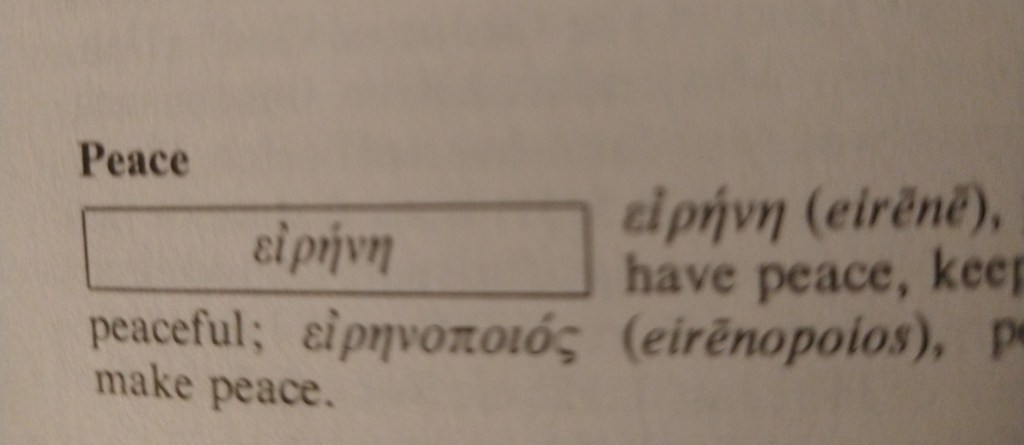
The Greek also has different words that have been translated “peace”. The word used most often in the New Testament, and the word I find in the Septuagint in my study passage, is eirene (G1515). This word means “peace, prosperity, quietness, rest, to set at one again” and the Strong’s suggests it comes from the primary verb eiro which means “to join”. Related to eirene and also translated “peace” are the words eirenopoios (G1518) and eirenopoieo (G1517). Eirenopoios means “pacificatory, peaceable, peace maker” and eirenopoieo means “to harmonize, make peace.”
There are four Greek words for “holding one’s peace”. The first is siopao (G4623) which means “silence, muteness” but is an involuntary stillness or inability to speak. This word is contrasted with sige (G4602) which is a refusal to speak but sige doesn’t appear in the Strong’s list. Sigao (G4601) which comes from sige does and means, “to keep silent”. Phimoo (G5392) appears in Mark 1:25 and Luke 4:35 and means “to muzzle”. Hesuchazo (G2270) appears in Luke 14:4 where it is translated “held their peace” or “kept silent”. Jesus has asked the lawyers and Pharisees, “Is it lawful to heal on the Sabbath?” and they kept silent. The word hesuchazo does mean “to keep still” but this stillness is in the sense of refraining from labor, meddlesomeness of speech, rest.
I find all of this riveting. It’s not like I don’t know what these passages mean when I read them in English and read the word “peace”: I can glean the meaning from the context. And yet, I am missing subtleties by not knowing all of these are different Greek and Hebrew words with unique meanings. Does it really matter? I think it does. I have seen written and heard said that scripture “means exactly what it says”. I have also heard the word “infallible” used when it comes to scripture. I cannot commit myself to agree with those who claim the aforementioned until I know exactly what they mean. If they are referring to their English translation, I have to disagree. Not that I do not value my English translation: I do and I enjoy reading it. My quibble comes when dogmatic statements are made based on the English translation when it does lack the subtlety and precision of the Hebrew, Greek, and even Aramaic.
Last week I mentioned Jeff A. Benner and his YouTube channel. In a few of the videos I’ve watched, he puts up a picture of a fast food meal and another of a steak dinner. He asks if he were to invite us to dinner, which would we choose? He then compares reading a translation of scripture to the fast food meal and reading it in the original language to the steak dinner. Both will fill you up and satisfy hunger, but which would you prefer?
As I study, I find I agree. I have used the word “peace” in all of its meanings throughout my life. I’ve read scripture and had an intellectual grasp of what the passages meant when I read “peace”. I understand but it’s a surface understanding and is like a fast food meal: something I’ve grabbed on the run because I don’t have the time to prepare a meal and sit down to consume it. It satisfies at the moment but is not all the food there is and, stretching this analogy further, a diet of fast food is unhealthy. Studying, questioning, and looking up the different words and their meanings: this feels like the steak dinner with the trimmings (or a lovely lentil and vegetable meal for my vegetarian friends). It’s not the word consumed on the run but it’s me taking the time to savor the different flavors and textures.
What about those who cannot study the ancient languages, for whatever reason? I am so grateful for the opportunities I have to study but nothing compares to being in the presence of the risen and ascended Lord Jesus Christ. The best meal of all is the one we partake of in and by the Holy Spirit living and working inside of us. There is no better food than that which comes directly from the hand of He who made it.
As I move forward in my study, I will be focusing on shalom and eirene, exploring beneath the definitions and usage, and seeing what can be unearthed. I have seen eirene coming from eiro means “to join” and here I finally see the idea of “to fasten” found in the dictionary. I am curious if I’ll find the same idea in shalom.
To be continued…
References
The Holy Bible, New King James Version, Thomas Nelson Publishers, Nashville, Tennessee, 1982
Guralnik, David B., Webster’s New World Dictionary of the American Language, Second College Edition, William Collins + World Publishing Co., Inc., Cleveland•New York, 1970, 1976
Rodale, J.I., The Synonym Finder, Warner Books, Rodale Press, Inc., Emmaus, Pennsylvania, 1978
Strong, James, LL.D., S.T.D., The New Strong’s Exhaustive Concordance of the Bible, Thomas Nelson Publishers, Nashville, Tennessee, 1990







 Renaissance Woman
You must be logged in to post a comment.