
• About Me
  • Study Links

Renaissance Woman

~ Test All Things; Hold Fast What is Good-1 Thessalonians 5:21

Renaissance Woman

Tag Archives: Isaiah 45:7

Wellspring of Peace

25 Monday Jul 2022

Posted by Kate in Isaiah 45:7, Studies

≈ Leave a comment

Tags

Bible Study, Biblical Hebrew, Book of Isaiah, Hebrew Letters, Indwelling Spirit, Isaiah 45:7, One with Christ, Peace, Shin, Union, Unity

Hello and welcome-or welcome back-to Renaissance Woman.  This week I am continuing my study of Isaiah 45:7 specifically “peace”. 

I remembered Malcolm Smith had done a lecture series on the Beatitudes (Matthew 5) and, curious what he had to say about peace, I found and listened to them.  The Hebrew word translated “peace” in my study passage is shalom and, in the first Peace lecture, Mr. Smith explores all the word means.

First of all, shalom is not merely the absence of war.  Shalom describes union-the fitting together of two or more, and it means harmony, melody, covenant friendship.  Shalom is reconciliation, wholeness, completeness, tranquility of heart, and a sense of well-being.  Mr. Smith also says shalom is abundance.  Shalom doesn’t stay inside of us.  It comes out through our words and hands and brings abundance because it springs from a mind that thinks abundance or thinks in terms of “enough”.

I have had ample opportunity to think about these definitions of peace.  I have been going through a great deal over the last weeks.  I believe it is a Holy Spirit truth that He does not guide me into a path of study without also guiding me through situations where I get to experience just what I’m studying.  I have wondered “how am I going to pay for this”, “what am I going to do about that”, and “I have no idea how to begin to deal with this other thing.”  I have needed Peace and there have been times I have felt anything but peaceful.  I have Mr. Smith’s definitions written down and my thoughts have not progressed far beyond the first definition he gives: that of Union. 

I know my Father is with me no matter what I am going through and no matter how I might feel about it.  He cannot leave me.  We are united, fitted together, One Spirit because I am joined to the Lord Jesus Christ in and through the Holy Spirit.  This is a truth that deserves celebration and peace and yet it is one that is also frustrating.  He is with me.  I am in Him and He is in me.  In Him I live and move and have my being every iota of every day.  This being so, if He would just tell me what I should do next, where were going, and what exactly is going to happen, then I would have peace. 

I don’t know about any of your experiences with living life out of the Holy Spirit but He has never done that for me.  I pray about a situation, put it entirely in His hands (something I often have to do over and over), trust that He will handle it, and then ask Him to open my eyes so I can see how He has chosen to handle it.  The path ahead is never completely clear.  A door will appear to open and all I can do is try and walk through it.  Sometimes it will be an open door but sometimes, while the door itself will close, it will have opened a pathway to learning something I did not know and experiencing something new: in this case, peace.

Union.  What does it mean?  There are various groups of people who are united around an idea or a creed but this is agreement rather than union.  True union belongs to God.  We find it in the heart of God in that mysterious union of Father, Son, and Spirit.  We are included in this union in Jesus Christ by His Spirit living within us.  This union is vital and alive.  I have seen a picture of this vital union during my study of the Hebrew Letter Shin and I was not surprised Mr. Smith’s first definition of shalom was union as the first letter of shalom is the Shin.

I’ve looked at Shin twice before and shared how the word Shin means urine and, without the Yod; means tooth, claw, or jaw.  The picture is of chewing food, breaking it down, digesting it, and then eliminating it as waste.  Shin represents the totality of an overall process, one that is whole, entire, intact, complete, integral, full, and perfect. (1)  This process is one that is repeated over and over and, considering the learning process, what we repeat over and over becomes inculcated within us.2

I have also found Shin is the letter in the Hebrew word for fire (esh), and begins and ends the word for the sun (shemesh).  The three upraised arms of the letter Shin represent the flames of fire.  Here too is the idea of consuming and, thinking of the refining of gold or silver; there is once more the idea of processing and completion.

While conducting my study on Isaiah 45:7, I have also been reading a series of studies on the Book of Revelation.  I have just finished the section on Revelation Chapter 12 so have the Woman in the Wilderness fresh in my mind.  She is persecuted by the dragon but is given two wings of a great eagle so she can fly into the wilderness to her place where she is nourished. (Verses 13-14).  The wilderness is a dangerous place where food and water are scarce and yet the woman has a place in it and it is a place where she is nourished.  This was called to mind when I looked up Shin in Mr. Haralick’s book and saw he gives it the definition of Cosmic Nourishment.

I can attest to everything I’ve written in this post being true because I’ve experienced it.  My life will be full of knowledge of the Holy Spirit and awareness that I am in the midst of great rivers and streams and then those rivers and streams dry up and I find myself in a barren wilderness with no idea what’s going to happen or where I’m going to go next.  I read in those same Revelation studies that God calls us to the wilderness places, not to torment us, but to bring us into a deeper revelation, relationship, and reliance on Him.  I see this is true because there is a specific place in the wilderness for the woman where she is nourished.  She is not cast into the wilderness to wander aimlessly until she drops dead.  No, she is cared for.

Knowing it is true doesn’t make it easy.  The pain is real.  The circumstances are real.  The worry and helplessness are real.  I do not feel nourished and cared for right away.  I know God is with me.  I know He will never leave me nor forsake me.  I know our union is one that cannot be dissolved no matter what happens.  Yet I know I am in a tight place with no way out, totally helpless, and all I can do is wait until He rescues me.  My attitude is not always one of faithful submission.  It’s more, “a little help here!  Now!”

I am still in the wilderness.  I don’t know what will happen from one day to the next.  I still feel the grinding and processing revealed by the Shin.  In the midst of it, the refreshing and nourishment has come so I can also attest to the faithfulness of our God.  He is with me, always, even unto the end of the age (Matthew 28:20).  He does make a way where there is no way and the spring of peace has just begun to bubble to the surface.   

Inculcate: to tread in, tread down, to trample underfoot, to impress upon the mind by frequent repetition or persistent urging

  1. Haralick, Robert M., The Inner Meaning of the Hebrew Letters, Jason Aronson Inc., Northvale, New Jersey, 1995, Page 295
  2. Ibid.

Other References:

(1) WEBINAR 273 – Peace Makers – YouTube

The Woman in the Wilderness

The Holy Bible, New King James Version, Thomas Nelson Publishers, Nashville, Tennessee, 1982

Bentorah, Chaim, Hebrew Word Study Beyond the Lexicon, Trafford Publishing, USA, 2014, Pages 148-152

Guralnik, David B., Webster’s New World Dictionary of the American Language, Second College Edition, William Collins + World Publishing Co., Inc., Cleveland•New York, 1970, 1976

Share this:

  • Print (Opens in new window) Print
  • Tweet
  • Email a link to a friend (Opens in new window) Email
  • Share on Tumblr
Like Loading...

Mindful of Meaning

18 Monday Jul 2022

Posted by Kate in Isaiah 45:7, Studies

≈ Leave a comment

Tags

Bible Study, Biblical Languages, Book of Isaiah, Christ Life, Classical Hebrew, Definitions, Greek, Hebrew, Holy Spirit, Indwelling Spirit, Isaiah 45:7, Koine Greek, Meaning, Peace

Hello and welcome back to Renaissance Woman!

This week I am continuing my study of Isaiah 45:7 looking specifically at the meaning of peace.  Since I have begun focusing my attention on not only the meaning of peace but its nature, I realize how often I have used the word peace without taking time to think about what exactly I meant.

For instance, over the last week, there was a situation I did not have peace about and yet I held my peace.  I saw others involved keep the peace-despite provocation-and strive to make peace.  I am using the same word to say what I mean and yet I mean different things each time.  I’ve been pondering the six definitions of peace in the dictionary.  Each definition is not diametrically opposed to the other: the dictionary tells me “peace” comes from the Latin pax (pacis, pangere) which means to fasten and the Latin pacisci to confirm an agreement. 

The first four entries under “peace” in the dictionary are, freedom from war, a treaty or agreement to end war, freedom from public disturbance, and freedom from quarrels.  Each one of these reflects that idea of confirming an agreement but, as I previously shared, does not necessarily mean the parties are in accord; merely the parties have agreed not to fight.  Entries five and six-an undisturbed state of mind, absence of mental conflict, calm, quiet, and tranquility-do not conform as well to the idea of confirming an agreement.  It made me wonder if it didn’t make more sense to use different words for these concepts.

Out of curiosity, I checked my thesaurus to see what words I could find to better express the substance of my thoughts.  I could say:  I was upset and uneasy when I found myself confronted with a situation ripe for conflict.  I remained silent and watched while others refused to be provoked, responded amicably, sought accordance and reconciliation rather than discord, and averted hostilities.  While my mind is still not tranquil, I find the more I offer the situation up to Jesus the closer I come to ataraxia. 

I admit I got a bit carried away at the end there but, as a side note, ataraxia is a great word and I am now going to practice interjecting it into my everyday conversation.  I do think my second description is more precise than the first where I only used “peace”.  As I began to study “peace” in the Hebrew and Greek, I found both languages to be equally precise.

I looked up “peace” in the Strong’s Concordance and took a look at the list of Hebrew and Greek words.  Holding one’s peace is charash (H2790) which has a range of meanings.  It does mean “to be silent” or “to let alone” but also, oddly, means “to scratch, to engrave, plow”. Leviticus 10:3 which records Aaron as “holding his peace” uses the word damam (H1826).  This word means “to be dumb…astonished…to cease…quiet self…tarry”.  2 Kings 2:3, Psalm 39:2, and Isaiah 42:14 (among others) use the root chashah (H2814) for holding one’s peace while Nehemiah 8:11 and Zephaniah 1:7 use the root hacah (H2013).  Both of these words mean “hush, keep quiet”.

The other words translated peace all come from the same family. “Making peace” or “being at peace” is the root shalam (H7999) except for Joshua 9:15 where Joshua makes peace and a covenant with the inhabitants of Gibeon.  The Strong’s has shalom (H7965) listed here.  The word for “peace offerings” is shelem (H8002).  Shalom then is the word translated “peace” the most often except for two instances in Daniel (4:1 and 6:25) where the word shelam (H8001) is used. 

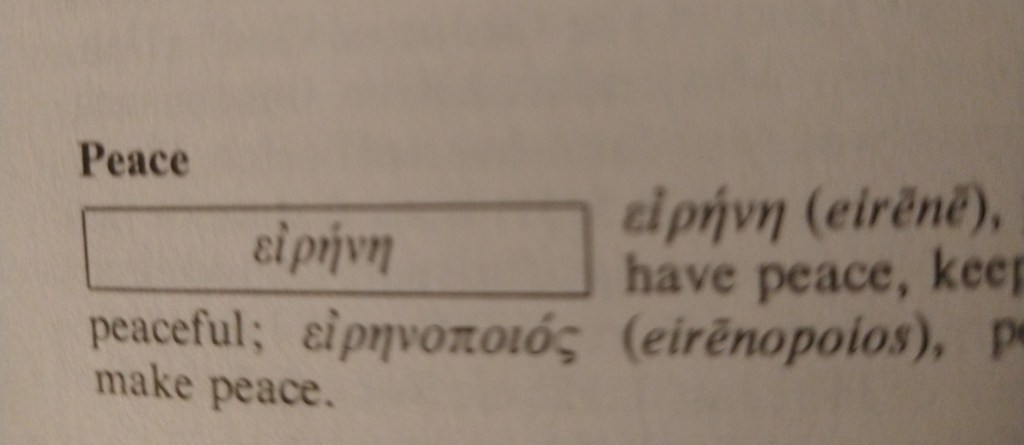
The Greek also has different words that have been translated “peace”.  The word used most often in the New Testament, and the word I find in the Septuagint in my study passage, is eirene (G1515).  This word means “peace, prosperity, quietness, rest, to set at one again” and the Strong’s suggests it comes from the primary verb eiro which means “to join”.  Related to eirene and also translated “peace” are the words eirenopoios (G1518) and eirenopoieo (G1517).  Eirenopoios means “pacificatory, peaceable, peace maker” and eirenopoieo means “to harmonize, make peace.” 

There are four Greek words for “holding one’s peace”.  The first is siopao (G4623) which means “silence, muteness” but is an involuntary stillness or inability to speak.  This word is contrasted with sige (G4602) which is a refusal to speak but sige doesn’t appear in the Strong’s list.  Sigao (G4601) which comes from sige does and means, “to keep silent”.  Phimoo (G5392) appears in Mark 1:25 and Luke 4:35 and means “to muzzle”.  Hesuchazo (G2270) appears in Luke 14:4 where it is translated “held their peace” or “kept silent”.  Jesus has asked the lawyers and Pharisees, “Is it lawful to heal on the Sabbath?” and they kept silent.  The word hesuchazo does mean “to keep still” but this stillness is in the sense of refraining from labor, meddlesomeness of speech, rest.

I find all of this riveting.  It’s not like I don’t know what these passages mean when I read them in English and read the word “peace”: I can glean the meaning from the context.  And yet, I am missing subtleties by not knowing all of these are different Greek and Hebrew words with unique meanings.  Does it really matter?  I think it does.  I have seen written and heard said that scripture “means exactly what it says”.  I have also heard the word “infallible” used when it comes to scripture.  I cannot commit myself to agree with those who claim the aforementioned until I know exactly what they mean.  If they are referring to their English translation, I have to disagree.  Not that I do not value my English translation: I do and I enjoy reading it.  My quibble comes when dogmatic statements are made based on the English translation when it does lack the subtlety and precision of the Hebrew, Greek, and even Aramaic.

Last week I mentioned Jeff A. Benner and his YouTube channel.  In a few of the videos I’ve watched, he puts up a picture of a fast food meal and another of a steak dinner.  He asks if he were to invite us to dinner, which would we choose?  He then compares reading a translation of scripture to the fast food meal and reading it in the original language to the steak dinner.  Both will fill you up and satisfy hunger, but which would you prefer?

As I study, I find I agree.  I have used the word “peace” in all of its meanings throughout my life.  I’ve read scripture and had an intellectual grasp of what the passages meant when I read “peace”.  I understand but it’s a surface understanding and is like a fast food meal: something I’ve grabbed on the run because I don’t have the time to prepare a meal and sit down to consume it.  It satisfies at the moment but is not all the food there is and, stretching this analogy further, a diet of fast food is unhealthy. Studying, questioning, and looking up the different words and their meanings: this feels like the steak dinner with the trimmings (or a lovely lentil and vegetable meal for my vegetarian friends).  It’s not the word consumed on the run but it’s me taking the time to savor the different flavors and textures.  

What about those who cannot study the ancient languages, for whatever reason? I am so grateful for the opportunities I have to study but nothing compares to being in the presence of the risen and ascended Lord Jesus Christ. The best meal of all is the one we partake of in and by the Holy Spirit living and working inside of us. There is no better food than that which comes directly from the hand of He who made it.   

As I move forward in my study, I will be focusing on shalom and eirene, exploring beneath the definitions and usage, and seeing what can be unearthed.  I have seen eirene coming from eiro means “to join” and here I finally see the idea of “to fasten” found in the dictionary.  I am curious if I’ll find the same idea in shalom. 

To be continued…

References

The Holy Bible, New King James Version, Thomas Nelson Publishers, Nashville, Tennessee, 1982

Guralnik, David B., Webster’s New World Dictionary of the American Language, Second College Edition, William Collins + World Publishing Co., Inc., Cleveland•New York, 1970, 1976

Rodale, J.I., The Synonym Finder, Warner Books, Rodale Press, Inc., Emmaus, Pennsylvania, 1978

Strong, James, LL.D., S.T.D., The New Strong’s Exhaustive Concordance of the Bible, Thomas Nelson Publishers, Nashville, Tennessee, 1990

Share this:

  • Print (Opens in new window) Print
  • Tweet
  • Email a link to a friend (Opens in new window) Email
  • Share on Tumblr
Like Loading...

Having My Fill

11 Monday Jul 2022

Posted by Kate in Isaiah 45:7, Studies

≈ Leave a comment

Tags

Abstract verses Concrete Thinking, Bible Study, Book of Isaiah, Christian Life, Eastern Mindset, Filled to Overflowing, Indwelling Spirit, Isaiah 45:7, Peace, Satisfied by the Holy Spirit, Western Mindset

Image by Yinan Chen from Pixabay

This has been an interesting week.  In last week’s post, I asked questions I didn’t have answers for.  I had no idea where the Holy Spirit was going to take me as I began to seek to understand the Peace that comes only from Jesus Christ but I have been taught of Him long enough to know He was going to take me somewhere.  As I write this post, I still cannot say I have a complete understanding what peace is but I do understand why I haven’t been satisfied with any of the definitions for peace I have come across.

I subscribe to Jeff A. Benner’s YouTube Channel and so, when I set myself to study the Hebrew word for peace, I checked out some of Mr. Benner’s videos on studying Hebrew.  Lecture # 33 is titled “Eastern and Western Thought” and caught my attention because I’ve been thinking so much about the power of my thought life and the necessity for my thoughts to be brought under the rule of Jesus Christ.  This video is a short one and I’ll include a link to it at the bottom of this post.  It is short but it brought to mind something I hadn’t given thorough consideration.

I think we all understand the Hebrew People of the Old Testament had a very different culture, language, and thought process than we who live in the West.  Have any of us sought to acknowledge what that means?  I think it’s important to do so.  I am deeply grateful for my English Bibles.  To be able to sit and read it in my native language is a gift I never take for granted.  Such a gift is mine because of many people but I always have William Tyndale in the back of my mind whenever I look at the multiple translations I have on my shelves.  He dared to translate the bible into English, was condemned as a heretic, and was burned at the stake.  The Bible I hold in my hands is only there because William Tyndale, and others like him, so believed in the importance of it, that they gave their lives.  For this reason, I cannot disparage any translation.

That being said, what I have is a translation.  The English language comes with culture and a thought process very different from the cultures and thought processes in place when the Old and New Testaments were written.  Mr. Benner speaks of two schools of thought: the Greek and the Hebrew.  The Greek is equated with abstract thinking and the Hebrew is equated with concrete thinking.  What’s the difference?  Abstract thinking refers to the process of thinking deeply about some abstract idea and involves emotions such as love, hatred, anger, etc.: thoughts that are not real but a concept of our intelligence.  Concrete thinking involves thinking about physical things that can be felt, done, or processed by someone.  Is one better than the other?  I think that depends on whether we focus on one to the detriment of the other.

Malcolm Smith often utilizes an analogy of reading off a menu as opposed to eating the food the menu points to.  While Mr. Smith does not specifically attribute this analogy to abstract v concrete thinking, I think it works.

Imagine you are sitting at the table pictured at the top of this post.  Your friends and family are gathered around you.  The food has been prepared and set before you.  The aromas that wafted from the kitchen as the food was being prepared were indescribable.  They whetted your appetite and, now, as you sit at the table with the food before you, your stomach is growling.  The Host of the feast rises and begins to describe the food to you.  Perhaps the Host uses words like “delight”, “satisfaction”, “savory”, “sweet”, and “aromatic”.  All of these words are describing something real-the food is on the table before you-but then suppose the Host sits and everyone around the table begins to describe their favorite dish.  They share how it tasted that time they ate it, how wonderful it was, and how the taste would differ from anything on the table.  You’re ready to try the food for yourself.  All of your salivary glands are in overdrive and you can’t wait to taste what has been described to you, what you can smell, and what you can see on the table before you.  But then, everyone around the table sighs and says, “one day”.  They sing a song about how great the food was and how great it will be and then leave the table without eating a bite. 

The concrete mindset sees the food is there.  You can see it and smell it.  All you have to do is fill your plate and eat.  You do so and the food is just as wonderful as described!  You taste the promise contained in the smells.  You eat until you cannot possible take another bite and, while doing so, you and the others at the table with you laugh and talk and fellowship.  Perhaps one has tried a dish you haven’t tried yet.  He or she gushes about how delicious it is and the dish is passed down the table to you.  You taste it and find it is as marvelous as described.  You pass around your favorite dish and see the delight on your companions faces as they too experience it.  Perhaps no one wants to leave the table because the experience is too good and you all sit together enjoying each other’s company.  When the company finally does break up, it does so with the promise that you all will get together again and will eat together until you are filled to the brim.  Each morsel you taste between that meeting and the next is done so with the idea of sharing it with those who ate at the table with you. 

If you’ve stayed with me through that analogy, I hope you can see how abstract and concrete can work together.  I think abstract thinking can enhance the enjoyment of concrete thinking.  The Hebrew word for peace in my study passage is shalom and Mr. Benner covers it in his Lecture #8 video titles “An Introduction to Word Studies”.  He says shalom is not cessation from war but rather means “completeness”.  I take that definition to John 14 where Jesus says, “My peace I give unto you.”  I look at the Fruit of the Spirit as being “completeness”.  I remember Colossians 2:10 where the Apostle Paul declares I have been made complete in Christ.  Have been made!  Now! 

All of this is well and good but if all I do is remember it, it’s just the aromas.  Knowing all of this certainly whets my appetite but if I don’t actually eat it, I’m never satisfied.  I can look at peace as an abstract concept.  I can study it, compare and contrast it with other concepts, and learn all there is to know about peace.  This is not how the Hebrew people thought of peace.  The peace of God was something concrete with a very real application to their everyday lives.  So it is to my life today and I am convinced the only way to move from my enjoying the abstract to having my fill of the concrete is to leave my books and all my studying and allow the Holy Spirit to make everything I have learned real to me.  How do I do that?

I admit that as wonderful as it is, my abstract thinking isn’t enough.  I acknowledge I’m hungry and want Him to not only show me what peace is but to fill me with it until I overflow.  I ask Him to open my eyes that I might recognize the concrete reality of peace and then I rejoice along with the Psalmist because I know “my soul shall be satisfied as with the richest of foods” (Psalm 63:5, NI).

Lecture #33: Eastern and Western Thought – YouTube

Lecture #8: An Introduction to Word Studies – YouTube

Difference Between Concrete and Abstract Thinking – Ask Any Difference

Great Britons: William Tyndale – The Man Who Translated the Bible Into English (anglotopia.net)

MalcolmSmithWebinars – YouTube

Share this:

  • Print (Opens in new window) Print
  • Tweet
  • Email a link to a friend (Opens in new window) Email
  • Share on Tumblr
Like Loading...

Getting a Grasp on Peace

04 Monday Jul 2022

Posted by Kate in Isaiah 45:7, Studies

≈ Leave a comment

Tags

Bible Study, Biblical Greek, Biblical Hebrew, Book of Isaiah, Christian Life, Holy Spirit, Indwelling Spirit, Isaiah 45:7, Peace, Peace Makers, Peace of God, Peace of Jesus

Image by Avelino Calvar Martinez from Pixabay

Hello and welcome to Renaissance Woman as I continue in my study of Isaiah 45:7: “I form the light and create darkness, I make peace and create calamity; I, the Lord, do all these things.”  I am moving on from my study of the word “make”.  The Hebrew word translated make, asah, is one I do want to look at further but, for now, I am content with what I have already discovered.  God is an artist, The Artist, and He pours His very self into everything He makes.  In Isaiah 45:7, the thing He is making is peace.  What does that mean?  What is peace?

I looked at peace a bit when I was conducting my study on the Fruit of the Spirit.  In that study, I saw peace as something that belongs to Jesus and can only be given by Him.  It is given to each individual believer as we come to see ourselves in Him and Him in us through the Holy Spirit.  It is not something that can be imposed on us from without rather peace becomes our way of being as His life is formed in us.  The peace of Jesus Christ is not something we can impose on others but flows out from us as the springs of His life in us overflow.  Such were my conclusions during that study and, while I still wholeheartedly believe what I wrote, I did not define what peace is. 

As I try to answer that question, some of my favorite scriptures on peace come to mind.  There is John 14:27: ““Peace I leave with you, My peace I give to you; not as the world gives do I give to you.  Let not your heart be troubled, neither let it be afraid.”  There is Isaiah 26:3: “You will keep him in perfect peace whose mind is stayed on You.”  I especially like the Isaiah verse as it states “whose mind is stayed on You” and I have been meditating a great deal on the importance of my thoughts.  Since peace is an aspect of the Fruit of the Spirit, I define it as something internal, something that comes from the life of Jesus Christ within me.  The verse in John does quote Him as saying, “not as the world gives do I give to you,” which tells me His peace is different than the peace I find in the world.  Is the difference between Jesus’ peace and the peace of the world that His is part of the flow of His life and, to the world, peace is something external?

I looked up peace in my New World Dictionary and find the answer to that is yes and no.  The first entries under “peace” are, 1., freedom from or a stopping of war, 2., a treaty or agreement to end war or the threat of war, and 3., freedom from public disturbance or disorder; public security; law and order.  This series of definitions can be summed up as “peace is the absence of conflict” which I admit is how I used to think of peace.  This idea of peace is fragile.  An argument escalates, or a law is opposed and this peace is broken.  This kind of peace is imposed on people from without and such imposition often breeds resentment.

Of course, the peace defined in the dictionary is not always imposed.  The fourth entry under peace says, “freedom from disagreement or quarrels; harmony; concord” and then under “make peace” I read, “to effect a reconciliation with, to end hostilities, settle arguments.”  Two individuals or disparate groups of people can choose to make peace with other, to cease from hostilities, and to settle conflicts.  And yet, there is no need of a heart change for this kind of peace.  It is not imposed from without but neither does it infer those parties ceasing from hostilities are now of one accord or that any restoration of relationship will follow.  This too is an absence of conflict but, just because they may not be acted on, does not mean resentment and bad feeling ceases to exist.

In entries five and six in the dictionary, I finally find peace defined as, “an undisturbed state of mind; absence of mental conflict, serenity, calm, quiet, tranquility”.  These definitions are certainly closer to what I think the peace of Jesus is and yet this peace too can be found in the world without Jesus being mentioned anywhere.  There are religions where the practices are meant to lead to serenity and a tranquil state of mind.  I have met some of the practitioners of these religions and they do seem more calm and confident-more peaceful-than I have ever dreamed of being.  I once watched a documentary where different religious leaders were interviewed and all of them spoke of life being good, peaceful, and blissful.  I listened carefully and Jesus as the source and giver of peace wasn’t mentioned once, even among those leaders who professed to be Christians.  If this is so, if this kind of internal peace can be achieved without Jesus, is He even necessary in our day to day lives?  Is the only bonus to a Christian life that belief in Jesus means you get to escape hell?  What is this peace He promised to leave with us and just how does it differ than that given by the world?

I looked up the Greek word for peace used in the John passage in the Strong’s concordance.  It is eirene (G1515) and means, “peace, prosperity, one, quietness, rest, set at one again.”  The entry in Strong’s Concordance suggests eirene comes from the primary verb eiro which means “to join.”  This same Greek word is used in the Septuagint in place of the Hebrew word translated peace in Isaiah 45:7 which is shalom.  The Strong’s gives a similar definition for shalom (H7965): well, happy, health, prosperity, rest.   

I see these definitions in Ephesians 2:14 where, speaking of Jesus Christ, the Apostle Paul says; “For He Himself is our peace, who has made both one, and has broken down the middle wall of separation”.  Here, peace is unity; being set at one again with no divisions or separations.  I feel this passage sums up most of the definitions of peace I’ve come across but it all happens within the peace that Jesus Christ Himself is.  What is this peace?  I’ve looked up definitions, compared and contrasted, and still don’t feel I have a grasp on it.

In Isaiah 45:7, God declares He is the One who makes peace  and then in Matthew, Jesus declares, “Blessed are the peacemakers, for they shall be called sons of God” (Mt. 5:9).  I feel there is more to this peace than a lack of war, conflict resolution, or a tranquil mind.  Just what more there is, I do not know.  I need to know because I cannot make peace if I do not know just what it is.  My prayer is that in the upcoming weeks the Spirit of Wisdom and Revelation will open my eyes to see what this peace is that God makes, this peace that is Jesus Himself.

Until next time…

Unless noted otherwise, all scriptures are quoted from The Holy Bible Old and New Testaments, The Authorized King James Version, Thomas Nelson, Inc., Printed in Colombia, 2003

References

Guralnik, David B., Webster’s New World Dictionary of the American Language, Second College Edition, William Collins + World Publishing Co., Inc., Cleveland • New York, 1974, 1976

Strong, James, LL.D., S.T.D., The New Strong’s Exhaustive Concordance of the Bible, Thomas Nelson Publishers, Nashville, Tennessee, 1990

Share this:

  • Print (Opens in new window) Print
  • Tweet
  • Email a link to a friend (Opens in new window) Email
  • Share on Tumblr
Like Loading...

Hey! What Are You Wearing?

20 Monday Jun 2022

Posted by Kate in Isaiah 45:7, Studies

≈ 1 Comment

Tags

Ancient Hebrew, Bible Study, Biblical Greek, Biblical Hebrew, Book of Isaiah, Hebrew Letters, Hei, Hey, Indwelling Spirit, Isaiah 45:7, Koine Greek, Secrets of Hebrew Letters

It’s a new week and I am continuing my study of Isaiah 45:7, specifically the phrase “I make peace.”  I am continuing to look at the Hebrew word asah translated “make” in this passage and, this week, am looking at the third letter comprising asah: the Hey (or Hei or Heh).

Robert Haralick defines Hey as “Power of Being”.  I had to take a moment to think on that because I was once more convinced the ministry of the Holy Spirit was being revealed to me.  I thought about Genesis where God asahs man.  The Ayin revealed the eyes of God focused on His making as well as His being the source of our life.  The Shin revealed the fire that God is inhabiting us and I also pictured that fire like the heat of a kiln, finishing and preparing us.  Now, in Hey, I see He is our Power of Being. The Living Word says, “the shape behind the Hey is of a mouth, breathing, breath”.  God breathed into the nostrils of the man He had made and that man became a living being.  Jesus breathed on His disciples and bade them receive the Holy Spirit.  The Spirit descended on those gathered on the Day of Pentecost as a rushing wind from heaven.  The Spirit is the wind from the heavenly realm, the very breath of Jesus within us: He is our Power of Being.

But, such are concepts I’ve already written about.  I was curious what more I could discover in studying the Hey.  The Shivimpanin video told me Hey represents a unification of giving and receiving as well as completeness for the three lines of Hey represent length, depth, and breadth.  Mr. Haralick shares a similar thought: “The shape of the letter Hey is composed of three lines, one separated from the other two.  The three lines are the three garments, the means of expression, of the soul.  The garments are thought, speech, and action.”  In his entry on the Hey, Mr. Haralick also writes; “The garments of our expression are thoughts, words, and actions.  That which is not manifest we bring into our awareness and our consciousness by our thoughts.  By words and actions we can bring what is in our thoughts to the awareness of others.”

I have been thinking a great deal on garments.  One of my Bible Teachers tells a story of attending a convention where one of the speakers, an Evangelist, took a handkerchief out of his pocket and covered his hand with it.  He likened Jesus to the handkerchief, the covering that hides us from the eyes of the Father and thus Jesus manages sneak us into the Kingdom.  I haven’t heard these exact words myself nor seen this image taught but, with them in mind, I have carefully listened to other believers as they speak.  I hear them speak of being saved but insist they are still flawed human beings and sinners or I hear something like: “God doesn’t see our sins because He sees us through His Son.”  Just this morning I was reading a devotional that said, “One day I’ll stand before a holy God and the grace of Jesus will clothe me.”  I listen to what others say or I read something like that and, while I cannot say I necessarily disagree, there is enough there to give me pause.  I cannot say I agree without more of an explanation of what they mean.

In all my listening, I have found there is very little believers are expecting from their Christian lives.  It seems it is enough to believe in Jesus and get to go to heaven when they die.  While they are waiting to die and go to heaven, they fill their lives with good works and try to be like Jesus and try to convince others to believe on Him so they too can escape hell.  After all, doesn’t Revelation 19 say the Bride of Christ is given fine linen to wear, clean and white, and that the fine linen is the righteousness of saints (verses 7-8)?  That’s the translation in the King James version.  Other translations say “the righteous acts of the saints”.  Doesn’t the Book of James say “faith without works is dead” so we thus prove we are the people of God with our works and, by performing righteous acts, ensure we won’t be found naked when He comes?

This is not the sum of my Christian life.  I expect I now live a life in and flowing out of the Holy Spirit and I do not have this expectation in vain.  I expect that God is faithful to His word and that what He has promised, He will do.  I expect He told the truth in Ezekiel 36 when He promised to give me a new heart and a new spirit and then promised He will put His spirit in me.  I expect the Apostle Peter told the truth when he declared Joel’s prophecy fulfilled and the Spirit of God poured out on all flesh.  I expect God’s word is true and that I know His Spirit is in me because His Spirit bears witness with my spirit that I am a child of God.  I expect that because His Spirit is in me that the law of the Spirit of life in Christ Jesus has made me free from the law of sin and death.  I expect that His Spirit in me makes the great work of the blood of Jesus a reality in my life and that His blood has cleansed me from all sin. 

I expect the life I now live I live by the faith of Jesus Christ.  I expect that His blood cleanses my conscience of dead works.  I expect works to prove my faith is alive because it is His faith, His works, and He is in me working both to will and to do.  I expect that because His Spirit is in me, I will do good works which God has before ordained that I should walk in.  I expect His Spirit in me keeps me abiding in Him and Him in me so that my life cannot help but bear fruit.  I expect that it is Christ IN me that is my hope of glory, not Christ ON me.

I expect that all of this is happening right now because the Spirit is renewing my mind.  In his letter to the Romans, the Apostle Paul beseeches us to “be not conformed to this world; but be ye transformed by the renewing of your mind” (12:2).  The Greek word translated “renewing” in this passage is anakainosis (G342) and means “renovation-renewing”.  Paul also beseeches us to “be renewed in the spirit of your mind” (Ephesians 4:23).  The Greek word translated “renewed” here is ananeoo (G365) and also has the meaning of “to renovate, reform, renew”.   

I expect the word of God to be true and I thank God that through Jesus Christ I am right this minute being delivered from my body of death!  Right now, because I am in Christ Jesus, I am a new creation.  Behold!  Old things have passed away and all things have become new.  The letter Hey is spelled Hey Aleph and means Lo!, or Behold!, or Here it is!  The letter Hey means Spirit, Revelation, and Receiving Understanding.  This changes how I pray Paul’s great prayer in Ephesians.  “The God of our Lord Jesus Christ, the Father of glory may give unto you the spirit of wisdom and revelation in the knowledge of him: the eyes of your understanding being enlightened; that ye may know what is the hope of his calling and what the riches of the glory of his inheritance in the saints…” (1:17-18). 

His Spirit, that Spirit that is wisdom and revelation and the Jesus Christ-life energy working in me to open my eyes, is in me right this moment.  Because that is true, I no longer worry so much about where I’m going when I die but what I am becoming right now.  Becoming isn’t even the correct word.  His Spirit renovates me, renews me, and restores me to His original plan revealed in Jesus.  God foreknew me before my parents ever came together and, because He foreknew me; He has predestined me to be conformed to the image of His Son.  This transformation and conformation happens first in my thoughts and I thank Him that in His gentleness, He doesn’t destroy me and then build me again.  I am transformed from glory to glory.  My death is swallowed up in His life. 

Proverbs 23:7 says, “For as he thinketh in his heart, so is he”.  I look at the letter Hey and see this is true: my very thoughts are my garments.  The goodness of God leads me to metanoia and, as I exchange my mind for His and my thoughts for His, my garments become His righteousness.  I do not fear I will be found naked when He comes because my garments cannot be separated from me.  They are His very life.  “It doth not yet appear what we shall be but we know that, when he shall appear, we shall be like him for we shall see him as he is” (1 John 3:2).

Hey!  Lo!  Behold!  Here it is!  Hallelujah!

Note: For ease of reading, I did not reference every scripture I’ve quoted but everything I wrote about what I expect is found in scripture.  I encourage everyone to look these promises up for yourselves and EXPECT!

Unless noted otherwise, all scriptures are quoted from The Holy Bible Old and New Testaments, The Authorized King James Version, Thomas Nelson, Inc., Printed in Colombia, 2003

References

HEI- Secrets of the Hebrew Letters – YouTube

Secret of the Hebrew letter Heh – YouTube

Haralick, Robert M., The Inner Meaning of the Hebrew Letters, Jason Aronson Inc., Northvale, New Jersey, 1995, Pages 69-83

Strong, James, LL.D., S.T.D., The New Strong’s Exhaustive Concordance of the Bible, Thomas Nelson Publishers, Nashville, Tennessee, 1990

Share this:

  • Print (Opens in new window) Print
  • Tweet
  • Email a link to a friend (Opens in new window) Email
  • Share on Tumblr
Like Loading...
← Older posts
Newer posts →

Categories

Featured Posts

Isaiah 45:7

When Tradition and I Part Ways

Keep reading
Kate's avatar by Kate November 28, 2022April 28, 2024
Gospel and Letters of John

A New Heart

Keep reading
Kate's avatar by Kate December 7, 2020March 14, 2021
Studies

The Way He Has Made

Keep reading
Kate's avatar by Kate August 7, 2023August 6, 2023

Enter your email address to subscribe to this blog and receive notifications of new posts by email.

Join 210 other subscribers
Follow Renaissance Woman on WordPress.com

Follow Me on Facebook

Follow Me on Facebook

Meta

  • Create account
  • Log in
  • Entries feed
  • Comments feed
  • WordPress.com

Blog at WordPress.com.

  • Subscribe Subscribed
    • Renaissance Woman
    • Join 169 other subscribers
    • Already have a WordPress.com account? Log in now.
    • Renaissance Woman
    • Subscribe Subscribed
    • Sign up
    • Log in
    • Report this content
    • View site in Reader
    • Manage subscriptions
    • Collapse this bar
 

Loading Comments...
 

You must be logged in to post a comment.

    %d