
• About Me
  • Study Links

Renaissance Woman

~ Test All Things; Hold Fast What is Good-1 Thessalonians 5:21

Renaissance Woman

Tag Archives: Christ in Me

Come to the Mountain

17 Monday Jul 2023

Posted by Kate in Studies, Whole Armor of God

≈ Leave a comment

Tags

Christ in Me, Freedom, Grace, Holy Spirit, Indwelling Spirit, Sin, Spiritual Warfare, Whole Armor of God

Hello Readers and welcome-or welcome back-to Renaissance Woman where, this week, I continue my study in Ephesians 6:10-18.  This passage is where the Apostle Paul describes the Whole Armor of God. In last week’s post, I looked at verse 10 which states, “Finally, my brethren, be strong in the Lord and in the power of His might.”  This week, I want to look at how “be strong in the Lord and in the power of His might” relates to Paul’s admonition that we “stand”.

I have read this passage many times but I have to say I never paid close attention to how many times the Apostle Paul says the word “stand.”  Verse 11 says, “Put on the whole armor of God that you may be able to stand against the wiles of the devil.”  Verse 13 says, “Therefore take up the whole armor of God that you may be able to withstand in the evil day and having done all to stand.”  The first word of verse 14 is “stand”. 

Malcolm Smith has pointed out that the soldiers guarding the Apostle Paul during the writing of the Epistle to the Ephesians were just that: guards.  They were not equipped to go out onto the battlefield and fight but, should the battle come to them, they were ready to mount a defense.  The soldiers stood in the strength and might of the authority of Rome.  How much more strength and might belongs to us because we are in Christ Jesus!

This is a truth I have not heard proclaimed by very many of my fellow believers.  They acknowledge that their Salvation is entirely a work of Jesus Christ but then everything else pertaining to the Christian life is somehow achieved based on behavior and merit.  The Apostle Paul asks the Galatians; “Having begun in the Spirit, are you now being made perfect by the flesh?” (Gal. 3:3).  I would ask this same question to those conducting warfare.  Our warfare is Spiritual not carnal.  Our weapons are Spiritual and so is our enemy.  It ought to be obvious ours is not a warfare we wage in our own strength.  We do not need to go out and seek our enemy.  We stand and our strength is in the Lord Jesus Christ and in the power of His might.  We stand in His victory which is made our victory because we are in Him and He is in us.  Our flesh life is exchanged for His.  As the Apostle Paul says, “I have been crucified with Christ; it is no longer I who live, but Christ lives in me; and the life which I now live in the flesh I live by faith in the Son of God, who loved me and gave Himself for me” (Galatians 2:20). (NOTE: the word “in” I have italicized is really “of” in the Greek.  It is not that we put our trust in the strength of our faith in Jesus, rather we live by His faith because He lives in us.  An important distinction.)

Christ’s victory is total and complete.  There is nothing that is not subject to Him (See 1 Corinthians 15:27).  This truth is something it appears believers have forgotten especially when it comes to sin.  My fellow believers do not recognize sin is put away by the atoning sacrifice of Jesus Christ and not for us only but for the entire world (1 John2:2) but are out engaging in “spiritual warfare” and miserably failing.  The result of conducting a battle in the strength of the flesh is much like the Hydra from Greek myth: if one head is cut off two more grow in its place.  Christ’s ultimate victory over sin and death is not spoken of as if it is the reality of believer’s day-to-day lives.  The Apostle Paul wrote an amazing passage on Jesus Christ’s victory over sin and death in his letter to the Romans.  I am quoting from The Message as I like the emphatic language:

“All that passing laws against sin did was produce more lawbreakers.  But sin didn’t, and doesn’t, have a chance in competition with the aggressive forgiveness we call grace.  When it’s sin versus grace, grace wins hands down.  All sin can do is threaten us with death, and that’s the end of it.  Grace, because God is putting everything together again through the Messiah, invites us into life-a life that goes on and on and on, world without end.

“So what do we do?  Keep on sinning so God can keep on forgiving?  I should hope not!  If we’ve left the country where sin is sovereign, how can we still live in our old house there?  Or didn’t you realize we packed up and left there for good?  That is what happened in baptism.  When we went under the water, we left the old country of sin behind; when we came up out of the water, we entered into the new country of grace-a new life in a new land.  That’s what baptism into the life of Jesus means.  When we are lowered into the water, it is like the burial of Jesus; when we are raised up out of the water, it is like the resurrection of Jesus.  Each of us is raised into the light-filled world by our Father so that we can see where we’re going in our new grace-sovereign country.  Could it be any clearer?  Our old way of life was nailed to the cross with Christ, a decisive end to that sin-miserable life-no longer captive to sin’s demands!  What we believe is this: if we get included in Christ’s sin-conquering death, we also get included in his life-saving resurrection.  We know that when Jesus was raised from the dead it was a signal of the end of death-as-the end.  Never again will death have the last word.  When Jesus died, he took sin down with him, but alive he brings God down to us.  From now on, think of it this way: Sin speaks a dead language that means nothing to you; God speaks your mother tongue, and you hang on every word.  You are dead to sin and alive to God.  That’s what Jesus did” (MSG, Romans 5:20-6:11).

I often hear 1 John 1:8-10 quoted as proof that even we believers are doomed to sin.  These verses ought not to be quoted without starting in verse 7:  “But if we walk in the light as He is in the light, we have fellowship with one another, and the blood of Jesus Christ His Son cleanses us from all sin.  If we say that we have no sin, we deceive ourselves, and the truth is not in us.  If we confess our sins, He is faithful and just to forgive us our sins and to cleanse us from all unrighteousness.  If we say that we have not sinned, we make Him a liar, and His word is not in us.” 

Read the passage of Romans again.  We each one of us lived in a realm of darkness where we knew sin.  Our eyes had not yet been opened to the reality of our lives in Jesus Christ and so, we cannot say we have not sinned.  But now, we have been raised into a light-filled world in Jesus Christ.  We are new creations in Him.  Romans 6:23 says, “For the wages of sin is death but the gift of God is eternal life in Christ Jesus our Lord.” 1 John 5:20 says, “And we know that the Son of God has come and has given us an understanding, that we may know Him who is true; and we are in Him who is true, in His Son Jesus Christ.  This is the true God and eternal life.”  1 John 5 also says, “We know that whoever is born of God does not sin; but he who has been born of God keeps himself; and the wicked one does not touch him” (verse 18).

 The word “keeps” in 1 John 5:18 is a word of warfare.  It is tereo (G5083) in the Greek and means, “a watch, to guard (from loss or injury by keeping the eye upon, to withhold, hold fast, preserve.” Paul writes to Timothy, “O Timothy!  Guard what was committed to your trust, avoiding the profane and idle babblings and contradictions of what is falsely called knowledge-by professing it some have strayed concerning the faith” (1 Timothy 6:20-21).  We are not to be idle or passive in our Christian lives but, like Paul’s Roman Soldiers; we guard the revelation of who Jesus is in us, we watch for those who would steal it from us, and we stand. 

My precious fellow believers, let us stop wasting our energy engaging in battles that cannot be fought in our own strength.  The battle is the Lord’s! So is the building the Kingdom of God here on earth.  Let us remember the word of the Lord which came to Zerubbabel through the prophet Zechariah: “not by might nor by power but by My Spirit.”  This word echoes that written by Solomon hundreds of years before: “Unless the Lord builds the house, they labor in vain who build it; unless the Lord guards the city, the watchman stays awake in vain” (Psalm 127:1).

His victory is ours by sheer gift. The greatness of the power that is ours in Christ Jesus is the same mighty power the Father worked in Christ when He raised Him from the dead and set Him at His right hand in heavenly places.  The law of the Spirit of life in Christ Jesus has set us free from the law of sin and death.  We are not come to Mount Sinai, the physical mountain where Moses received the law which was incapable of making anyone perfect: we are come to Mount Zion and the city of the Living God, one not built with hands. (See Ephesians 1:15-23, Romans 8:2, Hebrews 10:1-4, 11:10, 12:18-24). 

“Seeing then that we have a great High Priest who has passed through the heavens, Jesus the Son of God, let us hold fast our confession” (Hebrews 4:14).  Our warfare is not conducted in the same way the world conducts theirs.  Ours is not to gain victory but is rather conducted from the safety and security of His victory.  We stand in the truth of who Jesus Christ is in us and our strength is not that of the flesh which fails but is in the Lord Jesus Christ and in the power of His might.  May that truth saturate your being in the coming days and may it be the foundation on which you stand.

Unless noted otherwise, all Scriptures are quoted from The Holy Bible, New King James Version, Thomas Nelson Publishers, Nashville, Tennessee, 1982

Scripture quotations marked MSG are taken from THE MESSAGE, copyright ©1993, 2002, 2018 by Eugene H. Peterson.  Used by permission of NavPress.  All rights reserved. Represented by Tyndale House Publishers, Inc.

References

Strong, James, LL.D., S.T.D., The New Strong’s Exhaustive Concordance of the Bible, Thomas Nelson Publishers, Nashville Tennessee, 1990

Share this:

  • Print (Opens in new window) Print
  • Tweet
  • Email a link to a friend (Opens in new window) Email
  • Share on Tumblr
Like Loading...

A Quality of Life

03 Monday Jul 2023

Posted by Kate in Studies, Whole Armor of God

≈ Leave a comment

Tags

Bible Study, Christ in Me, Darkness and Light, Hearing the Word, Indwelling Spirit, Self-Talk, Spiritual Warfare, Whole Armor of God

This post marks the first in my new study series on the Whole Armor of God as described in the 6th chapter of Paul’s Epistle to the Ephesians.  The Armor is mentioned twice in this chapter.  In verse 11 we are instructed to put on the whole armor of God and in verse 13 we are instructed to take up the whole armor of God.  The words translated “put on” and “take up” are different in the Greek and I plan to take a look at them later in the study.  But where to begin? 

Despite it being the first mention of the Full Armor of God, picking up the study in Ephesians 5:11 felt like I was beginning in the middle of a thought.  While the entire Epistle is important to my understanding of the verses I will focus on, I decided on verse 10 as my starting point:  “Finally, my brethren, be strong in the Lord and in the power of His might.”  The latter half of that passage, “be strong in the Lord and in the power of His might” has been foremost in my mind over the past week.  They have taken on a special meaning for me as I have watched my backyard bloom.

In a previous post titled “Being Indestructible”, I told the story of my Mom rescuing some cactus pieces that had been uprooted and left lying by the side of the road.  Those cactus pieces have not only survived but thrived and the title of that older post was apt: they are all but indestructible.  At the writing of that pervious post, my stepdad had VERY carefully trimmed pieces of the abundant cactus and scattered them around the base of the tree to prevent wildlife from using the spot as a bathroom.  I watched and waited to see what these pieces would do.  Would they too, take root and thrive like their parent plant or would they wither and die?  The answer is, both.  Some have withered and died but others have taken root and are beginning to grow and thrive.

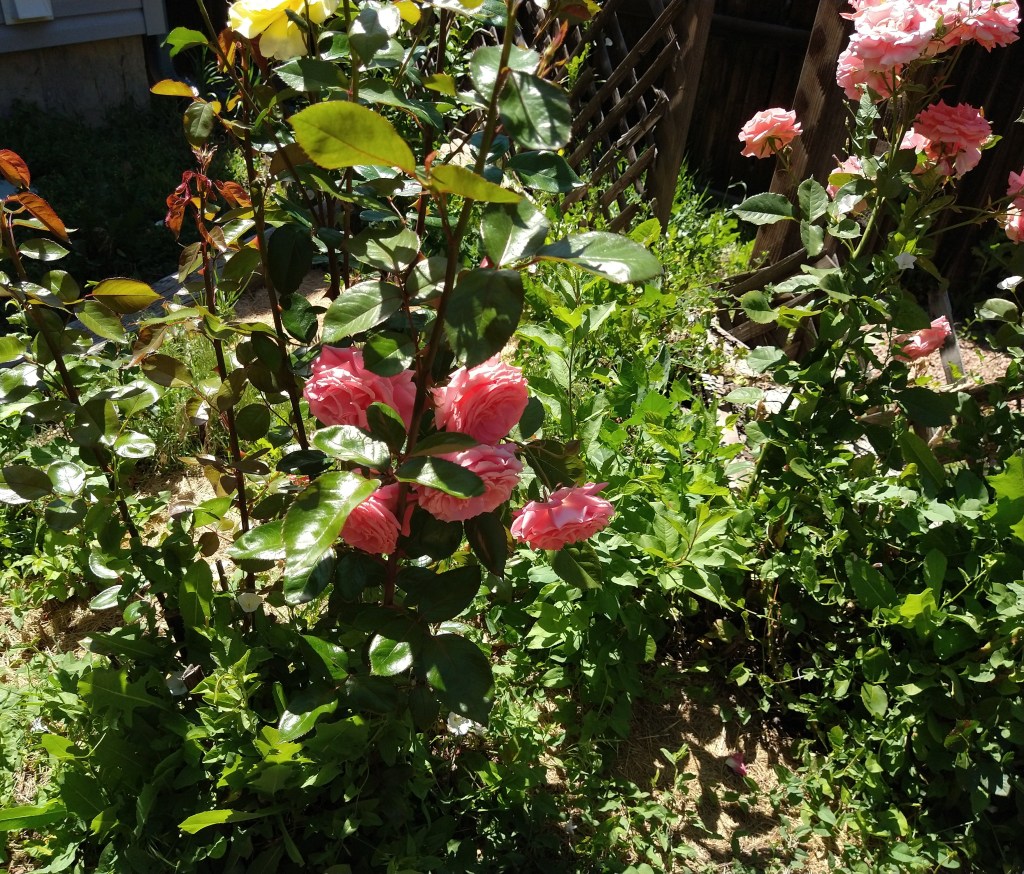
Just a few weeks ago, my stepdad was back at work in the backyard this time trimming my Mom’s rosebushes.  The bushes were thought to be dead and my stepdad was ruthless in his pruning.  His ruthlessness paid off because the bushes erupted in the most gorgeous blooms.  There was life in them after all.  As I spent last week preparing myself for what I hope will be an in-depth study on the Whole Armor of God, I meditated on the words from verse 10 and thought about the cactus and the roses.  Here they both were bursting with life when there was no reason to think life was in them.  It made me realize how our Christian lives were like that: circumstances might not appear suited to sustain life but we have a life within us that can never die.

This is a truth that must not only be guarded but kept in the forefront of our minds.  Over recent weeks I had been aware of, but hadn’t been paying close attention to, the effect the goings on in the world around me was having on my mental health.  It all came to a head when a particular headline brought me to tears and I realized how I was feeling.  I was angry and sad.  I was terribly afraid particularly that my loved ones were going to suffer.  I had no hope for any sort of future.  After all, terrible things had happened in the past so what was to stop the atrocities of history from being repeated?  I despaired.  The darkness was too vast and too powerful and there was no hope of standing against it.  The moment I realized the state of mind that had crept up on me, I had to act.

Fortunately, I have walked with the Lord Jesus Christ for years now and knew what to do.  First, I needed to be alone with Him with no other voices to distract me.  Second, I needed to give myself a good talking to.  Who was my God?  Did I really believe the darkness was anything compared to Him?  Of course not!  But, I had been bombarded by words which had no life in them and I needed to counteract them with words full of truth and life.  Words like John 1:5; “And the light shines in the darkness, and the darkness did not comprehend it”, and Paul’s prayer in Ephesians 1:

“Therefore I also, after I heard of your faith in the Lord Jesus and your love for all the saints do not cease to give thanks for you, making mention of you in my prayers: that the God of our Lord Jesus Christ, the Father of glory, may give to you the spirit of wisdom and revelation in the knowledge of Him, the eyes of your understanding being enlightened; that you may know what is the hope of His calling, what are the riches of the glory of His inheritance in the saints, and what is the exceeding greatness of His power toward us who believe, according to the working of His mighty power which He worked in Christ when He raised Him from the dead and seated Him at His right hand in the heavenly places, far above all principality and power and might and dominion, and every name that is named, not only in this age but also in that which is to come” (Verses 15-21).

As I quoted Paul’s beautiful prayer, my mind grasped hold of the words “in the knowledge of Him,” and I remembered another prayer of Paul’s in the same epistle: “For this reason I bow my knees to the Father of our Lord Jesus Christ from whom the whole family in heaven and earth is named that He would grant you, according to the riches of His glory, to be strengthened with might through His Spirit in the inner man, that Christ may dwell in your hearts through faith; that you, being rooted and grounded in love, may be able to comprehend with all the saints what is the width and length and depth and height-to know the love of Christ which passes knowledge; that you may be filled with all the fullness of God” (Ephesians 2:14-19). 

I do not think the importance of the knowledge of God can be understated.  Knowing Him is the very definition of eternal life (John 17:3, 1 John 5:20).  The weapons of our warfare are wielded against every argument and high thing that exalts itself against the knowledge of God (2 Corinthians 4-5).  I recently finished reading Andrew Murray’s Commentary on the Book of Hebrews and wanted to share something he wrote on the importance of knowing God:

“’Consider…Jesus.’ The one sure and effectual remedy the epistle offers for all the prevailing feebleness and danger of the Christian life, we know.  It has been said to us, “You do not know Jesus aright.’  The knowledge that sufficed for conversion does not avail for sanctification and perfection.  You must know Jesus better.  Consider Jesus!  As God!  As the Man!  In His sympathy! In His obedience!  In His suffering!  In His blood!  In His glory on the throne; opening heaven; bringing you in to God; breathing the law of God and the Spirit of heaven into your heart as your very life!  As little as you can reach heaven with our hand can you, of yourself, live such a heavenly life.  And yet, it is possible because God has borne witness to the Gospel of His Son with the gift of the Holy Spirit.  The Priest-King, on His ascension to the throne, sent down the Holy Spirit into the hearts of His disciples and, with Him, returned Himself to dwell in those who, in the power of His heavenly life, they might live with Him.  Consider Jesus, and you will see that you can live in the heavenlies with Him because He lives in you!” (Murray, 566)

That truth, that we are now seated with Jesus in heavenly places, is one of the most powerful weapons in our arsenal.  God, rich in mercy and because of His great love with which He loved us has made us alive together with Christ, raised us up together, and made us sit together in the heavenly places in Christ Jesus (Ephesians 2:4-6).  All authority in heaven and earth is His (Matthew 28:18) and anything the darkness might say to the contrary is a lie.

I was talking to my Mom about all of this and she described a video she’d seen which I think is a wonderful picture of what I am trying to say: a woman was painting her wall but there was a stain on it.  It didn’t matter how many coats of paint she used, she could not paint over that stain and her frustration grew.  Then, the camera pulls back and it’s revealed the stain is actually a shadow.  There is a staircase across the room and, because of how the light strikes, the shadow of the bannister is cast on the wall.  There is nothing there to paint over.

The darkness is like that.  Like the banister, it is very real.  However, there was no stain and nothing prohibiting the woman from completing the work that had been put in her hand to do: the stain was an illusion.  Being powerless against the darkness is also an illusion.  We do not have any ability when we rely on our own strength but we are strong in the Lord and in the power of His might. 

This is, I think, where Spiritual Warfare begins.  The Kingdom of God is within us and that is also where the battle rages.  It is a battle for the mind and part of the fighting of it is speaking the truth out loud to ourselves so our ears hear them.  Darkness covers the earth and gross darkness the people but we see Jesus.  He is the strength of our lives.  It doesn’t matter where we might be scattered or what our lives look like to an outside observer: Christ lives in us and His life is endless and indestructible.  Therefore, I will not fear!

Unless noted otherwise, all Scriptures are quoted from The Holy Bible, New King James Version, Thomas Nelson Publishers, Nashville, Tennessee, 1982

Read about the cactus here:

https://renaissancewoman.blog/2021/06/28/being-indestructible/

References

Murray, Andrew, Holiest of All: A commentary on the Book of Hebrews, Whitaker House, New Kensington, PA, 1996, 2004, Page 566

Share this:

  • Print (Opens in new window) Print
  • Tweet
  • Email a link to a friend (Opens in new window) Email
  • Share on Tumblr
Like Loading...

Fruit of the Mind

24 Monday Apr 2023

Posted by Kate in Studies

≈ Leave a comment

Tags

Battlefield in the Mind, Bible Study, Christ in Me, Harvest, Holy Spirit, Indwelling Spirit, Parables, Parables of Jesus, Thoughts, Wheat and the Tares

Hello and welcome-or welcome back-to Renaissance Woman!

This week I am continuing to look at the Parable of the Wheat and the Tares found in Matthew Chapter 13 verses 24-30.  There are two interpretations of this parable I find taught in Christian circles.  Both interpretations say the tares and the wheat represent two types of people-believers and unbelievers-and that it is impossible to tell which is which until the harvest is ready and the angels come to reap.  Then the believers will “be gathered into the barn” meaning go to heaven and the unbelievers will “gathered together to be burned” meaning everlasting torment in hell.  The only difference in these two interpretations are some say the wheat and the tares sit together in church and others say no, the wheat and the tares grow together in the world.

There is a third interpretation which I’ve shared in my previous two posts.  I do encourage going back and reading them before continuing on in order to better understand what I am going to say in this post.  I found the third interpretation in J. Preston Eby’s From the Candlestick to the Throne study series # 173 The Firstfruits, the Harvest, and the Vintage.  In a nutshell, this third interpretation suggests the parable is referring to the inner thought life of the believer. 

The woman quoted by Mr. Eby is named Dora Van Assen and her interpretation doesn’t start with the parable of the wheat and the tares.  She begins with the wheat and the chaff from Matthew 3:12 and the entire quote is worth reading.  I’ve linked the article below.  Regarding the wheat and the tares and the interpretation Jesus Himself gives in Matthew 13:36-43, Ms. Van Assen writes:

“The Holy Spirit deals with men in their minds and thoughts, and Satan can only attack man in his mind, giving false ideas and imaginations.  These thought-pictures are often called ‘brain children.’ And these determine what manner of man a man is!  These thought-pictures can be either good or bad, spiritual or carnal.  Paul exhorts us to ‘cast down imaginations and every high thing that exalts itself against the knowledge of God, and bringing into captivity every thought to the obedience of Christ’ (II Cor. 10:5).

“Bringing this parable down to us personally, we find that our own mind is the field in which are planted both good and evil.  The children or offspring of the kingdom, and the children or offspring of the wicked one, are a mixture of both good and evil, flesh and spirit, growing up together within us until the harvest, which is the time of separation.  The tares are somewhat different than the chaff in that that the chaff is part of the wheat; however the tares are not part of the wheat but a foreign implantation made to appear as wheat.  The harvest reveals what sort of seed was planted in our earth, and how they have matured in areas of our lives.  Only the mature know the difference!  And only by harvest conditions can the Lord bring the separation!”

 I am inclined to accept this third interpretation for a variety of reasons.  The first is because of the words of Jesus Himself.  Matthew’s gospel relates Jesus’ temptation in the wilderness and, after He had triumphed, how he began to preach and to say, “Repent, for the kingdom of heaven is at hand.”

Jonathan Mitchell’s New Testament has this verse as: “From that time on, Jesus began to be repeatedly making loud public proclamations (performing as a herald), and to be continually saying, “You folks be progressively changing your thinking (change your frame of mind, mode of thought, perceptions, understanding and state of consciousness, and then turn your focus to [Yahweh]) because the sovereign reign, dominion and activity of exercising the sovereignty of the heavens (or; kingdom from the skies and the atmospheres) has drawn hear and now continues being at hand is close enough to touch (=has arrived and is now accessible).”

The Greek word for “at hand” in this passage is engiken (ἤγγικεν)and “is the 3rd person single form of the verb eggus which means “near, close (of a place or a condition), nigh or at hand (of a time), nearly (of numbers), akin to (of relationships).”  Its tense is perfect (which indicates a present-tense report of an action that has been completed but has effects in the now; like: ‘he has done’), its voice is active (which indicates that the subject performs the action instead of receives it) and its mood is indicative (which describes a situation that actually is-as opposed to a situation that might be, is wished for, or is commanded to be).” (abirampublications.com).

How we think of the Kingdom of Heaven is important.  Do we think of it as it is revealed to us in the tense of the Greek, as something close enough to touch, complete and available to us now?  Or do we think of it as something reserved for some future date?  This is an important factor in understanding both the parable of the wheat and the tares and Jesus’ interpretation of it.  Matthew 13:39 says “the harvest is the end of the age.”  The two main interpretations of this parable say that “end of the age” is a future date and most likely references the Second Coming.

That interpretation discounts the First Coming.  With the death, resurrection, and ascension of Jesus, an age drew to a close.  With the pouring out of the Holy Spirit on Pentecost, a new age was inaugurated: that of the New Covenant ministered to us and in us by the Indwelling Holy Spirit.  What if that was the “end of the age” Jesus meant? What could it mean for us as believers?  For one thing, we can pray “Thy Kingdom Come” with the assurance that, since the Kingdom is near, completed, having effects in the now, our prayer is answered now.  We can expect His will to be done on earth as it is in heaven now.    

“The Kingdom of heaven is like…” wheat and tares sown in the same field.  It is important to remember the tares never become wheat and the wheat never become tares.  Conversion one to the other is not possible.  The call of both John the Baptist and Jesus was “Repent! For the Kingdom of Heaven is at hand.”  Repent is not perhaps the best translation of the Greek word which is metanoia and it means “think differently”.  Think Differently! For the Kingdom of Heaven is available to you now!  It is clear to me the expectation is that we humans can change our minds and think differently.  I cannot accept that Jesus called for humankind to “think differently” without the expectation we were capable of doing so.  I do not believe Jesus ever considered any person a tare, incapable of changing his or her mind, and fit only for the fire.

So then, if the wheat and tares are not symbolic of two groups of people but are rather symbolic of thoughts coming to fruition in the field of our hearts and minds, doesn’t that suggest a duality of mind?  Is there no hope for us but to think both carnally and spiritually until Jesus returns?  I would say yes, if the “end of the age” did mean some date in the future.  If it did not, if Jesus was referring to when He accomplished His work and inaugurated in a New Age, then it ought to be possible to have the fields of our hearts and minds sown only with good seed.

Does the Bible support this possibility?  That is something I will continue to look at next week.

Until then, I leave you with 2 Corinthians 5:17: “Therefore, if anyone is in Christ, he is a new creation; old things have passed away; behold, all things have become new.”  Something well worth thinking about.

Unless noted otherwise, all Scriptures are quoted from The Holy Bible, New King James Version, Thomas Nelson Publishers, Nashville, Tennessee, 1982

References

Kindgdom Bible Studies Revelation Series (kingdombiblestudies.org)

Matthew 13 – Barclay’s Daily Study Bible – Bible Commentaries – StudyLight.org

εγγυς | Abarim Publications Theological Dictionary (New Testament Greek) (abarim-publications.com)

Green, Jay P. Sr., The Interlinear Bible, Volume 4, Authors For Christ, Inc., Lafayette, Indiana, 1976, 1985

Mitchell, Jonathan, The New Testament, Harper Brown Publishing, 2019

Strong, James, LL,D., S.T.D., The New Strong’s Exhaustive Concordance of the Bible, Thomas Nelson Publishers, Nashville, Tennessee, 1990

Share this:

  • Print (Opens in new window) Print
  • Tweet
  • Email a link to a friend (Opens in new window) Email
  • Share on Tumblr
Like Loading...

If No One is Watching

04 Tuesday Apr 2023

Posted by Kate in Walking in the Way

≈ Leave a comment

Tags

Christ in Me, Christian Life, Holy Spirit, Hypocrite, Indwelling Spirit, People Pleasers, Tree of Life, Tree of the Knowledge of Good and Evil

Hello and welcome-or welcome back-to Renaissance Woman!

I am running a bit late this week but I did get a post completed!  I had thought I would take a deeper look at the word “wicked” in scripture but then saw some fascinating things in the NT about faith I wanted to look at as well.  And then, there have been so many avenues of study opened up to me through my study of Isaiah 45:7, I wasn’t sure which one to pursue first.  I’ve known my next study was going to be on the full armor of God as described in Paul’s letter to the Ephesians (See Ephesians 6: 10-18) and, as I started to put together notes this this week’s post, I realized everything I was looking at would be explored as I looked at the various pieces of armor.  Perhaps I should just wait to post until deeper into my Armor of God study…but then, I read something interesting in Ephesians Chapter 6.  The word as found in The New King James Version of the Bible is “eyeservice” found in verse 6. 

“Eyeservice” caught my attention because of my study of the word “evil”.  I had looked at the Hebrew and Greek words for “evil” during my study of Isaiah 45:7 and the Hebrew word translated “evil” is ra.  Ra is spelled Resh (ר) Ayin (ע).  Resh is a picture of a bent head or one bent under a heavy burden and the Ayin is the picture of the eyes.  So, those who do evil are those who allow their actions to be guided by what they have determined is right in their own eyes.

The Greek word translated as “eyeservice” is ophthalmodouleia (G3787)and is a bit of a tongue twister.  It’s a combination word of opthalmos meaning “the eye” and douleia meaning “slavery” or “bondage”.  This Greek word appears twice in scripture: here in Ephesians 6:6 and then again in Colossians 3:22 where Paul writes, “Servants, obey in everything those who are your earthly masters, not only when their eyes are on you, as pleasers of men, but in simplicity of purpose (with all your heart) because of your reverence for the Lord and as a sincere expression of your devotion to Him” (Amplified). 

At first glance, the word ophthalmodouleia doesn’t have any relation to “evil”.  The two passages where this word appears does seem to be speaking about a bondage to another’s opinion rather than doing what is right on one’s own eyes.  Since the two passages are similar, I am focusing on Ephesians 6:6 and  Jonathan Mitchell’s New Testament renders the passage as, “not in accord with eye-service (or; in line with slavery to the eyes [of folks watching]; or = doing it only when being watched) as folks desiring to please men, but rather as slaves of Christ, constantly doing (performing; producing) the will and intent of God-from out of [the] soul (=with the whole inner being; mind, will, emotion, life-force; or: = spontaneously)”. 

The Amplified is a smoother read: “Not in the way of eyeservice-as if they were watching you-and only to please men; but as servants (slaves) of Christ, doing the will of God heartily and with your whole soul.”  Paul’s admonition is to not behave one way when another person is watching you and another when they are not.  In other words, Paul is telling us not to be hypocrites.  And yet, I do see a deeper meaning in this passage.

In June of 2020, I was in prayer asking not only that the eyes of my understanding be enlightened but that I would see the Holy Spirit guiding me into all truth.  The answer I received was “the Tree of the Knowledge of Good and Evil”.  I did a word study on Genesis 2:9 but, once I’d completed it, I wasn’t sure where to go next.  I didn’t need to worry: the Holy Spirit was about to guide me.  I began hearing my Bible Teacher’s mention the Tree of the Knowledge of Good and Evil and then they weren’t just mentioning it but teaching on it.  I also would just happen to come across books and other writings teaching on the Tree of the Knowledge of Good and Evil as well as the Tree of Life.  Since June of 2020, I have come to see that there are two ways to live.  We can live our lives out from the Tree of the Knowledge of Good and Evil which means we have ourselves at the center of our lives and determine for ourselves what is good and evil.  We can live our lives out from the Tree of Life which is the very life of the risen and ascended Jesus Christ made real to us through the Indwelling Spirit. 

I do not see Ephesians 6:6 (or the passage in Colossians) as Paul only telling his listeners not to be hypocrites.  I see this passage as Paul urging his listeners, and us today, to live our lives out from the very life of Jesus Christ no matter what position we find ourselves in and no matter what work might be placed in our hands to do.

I hear the word “secular” a great deal.  I get what people are saying but may I suggest there is no such thing as “secular” where a Believer is concerned?  Our very bodies are the temple of the Holy Spirit.  We are One Body with Jesus Christ, partakers of His divine nature and co-creators with Him (2 Peter 1:4, 1 Corinthians 3:9).  This is our very identity.  This is not something we pick up and adorn ourselves with on a Sunday morning but then lay aside when we go to work or to school or whatever occupies our time on a day to day basis.  Everything we do we do unto the Lord and with Him because He is in us. 

That is what I saw in Ephesians 6:6.  I suppose “eyeservice” does have some relation to “evil” because a person who is living for the approval of others and is acting accordingly has determined it is good to do so.  In that sense, that person is doing what is right in his or her own eyes.  Let us not live that way.  Let us live-and live spontaneously-with our whole inner being: mind, will, emotion, out of the Christ.  Let us each one live joyfully knowing that it is no longer we who live, it is Christ who lives in us. 

Hallelujah!  Amen.

Unless noted otherwise, all Scriptures are quoted from The Holy Bible, New King James Version, Thomas Nelson Publishers, Nashville, Tennessee, 1982

References

The Comprehensive Study Bible, The Zondervan Corporation, Grand Rapids, Michigan, 1984

Mitchell, Jonathan Paul, MA, The New Testament, Harper Brown Publishing, 2009, 2013, 2015, 2019

Strong, James, LL.D., S.T.D., The New Strong’s Exhaustive Concordance of the Bible, Thomas Nelson Publishers, Nashville Tennessee, 1990
Walker, G. Allen, Koine Greek Textbook, Volume IV-V, 2014-2017

Share this:

  • Print (Opens in new window) Print
  • Tweet
  • Email a link to a friend (Opens in new window) Email
  • Share on Tumblr
Like Loading...

The Meaning of the Word

20 Monday Mar 2023

Posted by Kate in Walking in the Way

≈ Leave a comment

Tags

Bible Study, Biblical Greek, Biblical Hebrew, Christ in Me, Definitions, Evil, Holy Spirit, Indwelling Spirit, Meaning, Wicked

Image by Smim Bipi from Pixabay

Hello and welcome to Renaissance Woman where, this week, I am exploring another side path I encountered but steadfastly ignored during my study of Isaiah 45:7.

This side path presented itself during my study of the Hebrew word translated as “evil” in the King James Version but “calamity” in the New King James Version.  That Hebrew word is ra spelled Resh (ר) Ayin (ע) and does not necessarily mean “evil” in the way we think of “evil”.  In the word ra, we see the Resh which is a picture of bowing or a bent head, and the Ayin which is a picture of the eyes.  The head is bent to the eyes so those things that are “evil” in a Biblical sense are those things we do because they seem right in our own eyes.  In their study on Psalm 2:11, Chaim Bentorah and Laura Bertone have this to say about ra: “In Hebrew, there are about ten different words with a Semitic root of ra (ר), which is the basic word for “evil”.  However, ra (ר) does not necessarily have to signify something bad.  The Semitic concept of this word is an outside influence that causes us to react in a certain way in which we have little or no control over our actions.”1

As time passes, I am persuaded of the necessity of knowing what the original language behind our English words truly meant.  One such word is “evil”.  The Septuagint translated the Hebrew ra in Isaiah 45:7 as kakos but then translated “evil” (ra) in “The Tree of the Knowledge of Good and Evil” as poneros.  These words do not mean the same thing in the Greek although at first glance the difference does appear slight.  George Ricker Berry says “These words may be used with very little distinction of meaning but often the difference is marked.  (G2556) kakos frequently means evil rather negatively, referring to the absence of the qualities which constitute a person or thing what it should be or what it claims to be.  It is also used meaning evil in a moral sense.  It is a general antithesis to agathos.  Poneros is a word at once stronger and more active, it means mischief-making, delighting in injury, doing evil to others, dangerous, destructive.  Kakos describes the quality according to its nature, poneros, according to its effects.”2 (Agathos [G18]: good, benefit, well)

I cannot repeat everything I learned about “evil” during my Isaiah 45:7 study but I will repeat how aware I am that everything I learned in this study only scratched the surface.  There is so much more to be gleaned from scripture regarding the meaning of “evil”.  This is true for so many other words as well.  One such I came across while studying ra and I was astonished as I began to look into its meaning.  That word is rasha (רשע) often translated by the English word “wicked”.

I was looking up ra in Benjamin Blech’s The Secrets of Hebrew Words and found this entry: “רע (ra) means evil.  What does the wicked person do in order to gain acceptance?  He makes central to his very being the appearance of ש (shin), the letter appearing on every mezuzah as the acronym for שדי   (ShaDaY), the name of God.  The reprobate will claim that holiness is central to his being. All of his actions are hypocritically assigned to “holy causes”…the only way to unmask the רשע (RaShA) is to remove his ש (shin), the letter of piety that he uses to disguise his wickedness.”3

I have no doubt that we all have a person or two who readily springs to mind as someone who is rasha or wicked.  Before we start pointing fingers and leveling accusations, I want to share one other entry from Benjamin Blech.  His very next entry on rasha asks the question “how does one explain why someone is wicked” and then quotes the second half of Numbers 15:39: “And that you go not about after your heart and your own eyes, after which you use to go astray”.4 Benjamin Blech then writes:

“The eyes ought not to be our rulers.  Samson followed his eyes to lust after Philistine women.  His punishment, measure for measure, was that he became blind.  Look in retrospect at the רשע (RaShA) and see that backwards we are told the story behind his aberrant behavior: ע (ayin) the eye, became his   שר (SaR), ruler.  A   ישראל (YiSRaEL) is one who remembers ראש לי (LiY RoSh): I possess a head, a mind, and an intellect that must control the desires stemming from sight.  ראש (RoSh) also has the consonants  שר (SaR), ruler.  But central to rule as expressed by the word is the letter א (alef), the One of the universe Who dictates the difference between right and wrong, between what my eyes see and desire, and what my head determines is suitable or off limits.”5

These two entries riveted me because I realized that whenever I read the word “wicked” in the Bible, I was picturing something different in my head than what was meant by the original language.  And, while I can think of one or two people who would fit the Biblical definition of “wicked” I cannot resort to finger pointing.  The roots of the Tree of the Knowledge of Good and Evil have penetrated deep into the soil of my heart.  I have both eaten its fruit and produced its fruit in my life.  Even after I knew Jesus and had determined to follow Him I still nibbled the fruit from time to time.  My early following of Him consisted in trying to do right, believe the right things, keep the right rules, and present myself to Him as a good Believer with an absolutely stuffed resume He could be proud of.  I did not know then that even the good I tried to do was evil because I was either doing what seemed right in my own eyes or, at times, doing what another person told me was right.  That person of course knew more than I did so following his/her dictates meant I was safe, right?

No.  The wicked person is one who covers his evil deeds with holiness and piety.  It may be that contained within the word rasha is the idea that this covering of one’s deeds with holiness and piety is deliberate. This is a word I need to spend some more time with. Whether it is or not, wickedness can be hard to recognize because, while “evil deeds” are those things done because they seem right in a person’s eyes, they oftentimes do appear to be good. Knowing for certain I have turned from wickedness to righteousness can be quite a dilemma but one which has a both remarkably simple and intensely difficult solution.

“Let the peace of God rule in your hearts…Let the word of Christ dwell in you richly in all wisdom…and whatever you do in word or deed, do all in the name of the Lord Jesus, giving thanks to God the Father through Him.”  I am quoting bits of Colossians 3 verses 15-17 here and the Greek word for “name”, as in “the name of the Lord Jesus” is onoma (G3686).  It means “name” but also “authority, character”.  The Strong’s also has “surname” as a definition.  The word “in” is en (G1722) and it means “fixed position…a relation of rest”.

That’s it.  Rest in Jesus Christ.  Eat of the fruit of the Tree of Life which is Jesus Christ.  Let His life live in and through us.  It is at once utterly simple and the most difficult thing in to do.  There’s a scripture in the Book of Revelation which has often been quoted as something reserved for after this body dies.  The passage is: “Then I heard a voice from heaven saying to me, ‘Write: “Blessed are the dead who die in the Lord from now on.” ‘‘Yes, says the Spirit, ‘that they may now rest from their labors, and their works follow them’” (Revelation 14:13).  I don’t think this scripture is describing a rest that happens after physical death.  I think it’s describing what it means to live the Christian life here on earth while still in this body. Jonathan Mitchell’s translation of the New Testament seems to say as much. Listen to the tenses: “Write: “From the present moment (from this time; from now; henceforth) the dead ones [are] blessed (happy) folks-those continuously dying within the Lord!” “Yes, indeed” the Spirit continues saying, “to the end that they may rest themselves from out of their wearisome labor (travail; toilsome exhaustion), for their works (actions; deeds) are continually following together with them.”6

“I die daily,” Paul says in 1 Corinthians 15:31.  We have died in Jesus Christ, were buried with Him, rose with Him, and are now seated with Him in heavenly places.  Even so, there is a law in our members that seeks to draw us away from His life in us and then to lead us onto a path where we declare we are the gods of our lives and can determine for ourselves what is good and evil.  This path is almost impossible to stay off of except we have the Holy Spirit living within us.  He teaches us who Jesus Christ is and teaches us who we are in Him.  By His opening of my eyes I see Jesus Christ, the Tree of Life.  By His working within me, I can recognize the fruit of the tree that led to death.  By His wisdom and the revelation He gives, I know I am dead to sin and alive to God in Jesus Christ.  By His power, I do refuse to let sin reign in my mortal body and can present myself to God as being alive from the dead (Romans 6:10-13). 

2 Corinthians 4:10 says, “always carrying about in the body the dying of the Lord Jesus, that the life of Jesus also may be manifested in our mortal flesh.”  This is one of those living in the New Covenant paradoxes: living in union with Jesus is wondrous beyond words and each one of us would declare there is no other life worth living, and yet it also intensely painful.  There are times the finger is pointed at me accusing me of wickedness. It cuts the deepest when that finger belongs to someone close.  I have no defense to offer.  I know His Life is in me and I am joined to Him through His Spirit.  Because His peace is alive in me and ruling in my heart I can say, “my conscience is clear but that doesn’t prove I’m right.  It is the Lord Himself who will examine me and decide” (1 Corinthians 4:4, NLT).

Amen.  So be it.  Come, Lord Jesus.    

Unless noted otherwise, all Scriptures are quoted from The Holy Bible, New King James Version, Thomas Nelson Publishers, Nashville, Tennessee, 1982  

  1. Bentorah, Chaim with Laura Bertone, Hebrew Word Study: Exploring the Mind of God, Whitaker House, New Kensington, Pennsylvania, 2019, Page 246
  2. Walker, G. Allen, New Koine Greek Textbook Series Supplements, Berry’s Synonyms, Page 66
  3. Blech, Benjamin, The Secrets of Hebrew Words, Jason Aronson Inc., Northvale, New Jersey, 1991, Page 76
  4. Ibid., Page 77
  5. Ibid., Page 77
  6. Mitchell, Jonathan Paul, MA, The New Testament, Harper Brown Publishing, 2009, 2013, 2015, 2019, Page 629

References

Danker, Frederick William, A Greek-English Lexicon of the New testament and Other Early Christian Literature, Third Edition (BDAG), University of Chicago Press, Chicago, Illinois, 1957-2000

Strong, James, LL.D., S.T.D., The New Strong’s Exhaustive Concordance of the Bible, Thomas Nelson Publishers, Nashville Tennessee, 1990

Share this:

  • Print (Opens in new window) Print
  • Tweet
  • Email a link to a friend (Opens in new window) Email
  • Share on Tumblr
Like Loading...
← Older posts
Newer posts →

Categories

Featured Posts

Isaiah 45:7

When Tradition and I Part Ways

Keep reading
Kate's avatar by Kate November 28, 2022April 28, 2024
Gospel and Letters of John

A New Heart

Keep reading
Kate's avatar by Kate December 7, 2020March 14, 2021
Studies

The Way He Has Made

Keep reading
Kate's avatar by Kate August 7, 2023August 6, 2023

Enter your email address to subscribe to this blog and receive notifications of new posts by email.

Join 210 other subscribers
Follow Renaissance Woman on WordPress.com

Follow Me on Facebook

Follow Me on Facebook

Meta

  • Create account
  • Log in
  • Entries feed
  • Comments feed
  • WordPress.com

Blog at WordPress.com.

  • Subscribe Subscribed
    • Renaissance Woman
    • Join 169 other subscribers
    • Already have a WordPress.com account? Log in now.
    • Renaissance Woman
    • Subscribe Subscribed
    • Sign up
    • Log in
    • Report this content
    • View site in Reader
    • Manage subscriptions
    • Collapse this bar
 

Loading Comments...
 

You must be logged in to post a comment.

    %d