• About Me
  • Study Links

Renaissance Woman

~ Test All Things; Hold Fast What is Good-1 Thessalonians 5:21

Renaissance Woman

Category Archives: Personal Essays

Individual Individuality

14 Tuesday Jul 2020

Posted by Kate in Personal Essays, Writing

≈ Leave a comment

Tags

Blog, Blogging, Community, defining words, Humanity, individual, Inspiration, Spiritual Life, Spirituality

They Look Like Many, Yet They Are One

I love words.

This is a good thing because, as both an avid reader and a writer, I spend an inordinate amount of time thinking about words, studying them, breaking them down, and finding that perfect word that says exactly what I want to say.

Finding that perfect word isn’t always easy because the meanings of words change. Language is as fluid as a river and meanings can change over time or be forgotten and a word is now used to mean one thing when it was, at one time, used to mean the opposite.

Take the word “individual”. I have always believed this word to mean and have used it in my writing to mean: single, separate, distinguishable from others, unique. This is how the word is used almost exclusively today. And, the definition is not wrong: my Webster’s New World Dictionary does offer up “existing as a single, separate thing or being” as the second definition of Individual. And yet, I was reading a teaching by J. Preston Eby where he wrote that Individual meant “not divisible”. I had to look that up and, sure enough, the first definition of Individual is indeed “not divisible; not separable”.

Which is the correct usage? Does the fact that the second definition is used the majority of the time render void the first?

Everything in me revolts against sameness. What do I mean by this? The best fictional example I can think of is in “A Wrinkle in Time” by Madeleine L’Engle where she shows her readers the planet of Camazotz (which, if you’re interested, is the name of a bat god from Mayan mythology) The people of Ms. L’engle’s Camazotz are ruled by a single mind and are forced to be exactly alike, down the the perfect bouncing of balls during play time. Anyone deviating from what IT has decided is the norm is harshly re-educated. On this world, the first definition of Individual is paramount in every negative sense of the word.

I see this pressure towards sameness in the real world. Why? I get that there is safety in numbers but, historically, it’s the odd man or woman out who makes the discovery, solves the equation, writes the novel, and composes the masterpiece. The Individual is important. While I do not claim brilliance for myself, I am aware that I am unique. There is no one like me. There has never been anyone like me. There will never be anyone like me. I am an Individual and I hold as precious my sense of being a unique being. This being so, do I then believe the second definition is more important than the first?

No. I believe both definitions are equally important because, while I fiercely guard my own individuality, I am aware that every other human being on the face of this earth is also an Individual: as unique as I am. I think J. Preston Eby says it best:

“We speak of ourselves as individuals. Someone says, “I am an individual.” By that he means that he is separate from everyone else. We think, “I’m not like other people. I’m me. I’m something different. I’m special. I’m unique. I’m an individual.” The English word “individual,” however, comes from the Latin word individuus meaning indivisible or not divisible. It’s not that which is separate — it’s that which cannot be separated! It means that if I am an individual I am not separate from the rest of humanity. I am simply a unique expression of everything humanity is! It’s not separation from; it’s identification with!”

Identification with. Not separate from. An Individual yet part of an Individuum. How are these two seemingly opposite definitions reconciled in me? How do I live with my certainty of my own value without feeling threatened by the equal value of my fellow beings?

One of my favorite scriptures is Isaiah 30:15 specifically, “in quiet and confidence shall be your strength.” I have meditated on these words and, while there are many nuances of meaning, I am convinced that these two attributes are essential to my living in peace with myself and with everyone else. When I know that I am an Individual-in the words of J. Preston Eby “a unique expression of the word, of the spirit, of the mind, of the substance, of the totality of the being of our heavenly Father”-I find quietness and confidence. There is no turmoil in my spirit because I know how my heavenly Father sees me and I don’t have to compete with anyone nor assert my individuality. Seeing myself as He sees me gives me a confidence that can’t be shaken by anyone or anything so I don’t have to regard my fellow humans with suspicion.

I guess that, ultimately, the word I’m looking for isn’t Individual after all. It’s Identity.

Share this:

  • Print (Opens in new window) Print
  • Tweet
  • Email a link to a friend (Opens in new window) Email
  • Share on Tumblr
Like Loading...

Poems and Songs

01 Wednesday Jul 2020

Posted by Kate in Personal Essays, Writing

≈ 1 Comment

Tags

Ancient Poems, Poems, Poetry, Songs

Hello Readers!

I finally have a post. Things have been going awry with my laptop and then my internet connection so I haven’t been able to get online long enough to post. I am working on a poem that occupied my mind during my last walk at the reservoir so, while I consider iambs and rhythm and rhymes, I thought I’d post about poetry.

Poetry plays an important part of my reading and writing life. The musician in me likes reading poetry and likes reading it aloud so I can hear the rhythm and beat the author chose. Reading aloud also allows me to attempt to feel what the author intends for me to feel. I do the same when I write poetry. I read my own aloud because every syllable is deliberate. I am composing rather than writing as I attempt to put together words and rhythms that paint not only a picture for my reader but introduce them to the song I am creating. One of my favorite poets is a master at this. When Edna St. Vincent Millay writes “nor yet a floating spar to men that sink and rise and sink and rise and sink again”1, I know how it feels to be adrift in the sea: overwhelmed, unable to set my feet on anything solid, struggling to keep from drowning.

I read poetry as a writer because of the pictures authors are able to paint with words. Sometimes there will be that perfect phrase that shows me how to put in words the image important in my fiction. One of the most sense filled poems I’ve ever read is the Rubaiyat of Omar Khayyam of Naishapur. I can see myself lounging in a garden-without any mosquitoes and lumpy ground, of course- as Omar Khayyam writes, “Here with a loaf of Bread beneath the bough, A Flask of Wine, a Book of Verse-and Thou”2.

And then, I have found poetry to be the perfect medium for connecting with God. I feel what Rabia of Basra feels when she writes, “Prayer should bring us to an altar where no walls or names exist…In my soul there is a temple, a shrine, a mosque, a church that dissolve, that dissolve in God”3. I read her words and my heart knows it is so.

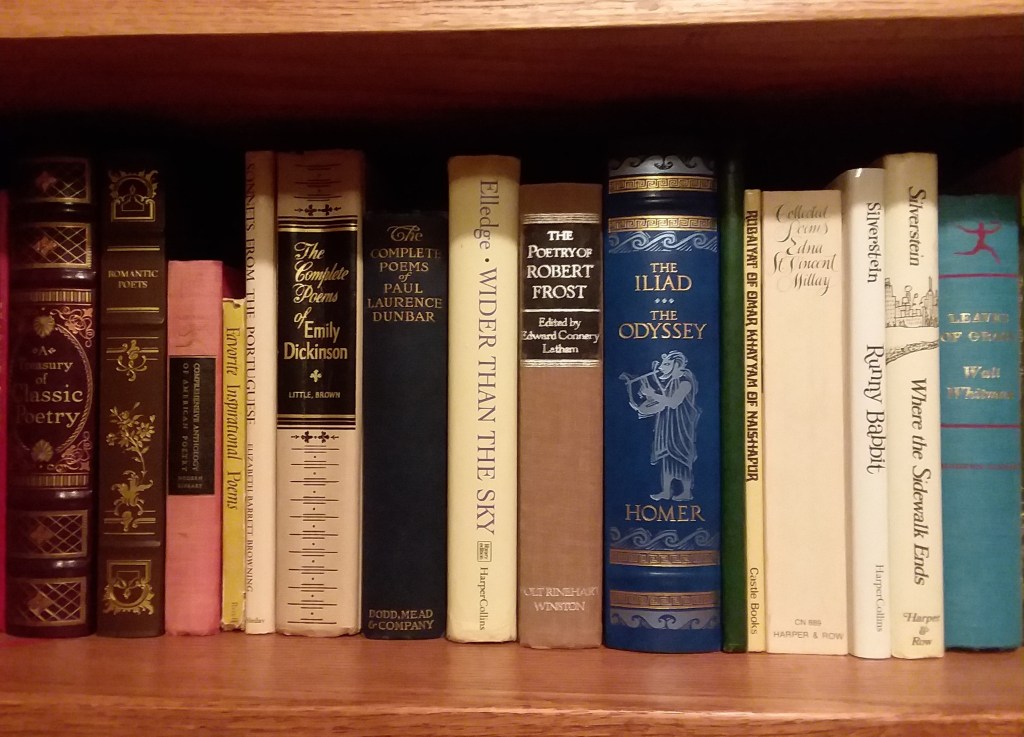
There are so many other poets whose works are on my bookshelves: poets whose works that span the ages. Emily Dickenson, Paul Laurence Dunbar, and Shel Silverstein (because silly verse is important as well), sit beside the Sagas of the Icelanders, Ovid, and Homer. I love that poetry has been a form of expression since before humankind wrote their words down. A cry formed in the human heart and found expression in poetry.

These poems often went hand in hand with music which brings me to my go-to poems: the Psalms. This collection of songs, prayers, and poems (my Amplified Bible even calls Psalm 16 a poem of David) are some of my favorite poetry. Whenever I pick up a new translation of the Bible, I immediately turn to the Psalms in order to hear these poems in a different way. A preacher I listen to recently said all of life is found in the Psalms. That made me turn to them again trying to read them with new eyes and I’ve found what he said is true.

Every expression of life can be found in the Psalms. Exaltation, Despair, Love, Betrayal, Longing, Fulfillment, Anxiety, Triumph: the gamut of human emotion is found in the Psalms. So is brilliant imagery. The writer in me reads and re-reads “Behold, (the wicked man) conceives iniquity and is pregnant with mischief and gives birth to lies. Psalm 7:14” and “He made darkness His secret hiding place; as His pavilion (His canopy) round about Him were dark waters and thick clouds of the skies. Psalm 18:11”. I don’t yet know how these mental pictures will end up woven into my fiction but I hold them at the ready.

As a person of Faith, the Psalms are a way I connect with God. Most of the time I go to them for that purpose rather than as a work of literature but I think they are that as well: some of the most beautiful ancient literature composed before Rome itself rose and fell.

  1. Collected Poems, Edna St. Vincent Millay. “Sonnet XXX”.
  2. Rubaiyat of Omar Khayyam of Naishapur. Translated by Edward Fitzgerald and Illustrated by Charles Stewart.
  3. Love Poems From God. Rabia of Basra. “In My Soul”.

Note: All quotes from the Psalms were taken from The Amplified Bible published by Zondervan.

Share this:

  • Print (Opens in new window) Print
  • Tweet
  • Email a link to a friend (Opens in new window) Email
  • Share on Tumblr
Like Loading...

The Human Effect

24 Sunday Apr 2016

Posted by Kate in Personal Essays, Writing

≈ 1 Comment

Tags

Chernobyl, Conscious Living, Conservation International, Environment, Nature

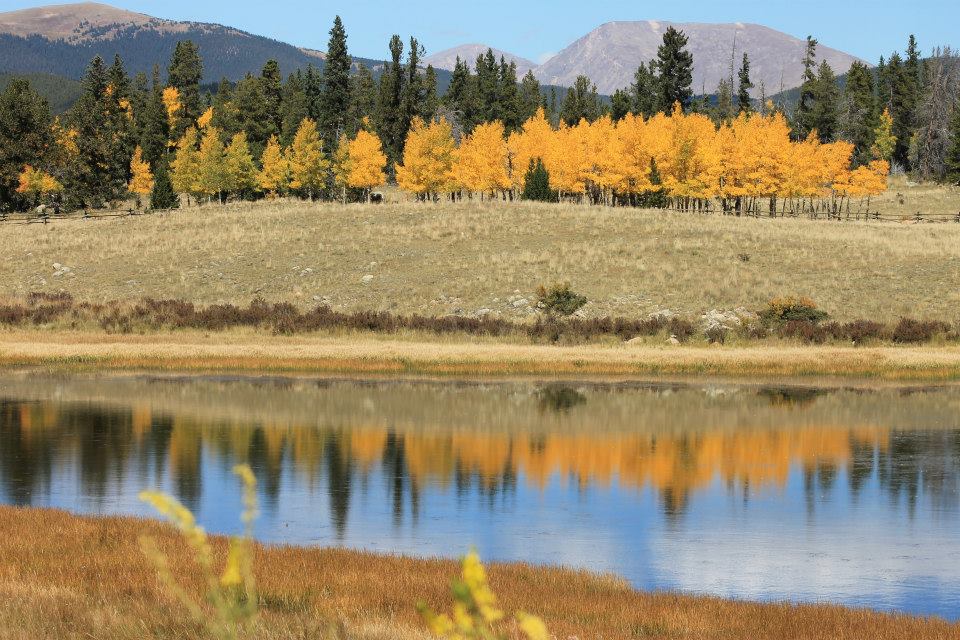
lake

I have recently been enjoying the “Nature is Speaking” series.  The message of each of these short videos is that we need nature; nature doesn’t need us.  These videos reminded me of a documentary I saw a while ago called “Radioactive Wolves”.  It was made to coincide with the 25th anniversary of the Chernobyl nuclear incident and is a fascinating study on just how well nature does without human involvement.

25 years has completely changed the landscape both around Chernobyl and within the zone so contaminated with radiation it’s uninhabitable by humans.  Cultivated land and the deserted cities have all been reclaimed by wilderness.  Man-made canals have been damned by beavers and the same beavers have undermined dykes thus returning drained marshland to its natural state.  The area around Chernobyl has become an unintended refuge for endangered species; species that seem to thrive despite the fact that bones of moose test at 50 times normal levels of radiation and fish bones from the area close to the reactor are so contaminated they can’t be touched by bare hands.

Gray wolf, Eagle, and Peregrine falcons are the top predator species that thrive in this reclaimed wilderness.  It doesn’t seem like thriving should be possible with the amount of radiation in the soil which is then taken up by the plants, eaten by the large herbivores and then consumed by the predators, but thrive they do.  The health of their populations stems from the fact that the area is toxic and thus lost to humans.

And, it is toxic.  The documentary referenced a six year study performed on dormice living within the contaminated zone.  4 to 6 percent of every generation shows some sign of abnormality, twice the rate of clean areas.  Those rates are unacceptable to humans and with an estimate of Chernobyl being uninhabitable by humans for the next 20,000 years; these species will be able to continue their uninterrupted life cycles without human intervention.

Almost without human intervention.  Bison were reintroduced into the Belarus side of the exclusion zone in the late 90’s and that decade saw wild horses being introduced on the Ukraine side.  However, wherever there are humans trying to help, there are humans causing problems.  Reproduction rates among the wild horses say there should be close to 200 individuals roaming the wilderness but poachers have brought that number closer to 60: a fact that seems to reinforce the Nature is Speaking message.  Nature doesn’t need us and, indeed, seems to do much better without us.

Does it have to be this way?  If human beings could realize our relationship with the world around us is symbiotic-our ability to thrive depends on the health of our environment-would we start living in balance with it rather than consuming its resources far faster than it can replenish itself?  As always, I can’t answer for anyone but myself.  I try to make the most responsible decisions I can and living in balance with my environment is an ongoing journey.


Share this:

  • Print (Opens in new window) Print
  • Tweet
  • Email a link to a friend (Opens in new window) Email
  • Share on Tumblr
Like Loading...

Books, How I Love Thee…

20 Friday Feb 2015

Posted by Kate in Personal Essays, Writing

≈ Leave a comment

Tags

Bibliomania, Bibliophile, Blogging, Books, Writer's Life, Writing

And I do.

I’ve been reading for as long as I remember. My mother tells me I started when I was two which I’ll have to take her word for as my memory is vague when I attempt to push it that far back. I do know there has hardly been a time in my life when I haven’t had a book of some sort with me and one of the joys of adult life is being able to build my personal library. Only the ones I know I’ll read again earn a permanent spot on my shelves and I have books that have been my favorites for decades along side new favorites. I find it interesting to see how my taste in reading has changed throughout the years but then I look at my shelves and wonder if it has, really.

One of my favorite stories is The Black Arrow by Robert Louis Stevenson. I can’t remember how young I was when I first read it but the adventure and romance captured my imagination then and continues to do so now. I think I understand more of it as an adult than I did as a child. All I saw was adventure and romance then, I see politics and racism now-but still adventure and romance.

A Wrinkle in Time is one of my favorites. Over twenty years have passed since I first read it and I can still pick it up and become immersed in what is marketed as a children’s book. Island of the Blue Dolphins is the same. I was ten or eleven when I first read it and was amazed at Karana. I wondered if I would be able to survive the way she had and was fairly certain I would not. There are still times I pick up this book and spend an hour marveling at Karana’s strength and mourning her loss. Mary O’Hara’s books have stayed on my shelves for decades as well.

My shelves also have books I would never have considered reading when I was younger. I liked fiction. The worlds I read about were real to me so why did I need non-fiction. Thank God that, as an adult, I have found joy in non-fiction. Think of all I would have missed, like the history books written by Philip Matyszak. His books make me laugh until my face hurts. Oddly, Herodotus’ Histories also make me laugh, something I did not expect. I swear I can hear the tone of his writing change when he begins making stuff up. He fascinates me because I read that he was an oddity for choosing to travel so far from his home. I like oddities, being one myself, and I’d like to know more about Herodotus. Unfortunately-or fortunately, depending on your view-Herodotus disappears inside his Histories and I found very little of his character revealed in his writing.

I read Thucydides because I read somewhere he scorned Herodotus’ Histories and wanted to write a pure history of the Peloponnesian War. Just the facts, ma’am. Thucydides sits on my shelf between Tacitus and Xenophon: my shelves are sorted both by genre and then alphabetical. One of my joys is to reconsider my current sorting method and decide whether or not there’s a better one. Should my classic literature be separate from my modern literature? Does Mark Twain qualify as literature or should he be moved to my Children’s books section? I may need to get out more.

Anywho…when I’ve had my fill of history I turn to a Georgette Heyer romance or a Jacqueline Girdner mystery. Or Jack London. Or Mark Twain. Or Robert Louis Stevenson. Or Helen MacInnes.  Or Wilkie Collins. Or Jane Austen. You’ll find all of them on my shelves along with so many others.

As my collection has expanded, it has caused me to indulge in some deep introspection. All of these books must be dusted, cared for, and read. Which means, what do I really want to keep hold of? Am I keeping books because they make me look smart when I have no interest in reading them ever again? That answer was yes.

I’d read Gone With the Wind in the third grade sure I was going to be exposed to a great romance. Perhaps I was but I remember I liked Walter Farley and Anna Sewell much better. I read it again as an adult and still preferred Walter Farley and Anna Sewell. Gone With the Wind was traded for something I’ll treasure.

I had to admit I don’t care for Dickens. I felt like I could tell he was paid by the word. Not that I dislike his writing: I enjoyed his foray into banking in A Tale of Two Cities and could picture a young man being kept in a basement until he was old. My problem? I’d almost forgotten the plot by the time Dickens wended his way back to it. I much prefer Wilkie Collins. I dragged The Moonstone everywhere with me until I’d finished it. It took me a full two days and I don’t think I was of much use to anyone until I closed the covers for the last time but it was worth it. The Woman in White and No Name quickly found space on my shelves.

I’ve tried twice to read Anna Karenina and never finished it. I had a co-worker urge me to try again and it’s on my list: perhaps the third time will be a charm. However, I devoured Ivan Turgenev’s Fathers and Sons in one sitting. I haven’t purchased it as I don’t know I’d read it again but I remember how the words flowed so smoothly the rhythm of my read was never interrupted. Not a happy story but not sad either. It intrigued me.

So why the introspection now? I recently reached a point where I could not purchase another book unless I started stacking them on the floor or acquired another bookshelf. I had to take another hard look at what I was keeping and ask myself, are you really going to read these again? I found a few where that answer was no. I find I prefer reading Plutarch, Julius Caesar, Cicero, and Marcus Aurelius rather than fiction about Rome (unless it’s an incredible story) so a few of those could go. Akhenaten fascinates me and I found myself annoyed with a fictional account of his and Nefertiti’s building of Amarna so that went in the trade box. A ruthless and honest look at my taste in books made me pull The Works of H.G. Wells. This consisted of his lesser known writings: excellent writing but the stories are a tad depressing. Into the box it went.

I’m well known at a few of the used bookstores in town and all I need to do now is clear some time when I can do some trading. The problem with used bookstores is I recognize my old books on the shelf and feel a tug towards them. Did I really want to weed that from the shelf? Won’t I read that again? Should I consider buying it back? I’ve yet to actually buy one of my trades back but who knows…I’ve cleared some space on my shelves…

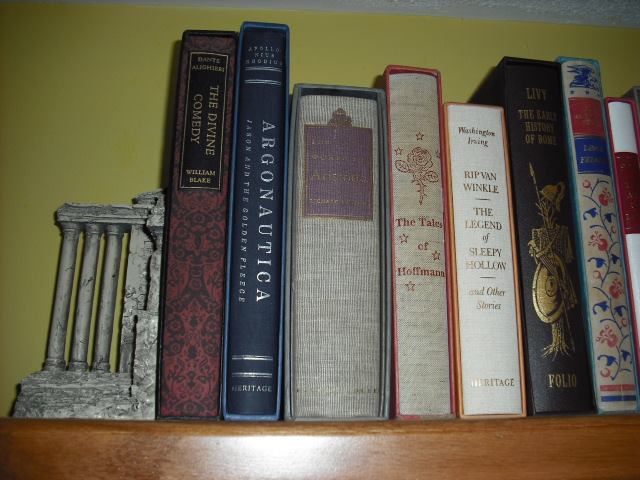
These will never be traded. My Argonautica is simultaneously English and Greek. I might learn Greek one day and read it in the original...

These will never be traded. My Argonautica is simultaneously English and Greek. I might learn Greek one day and read it in the original…

Share this:

  • Print (Opens in new window) Print
  • Tweet
  • Email a link to a friend (Opens in new window) Email
  • Share on Tumblr
Like Loading...

So What Do You Want Me To Do About It?

31 Wednesday Dec 2014

Posted by Kate in Personal Essays, Writing

≈ Leave a comment

Tags

Activist, Bible Living, Blog, Blogging, Conscious Living, Responsible Choices, Writing


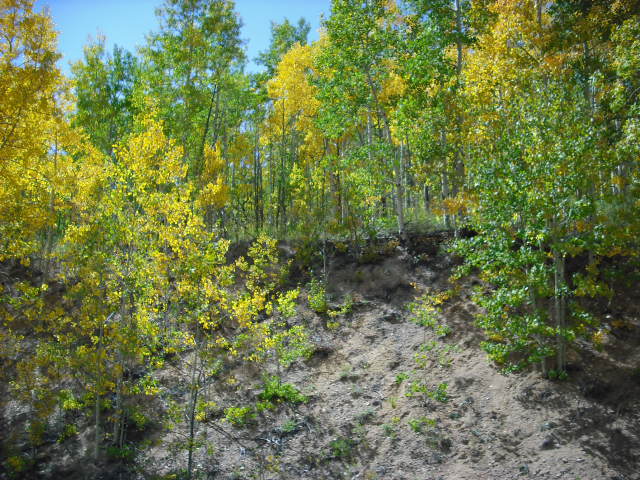
DSCF0016

I admit it.  I’m an activist.  I never thought I’d become one as the very word always elicited rather negative mental pictures.  But then I made some lifestyle changes and, the more I educated myself, the more of an activist I became.  I can’t label myself ‘activist’ for one particular cause: there are so many things I’m passionate about it would take more space than WordPress allots me to list them all.

One thing I am not passionate about are articles and documentaries that show me an injustice, get me riled up about it, and then neglect to offer me any action I can take to try and improve the situation.  I hold a deep belief that stirring up anger in someone without showing that person a constructive way of expressing/handling that anger is irresponsible.  If I read an article that gets me angry and leaves me that way, what do I do with that anger?  Stomp around my house?  Track down the people mentioned in the article and leave mean things on their Facebook pages?  Spend my afternoon with an anger that steadily morphs into depression and despair because there’s just nothing I can do about any of it so what’s the point in trying at all?

Ephesians 4:26 tells me to “Be angry yet sin not”.  To me, this tells me anger is a good thing.  I should be angry that fellow human beings are starving in refugee camps.  The systematic poisoning of our air and water should make me angry.  But, that anger should not become destructive.  Rather, the heat of it should make me get up off my duff, give money-or time since I’m short on money-and do something to change the situation. At the very least, I ought to take it to God in prayer.  (I’m joking!  Prayer should always be my first resort!)  Easiest of all, anger should make me look at my life and see how my choices affect this world I’m a tiny part of.

And I do mean tiny.  It’s difficult to believe anything I do or choice I make can have any sort of impact in the world.  The problems of the world are so vast: what can one limited (not disabled!) woman do, especially when I’m up against corporations who have billions of dollars and all the power that money buys at their backs?  To quote one of my favorite authors; A single drop can’t make even a puddle, but together, all our little drops and God’s planning can make not only a mighty ocean but a mighty difference.  (And It Was Good Madeleine L’Engle, 1983)

Quotes like this help me.  Maybe I am a tiny drop but there are others striving to make a difference.  They may not look like me, talk like me, or believe the same things I do but they are striving to better their part of the world the same way I seek to better mine.  My drop joins to theirs and, as more and more of us join together, we become a force at work in the world.  I find joy as well as hope in that thought.

So, thank you to all who write articles intended to make me angry but who add two or three actions I can implement in my life.  Thank you for your bravery in addressing issues that aren’t popular.  I have read your articles.  They have touched my life and my life is changing.


Share this:

  • Print (Opens in new window) Print
  • Tweet
  • Email a link to a friend (Opens in new window) Email
  • Share on Tumblr
Like Loading...
← Older posts
Newer posts →

Categories

Featured Posts

Isaiah 45:7

When Tradition and I Part Ways

Keep reading
Kate's avatar by Kate November 28, 2022April 28, 2024
Gospel and Letters of John

A New Heart

Keep reading
Kate's avatar by Kate December 7, 2020March 14, 2021
Studies

The Way He Has Made

Keep reading
Kate's avatar by Kate August 7, 2023August 6, 2023

Enter your email address to subscribe to this blog and receive notifications of new posts by email.

Join 210 other subscribers
Follow Renaissance Woman on WordPress.com

Follow Me on Facebook

Follow Me on Facebook

Meta

  • Create account
  • Log in
  • Entries feed
  • Comments feed
  • WordPress.com

Blog at WordPress.com.

  • Subscribe Subscribed
    • Renaissance Woman
    • Join 169 other subscribers
    • Already have a WordPress.com account? Log in now.
    • Renaissance Woman
    • Subscribe Subscribed
    • Sign up
    • Log in
    • Report this content
    • View site in Reader
    • Manage subscriptions
    • Collapse this bar
 

Loading Comments...
 

You must be logged in to post a comment.

    %d